



 647-812-5125


Take 30% off a $60 product that costs you $27, and you’ve just cut your profit from $33 to $15.
To make the same money, you now need to sell 220 items instead of 100.
That’s the trade most stores make in November without running the numbers first. It’s also why a record Black Friday can end in a worse December than last year.
Calculate Your Discount Margin →
The fix isn’t running fewer offers. It’s giving each one a job and a deadline. We call this EDP’s Holiday Offer Calendar: one goal, one offer, and one margin limit per phase.
There are only four goals worth chasing:
|
Goal |
What it means |
|---|---|
|
Acquire |
Win new customers and email subscribers |
|
Lift AOV |
Get each customer to spend more per order |
|
Clear |
Sell through old or seasonal stock |
|
Retain |
Turn holiday buyers into repeat buyers |
This guide includes 8 types of holiday offers, the phase each one belongs in, and the math to check before you discount anything.
What Are Holiday Promotions?
Holiday promotions are time-limited offers that online stores run between September and January, peaking at Black Friday Cyber Monday (BFCM). They include discounts, bundles, free gifts, and perks like free shipping. Stores use them to win new customers, raise order value, clear stock, or bring buyers back.
Why Your Offer Matters More Than Your Discount
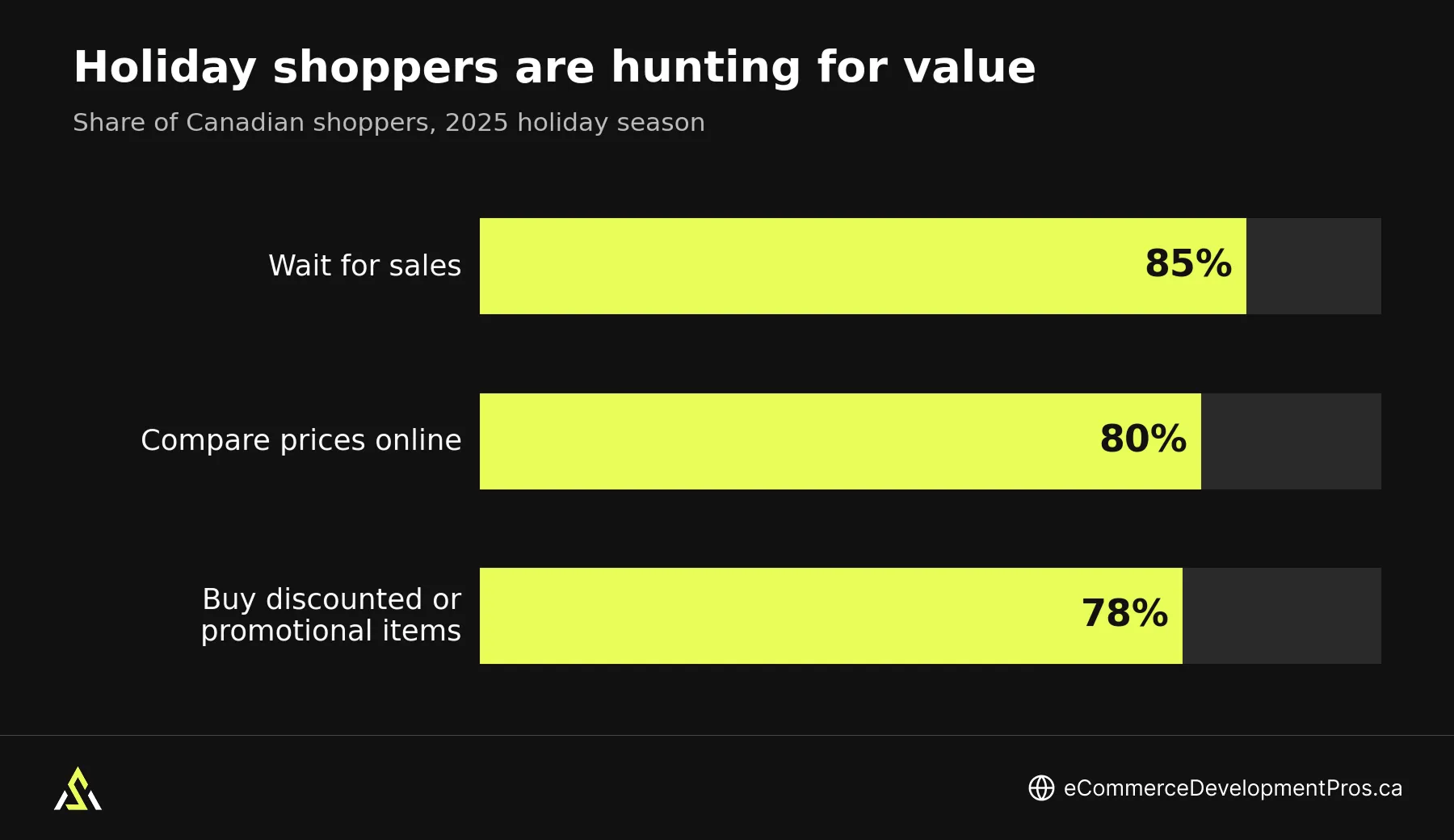
85% of Canadian shoppers wait for sales. 80% compare prices online. 78% buy discounted or promotional items.
Those figures come from the RCC × Leger 2025 Holiday Shopping Survey.
Your holiday offer is being compared with other offers. Price matters, but so does what the shopper gets for that price.
More than half begin researching 1 to 3 weeks ahead, and buying continues right through December.
That means two things for your store:
- Shoppers see your offer next to your competitors’ offers. A clear, easy-to-understand deal wins.
- The season is long. One offer can’t carry you from October to January.
8 Types of Holiday Offers (and What Each Costs You)
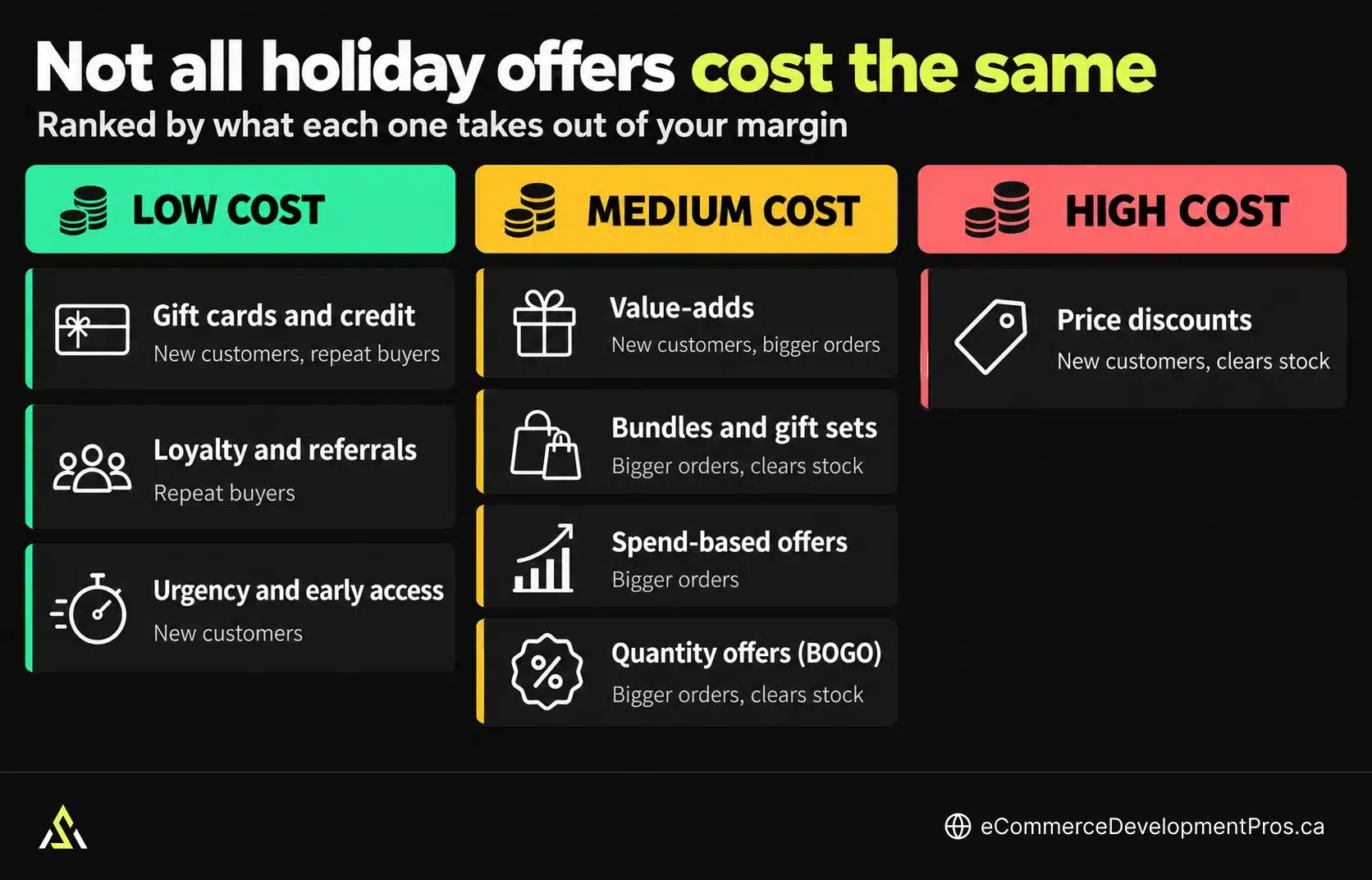
Every holiday offer falls into one of eight families. Some cost you a lot of margin. Others cost almost nothing.
Always pick the cheapest offer that still gets the job done.
1. Price Discounts
Price discounts cut the price a customer pays. They include percentage off, dollar off, sitewide sales, and collection sales.
- Example: “25% off all winter jackets, Nov 27–30”
- Margin cost: High
- Best for: Acquiring new customers and clearing old stock
- Skip it if: your gross margin is under 40%, or you already ran a sitewide sale this quarter
A price discount is the fastest offer to launch and the most expensive to run. Use it on a few chosen products, not everything.
2. Quantity Offers
Quantity offers reward customers for buying more units. They include BOGO (buy one, get one), buy X get Y, and multi-buy deals.
- Example: “Buy 2 candles, get the 3rd 50% off”
- Margin cost: Medium to High
- Best for: Lifting order value and clearing old stock
- Skip it if: customers rarely need more than one of your product
“Buy one, get one 50% off” costs far less than “buy one, get one free.” Start with the cheaper version.
3. Spend-Based Offers
Spend-based offers reward customers for reaching a spending threshold. They include tiered rewards and free-shipping minimums.
- Example: “Spend $100 CAD, save $15. Spend $200 CAD, save $40.”
- Margin cost: Medium
- Best for: Lifting average order value (AOV)
- Skip it if: most of your orders are single high-price items
Set your first tier a little above your current average order value. Customers will add one more item to reach it.
4. Bundles and Gift Sets
Bundles group several products into one package at a single price. They include fixed bundles, build-your-own bundles, gift boxes, and mystery boxes.
- Example: “Holiday Skincare Set: cleanser, serum, and lip balm for $79 CAD / ~$58 USD (a $98 CAD value)”
- Margin cost: Medium
- Best for: Lifting order value and clearing old stock
- Skip it if: your products don’t naturally go together
A product bundle lets you pair a slow seller with a bestseller. The customer sees one value price, and you move stock that was sitting still.
You can also partner with a non-competing local brand on a joint gift box. You both reach a new audience and share the cost.
5. Value-Adds
Value-adds give the customer something extra instead of a lower price. They include free gifts with purchase, gift wrapping, samples, and extended returns.
- Example: “Free gift wrap and a handwritten note on every order until Dec 18”
- Margin cost: Low to Medium
- Best for: Acquiring new customers and lifting order value
- Skip it if: the gift has no real value to your buyer
Holiday shoppers are often buying for someone else. Free gift wrap and a gift note solve a real problem for them and cost you very little.
6. Gift Card and Credit Offers
Gift card offers give customers extra value to spend on a future order. They include bonus gift card value and gift cards given with a purchase.
- Example: “Buy a $100 gift card, get a $20 bonus card to use in January”
- Margin cost: Low
- Best for: Acquiring new customers and retaining them
- Skip it if: you can’t handle a January rush of redemptions
Gift cards are a growing gift choice. Retail Council of Canada states that 47% of shoppers gave gift cards in 2025, up from 42% in 2024.
They also bring customers back ready to spend. More than two-thirds (68%) of consumers who redeem gift cards spend more than the card’s initial value, turning standard redemptions into a reliable revenue multiplier for retailers.
7. Urgency and Exclusivity
Urgency and exclusivity offers limit who can buy or how long an offer lasts. They include subscriber early access, flash sales, daily deals, and limited-edition products.
- Example: “Subscribers shop Black Friday 24 hours early”
- Margin cost: Low to High (depends on the offer attached)
- Best for: Acquiring new customers
- Skip it if: you run “limited time” sales so often that nobody believes them anymore
Early access is the cheapest version. You’re giving people time, not money.
A limited-edition holiday product, like a seasonal scent or colour, creates urgency with no discount at all.
8. Loyalty and Relationship Offers
Loyalty offers are about getting another purchase from a customer you already have. Double points, referral rewards, win-back offers, and subscribe-and-save all fit here.
- Example: “Refer a friend: you both get $15 CAD off your next order”
- Margin cost: Low
- Best for: Bringing customers back
- Skip it if: you don’t have a loyalty program or referral app set up yet
These offers work best after the holidays, when you have a fresh list of first-time buyers.
A charity tie-in, like donating a set amount per order to a local cause, gives shoppers a reason to choose you without cutting your price.
Tools that help: many bundle and cross-selling offers need an app. See our list of upsell and cross-sell apps for Shopify.
Quick Reference: Offer Types at a Glance
|
Offer family |
Example |
Best goal |
Margin cost |
|---|---|---|---|
|
Price discounts |
25% off one collection |
Acquire, Clear |
High |
|
Quantity offers |
Buy 2, get 3rd 50% off |
Lift AOV, Clear |
Medium–High |
|
Spend-based offers |
Spend $100, save $15 |
Lift AOV |
Medium |
|
Bundles and gift sets |
3-item gift set |
Lift AOV, Clear |
Medium |
|
Value-adds |
Free gift wrap |
Acquire, Lift AOV |
Low–Medium |
|
Gift card offers |
$20 bonus card |
Acquire, Retain |
Low |
|
Urgency and exclusivity |
24-hour early access |
Acquire |
Low–High |
|
Loyalty offers |
Refer-a-friend credit |
Retain |
Low |
EDP Insight
One of the most common holiday promotion mistakes we see is running the same sitewide discount from early November through Christmas. By mid-December, that sale price starts to feel like the regular price, and the offer loses its urgency.
Instead of: 20% off, November through Christmas
Try changing the reason to buy:
Early November → Early access
Black Friday weekend → Tiered spend offer
December → Free gift wrap
The goal isn’t a bigger discount. It’s a fresh reason to act.
Which Holiday Offers Fit Your Store?
The right offer depends on your margin and what you sell. Use this table to narrow your options before planning the season.
|
If your store |
Lean on |
Go easy on |
|---|---|---|
|
Has low margins (under 40%) |
Free-shipping thresholds, gift wrap, early access, gift card bonuses |
Sitewide % off, BOGO free |
|
Has high margins (60%+) |
Targeted % off, BOGO 50%, bundles |
Nothing ruled out, but run the break-even math |
|
Sells giftable products |
Gift sets, gift wrap, shipping guarantees, digital gift cards |
January clearance on core items |
|
Sells consumables (coffee, skincare, supplements) |
Multi-buy, subscribe-and-save, refill bundles |
One-off deep discounts |
|
Sells high-ticket items ($300+) |
Dollar-off offers, free add-ons, BNPL payment options |
Small % discounts that sound weak |
|
Has excess seasonal stock |
Bundles with bestsellers, Boxing Day clearance |
Holding stock into February |
For high-ticket stores, flexible payment can work better than a discount. Our buy now, pay later guide covers the providers, the fees, and when it isn’t worth it.
Holiday Promotion Ideas for All 6 Phases (Sep 2026 – Jan 2027)
The holiday season isn’t one moment. It runs from September to January, and breaks into six phases. Each one needs a different kind of offer.
Here’s EDP’s Holiday Offer Calendar in full.
EDP HOLIDAY OFFER CALENDAR 2026 |
||||
|---|---|---|---|---|
|
Phase |
Dates |
Goal |
Offers that fit |
What to avoid |
|
1. Build your list |
Sep 1 – Oct 11 |
Acquire — new subscribers before ad costs rise |
Early-access sign-up, first-order offer, quiz |
Sitewide discounts |
|
2. Early gifting |
Oct 12 – Oct 31 |
Acquire — catch organized gift shoppers |
Gift sets, gift with purchase, double points |
Deep % discounts |
|
3. Warm up |
Nov 1 – Nov 26 |
Acquire — build demand before the rush |
VIP early access, Singles Day deal, gift guides |
Revealing your best Black Friday offer early |
|
4. Black Friday Peak |
Nov 27 – Nov 30 |
Lift AOV — bigger orders, not just more |
Tiered spend, bundles, gift card bonus |
Letting discounts stack by accident |
|
5. Last-minute gifting |
Dec 1 – Dec 24 |
Acquire — convert before shipping cutoffs |
Delivery guarantees, gift wrap, bounce-back inserts |
Promising delivery past the cutoff |
|
6. After the holidays |
Dec 26 – Jan 31 |
Clear and Retain — sell through stock, keep new customers |
Boxing Day clearance, gift card redemption, win-back |
Going quiet after Christmas |
Phase 1: Build Your List (Sep 1 – Oct 11)
Goal: Acquire.
Your main job is growing your email and SMS list. Every subscriber you add now is someone you can sell to in November without paying for ads.
Offers that work:
- Early-access sign-up (“Get Black Friday deals 24 hours early”)
- A small first-order offer, like 10% off or free shipping
- A product quiz that ends with a sign-up
- Free samples with a first order
Avoid: big sitewide discounts. They teach shoppers to wait for your next sale.
While you’re growing the list, get the backend ready too. Our ecommerce holiday checklist covers what to check before the traffic arrives.
Phase 2: Early Gifting (Oct 12 – Oct 31)
Goal: Early revenue.
Organized shoppers start buying gifts now.
Key dates are:
- Canadian Thanksgiving (Oct 12)
- Halloween (Oct 31)
Offers that work:
- Gift sets and bundles, launched early
- Free gift with purchase over a set amount
- A short Halloween flash sale on selected items
- Double loyalty points for October orders
Avoid: deep percentage discounts. Black Friday is a month away, so save your strongest offer.
Phase 3: Warm Up (Nov 1 – Nov 26)
Goal: Build demand.
Shoppers are making lists and comparing stores. Tease your Black Friday offer and reward subscribers first.
Offers that work:
- VIP or subscriber early access to Black Friday deals
- A Singles Day (Nov 11) flash deal on one product
- A “12 days of deals” countdown or daily social giveaway before Black Friday
- Gift guides sorted by price (“Under $50”) or recipient (“For Him”), linking straight to product pages
Note on November Dates
- Nov 11 is also Remembrance Day in Canada, and many brands pause emails and social posts around 11:00 a.m. local time.
- Cultural holidays: If Diwali (Nov 8) or Hanukkah (from Dec 4) matters to your customers, plan for it as a gifting period rather than treating it as another marketing date on the calendar. Dedicated gift sets can work well here.
Phase 4: Black Friday Peak (Nov 27 – Nov 30)
Goal: Volume and AOV.
Black Friday (Nov 27) through Cyber Monday (Nov 30) is the busiest window of the year. In the 2025 RCC survey, 84% of Canadians called Black Friday their most important shopping day, far ahead of Boxing Day at 55%.
Ad costs also peak this week, so every order needs to be worth more.
Offers that work:
- Tiered spend rewards (spend more, save more)
- Bundles at a clear value price
- BOGO 50% off on popular items
- Gift card bonus (buy $100, get $20 extra)
- Free shipping over a threshold
Avoid letting discounts stack by accident. Check your combination settings before launch (see the Shopify section below).
For the full Black Friday playbook, see our guide to Black Friday marketing strategies.
EDP Insight
Tiered offers usually outperform one flat discount at Black Friday. Shipping and ad costs stay about the same whether a customer buys one item or three. A reward for adding more puts that fixed cost to work.
Phase 5: Last-Minute Gifting (Dec 1 – Dec 24)
Goal: Convert before the deadline.
The question on every shopper’s mind is now “Will it arrive in time?“
Know your carrier cutoffs. Canada Post’s national regular parcel deadline has landed around Dec 8 or 9 in recent years. Carriers publish the current year’s dates in October, so check Canada Post, USPS, UPS, and FedEx directly before you promise anything.
Two other key dates worth knowing:
- Green Monday (Dec 14) is the last Monday with enough time for standard shipping to arrive before Christmas, and it’s one of December’s biggest online sales days.
- Super Saturday (Dec 19) is the final Saturday before Christmas, when last-minute shoppers buy.
These are industry terms, not consumer ones, so use them to plan rather than to advertise.
Offers that work:
- “Order by [date], get it by Christmas” guarantees
- Free gift wrapping and a personal note
- A bounce-back insert in every box: a printed January discount code that brings buyers back
- Free shipping upgrades in the final week
- Digital gift cards once shipping cutoffs pass
- Local pickup, if you have a location
Avoid: promising delivery past your carrier’s cutoff. One late gift can cost you a customer for good.
Phase 6: After the Holidays (Dec 26 – Jan 31)
Goal: Clear and Retain.
Boxing Day (Dec 26) is still a major shopping day in Canada. After that, your biggest opportunity is the list of people who bought from you for the first time.
Offers that work:
- Boxing Day or Boxing Week clearance
- Gift card redemption offers (“Use your gift card, get free shipping”)
- Bonus store credit on exchanges instead of refunds
- A thank-you email that reminds buyers of their bounce-back code
- New Year bundles
Avoid: going quiet after Christmas. January shoppers are still spending.
EDP Insight
Holiday buyers are your cheapest source of repeat customers because you’ve already paid to acquire them. A simple thank-you email with a small January offer does more for their customer lifetime value than another ad campaign would.
How Much Discount Can You Afford? Use Our Free Discount Margin Calculator
A discount doesn’t cost you the discount. It costs you a chunk of the profit on every sale you were going to make anyway.
The discount you can afford depends on your selling price, product cost, and profit per sale.
Say you sell something for $60 CAD / ~$44 USD and it costs you $27 CAD / ~$20 USD. You make $33 on each sale.
Take 30% off, and you now make $15. You’d have to sell more than twice as many units to end up in the same place.
Try It With Your Own Numbers
Enter your selling price and product cost. The calculator shows your profit before and after the discount, how many units you need to sell to maintain the same total profit, and whether the discount is affordable, tight, risky, or a loss.
Discount Margin Calculator
See how a discount affects your profit and how much more you need to sell.
Your price needs to be higher than your cost.
Profit per sale at full price
$33.00Profit per sale after the discount
$15.00Sell 100 now? You'd need to sell
220The calculation compares your profit per sale before and after the discount, then works out how much extra volume closes the gap.
Two Things the Calculator Can’t See
- Some of those discounted sales would have happened at full price anyway, so the real result is usually worse than the number shown.
- And during Black Friday week, ad costs rise because every store is bidding at once. If you pay more per customer while earning less per sale, your return on ad spend can drop below break-even fast.
Treat the calculator’s number as your best case.
Setting Up Holiday Offers in Shopify
Shopify has most holiday offer types built in. You don’t need an app for the basics.
|
What you want |
Where to set it up |
|---|---|
|
Collection or product discount |
Discounts → Amount off products |
|
BOGO or buy X get Y |
Discounts → Buy X get Y |
|
Spend-based reward |
Discounts → Amount off order (with a minimum purchase) |
|
Free shipping threshold |
Discounts → Free shipping |
|
Gift cards |
Products → Gift cards |
|
Start and end times |
Active dates on any discount |
|
Control stacking |
Combinations on each discount |
Three Setup Rules That Prevent Costly Mistakes
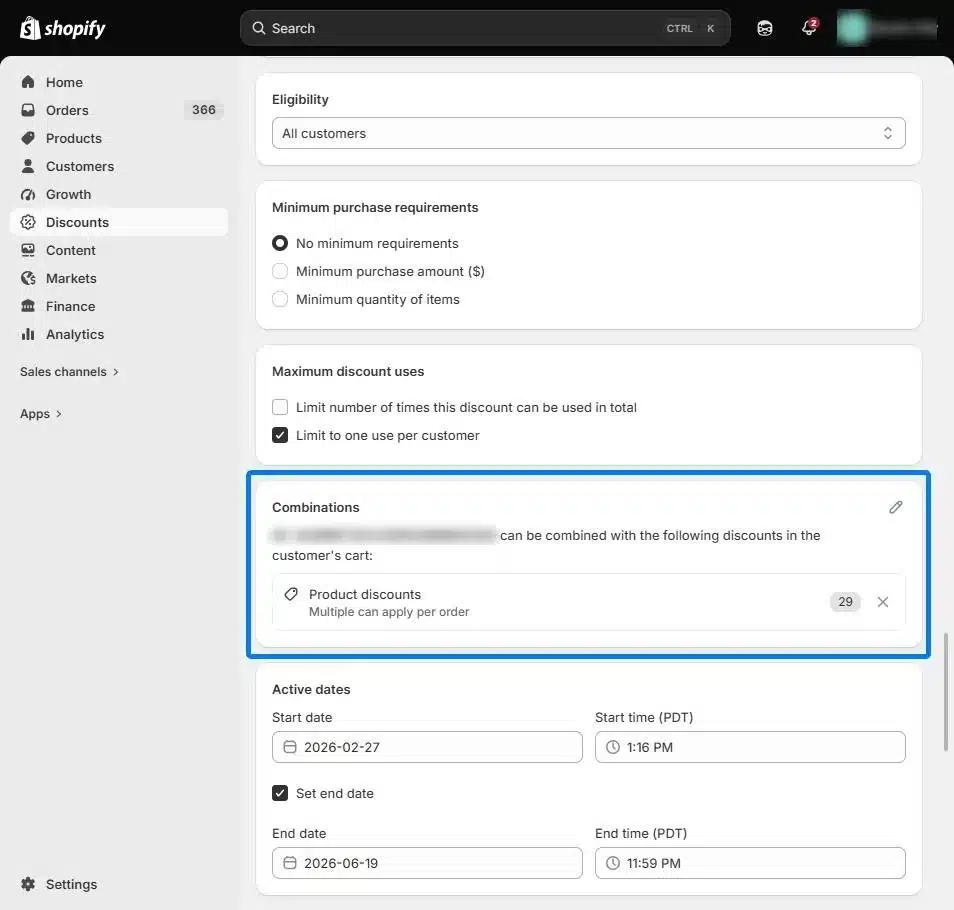
- Combinations must be set on both discounts.
For a product discount to combine with a free shipping discount, open each discount and allow it to combine with the other’s discount class. If only one is set, they won’t combine.
- Buy X get Y doesn’t stack with other product discounts.
Per Shopify’s documentation, products in a Buy X get Y discount can’t receive further product discounts. If a customer enters a code for those products, only the code applies. Test your BFCM offers together before launch.
- Schedule everything ahead. Set start and end dates so offers go live on time, even at midnight.
More tips:
- Automatic discounts apply at checkout without a code. Use them for public offers.
- Discount codes work best for subscriber-only and VIP offers.
- Shopify Flow can tag customers automatically, like “first holiday order,” so you can target them in January.
A Note for Shopify Plus Stores
Shopify Plus stores can go beyond the built-in options. Shopify Functions allow custom discount logic, like tiered rewards by customer segment. Plus stores selling wholesale can also run separate B2B holiday pricing. Custom logic needs developer time, so plan it by early October.
For more ways to turn holiday traffic into sales, see our Shopify CRO strategies.
Holiday offers work best as part of a full-year plan, which our Shopify marketing strategy guide covers.
Track Which Offer Actually Worked
Revenue alone doesn’t tell you if an offer worked. Track these numbers for each offer, not just for the season.
|
Metric |
What it tells you |
Good sign |
|---|---|---|
|
Profit per order |
Whether the offer made money after the discount |
Stays close to your normal level |
|
Average order value |
Whether spend-based offers and bundles worked |
Rises during the offer |
|
Discount cost as % of revenue |
How much margin you gave away |
Lower than last year for similar sales |
|
New customers acquired |
Whether acquisition offers worked |
Rises in Phases 1 to 3 |
|
January repeat rate |
Whether holiday buyers came back |
Rises after your Phase 6 offers |
A simple habit: give each offer its own discount code or name in Shopify. Then Analytics → Reports shows exactly which offer drove which sales.
Canada vs. US: The Three Dates That Differ
Most of the holiday season is identical in both countries. Three dates aren’t.
|
Date |
Day |
What to do |
|---|---|---|
|
Mon, Oct 12 |
Canadian Thanksgiving |
Launch your gift sets and bundles this week instead of waiting for November. Show them to both markets. |
|
Wed, Nov 11 |
Remembrance Day (Canada) / Veterans Day (US) |
Pause marketing emails and SMS to Canada until noon. Send to US customers as normal. |
|
Sat, Dec 26 |
Boxing Day (Canada) |
Run your clearance in both markets. Canadians expect a Boxing Day sale, and US shoppers are browsing post-Christmas deals anyway. |
That’s it. One calendar covers the rest of your season.
Frequently Asked Questions
When should ecommerce stores start holiday promotions?
Start building your email list in September. Launch gifting offers in mid-October, and save your strongest offers for Black Friday week.
Is it too late to plan holiday promotions in November?
No. With three weeks left, skip the list-building phase and go straight to a tiered spend offer or a bundle for Black Friday, then a shipping-deadline push in December. Both can be set up in Shopify in under an hour.
How do I calculate how much discount I can afford?
Start with your product’s selling price and cost to calculate your profit per sale. Then apply the planned discount and calculate your new profit. The difference shows how much profit you give up per order and how many additional sales you may need to maintain the same total profit. Use our Discount Margin Calculator above to compare different discount levels and see what your margins can realistically support.
What holiday promotions work without big discounts?
Bundles, free gifts with purchase, gift card bonuses, free gift wrapping, early access, and tiered spend rewards. These add value without cutting your price.
What’s the best offer to increase average order value?
Tiered spend rewards and bundles. Set your first tier just above your current average order value, so customers add one more item to reach it.
How do I run holiday promotions without losing money?
Give each offer one goal and one phase, and set a margin limit before you launch. Check your discount combination settings in Shopify so offers don’t stack unexpectedly. Before running a percentage discount, calculate how it changes your profit per sale and how much additional sales volume you would need to maintain the same total profit.
What’s the best holiday promotion for a small store?
Early access for email subscribers, followed by a bundle or tiered spend offer at Black Friday. Early access costs you nothing but time, and bundles raise order value without cutting your price. Both take under an hour to set up in Shopify.
What are the key holiday shopping dates in Canada and the US for 2026?
Canadian Thanksgiving is Oct 12. Black Friday is Nov 27, and Cyber Monday is Nov 30. Green Monday is Dec 14, Super Saturday is Dec 19, and Boxing Day is Dec 26.
Should I run a Boxing Day sale if I sell in Canada?
Yes. Boxing Day is still a major shopping day in Canada. Use it to clear seasonal stock and to welcome back gift card holders.

Want a Holiday Offer Plan Built for Your Store?
We’ll map your offers, dates, and margins so every promotion earns its place. Canadian team, 17+ years in ecommerce.