



 647-812-5125


What Is a Shopify Fashion Theme?
A Shopify fashion theme is a storefront template built for clothing and accessories brands on Shopify. Unlike general-purpose themes, they come with fashion-specific features — size guides, color swatches, lookbook layouts — that directly affect how products are browsed and bought. Choosing the right fashion theme directly affects your store’s conversion rate, brand perception, and how products appear across desktop and mobile devices.
Why Your Fashion Theme Choice Actually Matters
Most “best Shopify themes” posts list 25+ options and tell you nothing useful. We’ve built and migrated over 30+ fashion stores on Shopify — from luxury fashion to streetwear and DTC labels — and the pattern is consistent: theme choice drives results that merchants usually blame on something else.
A slow theme tanks your Core Web Vitals, dragging down your Google ranking and conversion rate together. Weak size-chart and swatch support pushes returns up and add-to-cart down.
Your template sets a ceiling on performance before you add a single product.
So this isn’t a list of every theme with “fashion” in the name. We picked 16 themes that actually work for clothing brands in 2026 — including newer ones we’ve tested on client projects that beat the usual suspects on speed and mobile.
We also cover when a pre-built theme won’t cut it, and custom development is the smarter call.
EDP Insight
Migrations are where traffic quietly disappears. If a new theme doesn’t keep your old URLs, page speed, and layout intact or improve, you can lose 15-30% of your organic traffic. Most store owners don’t realize the theme caused it until months later. Theme choice isn’t just about looks. It’s structural.
What to Look for in a Fashion Shopify Theme
Before you scroll through 16 theme cards, get clear on the features that separate a fashion-grade theme from a generic one. Every theme on our list checks most of these boxes, but knowing what matters lets you weigh trade-offs for your specific brand.
- Size Charts & Fit Guides. Fashion returns run 20-40%. A theme with built-in size chart support (not just an app bolted on) reduces return rates and support tickets. Look for accordion or pop-up size chart sections on the product detail page (PDP).
- Color & Variant Swatches. Dropdown menus for color selection kill conversion in fashion stores. Swatch selectors — especially ones that update the product image on hover — are non-negotiable.
- Lookbook & Editorial Layouts. Fashion shoppers browse visually. Themes that support full-width lookbook sections, editorial grids, or campaign-style landing pages help you merchandise the way your brand actually thinks.
- Mega Menu Navigation. If you carry more than 50 SKUs across multiple categories, a standard dropdown won’t cut it. A mega menu is essential once your catalog crosses 50+ SKUs. Look for image support and featured collection slots inside the dropdown — not just text links.
- Mobile-First Design. Over 70% of fashion ecommerce traffic is mobile. Test every theme on a real phone before buying. Swipe-friendly galleries, sticky add-to-cart buttons, and fast mobile load times are the baseline.
- Page Speed & Core Web Vitals. Heavy themes with bloated JavaScript destroy your rankings and your conversion rate. Check the theme’s Lighthouse score on its demo store before purchasing. Anything below 60 on mobile is a red flag.
- Quick View & Quick Add. Fashion shoppers browse a lot of products. Quick-view modals that show key details without a full-page load reduce friction and keep shoppers in the browsing flow.
EDP Insight
When we audit a fashion store’s theme, page speed is the first thing we check. We’ve seen themes with gorgeous demos that score 25 on mobile Lighthouse once you add real products, reviews, and apps. The demo is marketing — always test with a populated store.
Quick Comparison: All 16 Premium Fashion Themes + Free Option at a Glance
Prices below are shown in CAD first, then USD. Since Shopify charges in USD, the USD amount is what you’ll actually pay. The CAD figure is an approximate conversion, so check the live price before you buy.
| Theme | Price (~CAD / USD) | Best For | Standout Feature |
|---|---|---|---|
| Impulse | ~$630 CAD / $450 USD | High-volume fashion stores | Predictive search + promotional tiles |
| Prestige | ~$560 CAD / $400 USD | Luxury fashion brands | Editorial storytelling layouts |
| Gravity | ~$400 CAD / $290 USD | Streetwear & bold brands | Full-screen video hero sections |
| Lykke | ~$450 CAD / $320 USD | Minimalist fashion labels | Ultra-clean typography system |
| Palo Alto | ~$590 CAD / $420 USD | Premium boutiques | Lookbook-style collection pages |
| Release | ~$560 CAD / $400 USD | Seasonal drop brands | Countdown + launch sections |
| Reformation | ~$600 CAD / $430 USD | Sustainable fashion | Story-driven product pages |
| Zest | ~$460 CAD / $330 USD | Colorful/youthful brands | Dynamic color-block layouts |
| Xclusive | ~$700 CAD / $500 USD | Multi-brand retailers | Advanced mega menu + filters |
| Aurora | ~$550 CAD / $390 USD | Modern fashion DTC | Smooth scroll animations |
| Monaco | ~$530 CAD / $380 USD | High-end accessories | Image hotspots + editorial grid |
| Dune | ~$630 CAD / $450 USD | Earth-tone / natural brands | Warm, textured design system |
| Cozy | ~$700 CAD / $500 USD | Loungewear & intimates | Soft UI + lifestyle imagery focus |
| Phantom | ~$500 CAD / $360 USD | Dark aesthetic brands | Dark-mode-first design |
| Etheryx | ~$520 CAD / $370 USD | Avant-garde/experimental | Asymmetric grid layouts |
| Borders | ~$530 CAD / $380 USD | International fashion | Built-in multi-currency UX |
| Horizon | Free | New fashion stores on a budget | Clean collection grid + quick view |
Best Premium Shopify Fashion Themes
1. Impulse
Verdict: The industry benchmark for high-volume fashion stores. It’s on every list for a reason — but it’s also the theme your competitors are most likely already running.
Best for: High-volume fashion retailers with 100+ SKUs
Price: ~$630 CAD / $450 USD
Rating: 94% — consistently one of the highest-rated premium themes
Key features:
- Predictive search with product image previews
- Promotional tiles and countdown timers for flash sales
- Built-in color swatches with image-linked variants
- Multi-column mega menu with promotional banners
EDP Insight
Impulse is a safe pick. Too safe, honestly. We see it on roughly 1 in 5 mid-market fashion stores we audit. It performs well out of the box, but if brand differentiation matters to you, know that your customers have probably seen this layout before. Consider heavier customization or pairing it with a custom homepage build.
Who should skip it: Brands that need a visually unique storefront. Impulse is polished but familiar — if standing out matters more than speed-to-launch, look further down this list.
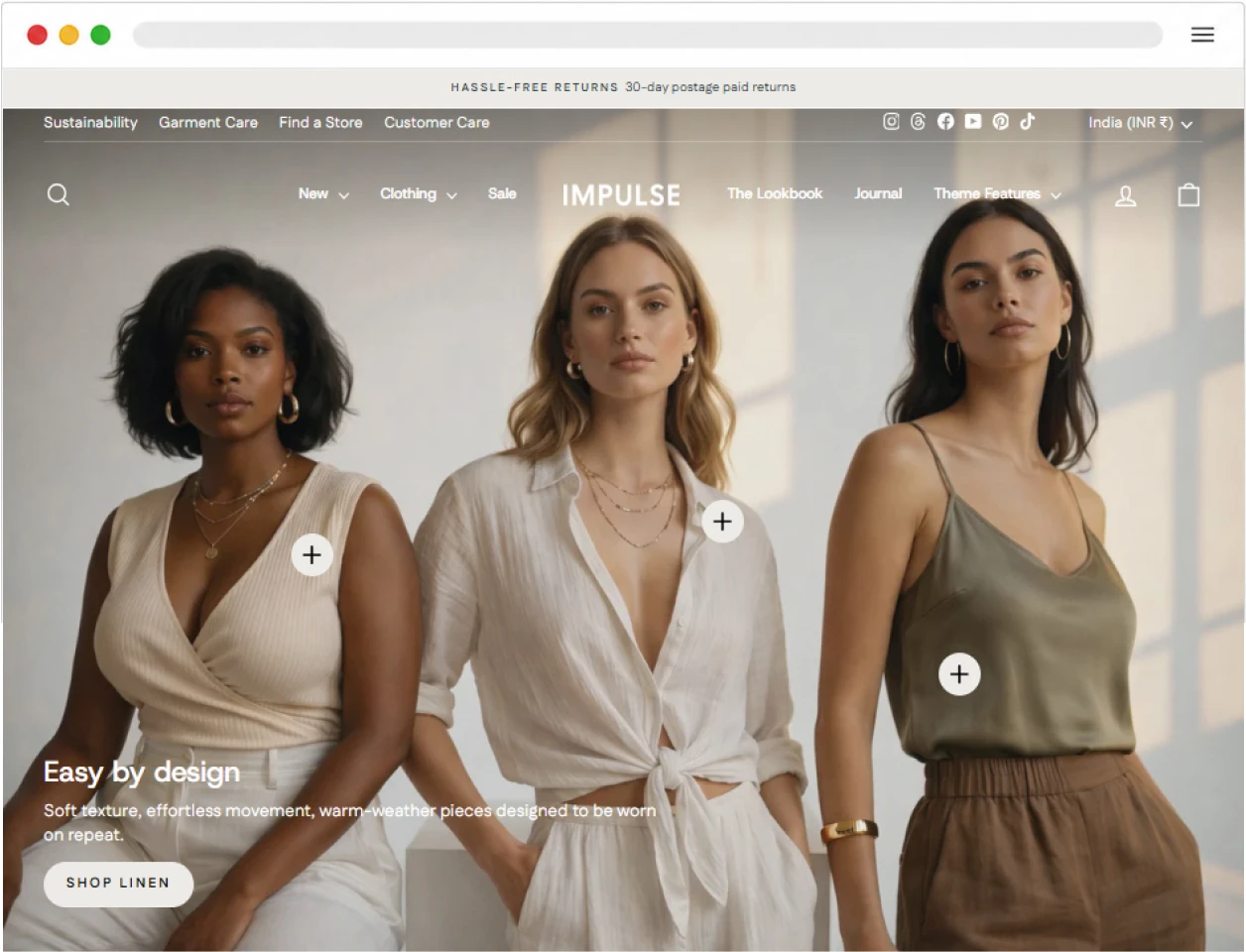
Impulse — the high-volume fashion benchmark
2. Prestige
Verdict: The go-to for luxury fashion. Editorial layouts, refined typography, and a design system that communicates premium without any customization.
Best for: Luxury and designer fashion brands
Price: ~$560 CAD / $400 USD
Rating: 91% — highly rated among luxury-focused merchants
Key features:
- Parallax story sections that scroll like an editorial magazine spread
- Product image zoom and gallery lightbox — the zoom is genuinely smooth
- Built-in brand timeline section (no app needed)
- Typography scale that reads luxury out of the box
EDP Insight
Prestige earns its name. For luxury clients, we often start here and customize from it rather than building from scratch. The built-in editorial sections save 20-40 hours of custom development versus trying to get the same result from a general theme.
Who should skip it: Budget-conscious stores or brands with a casual, playful aesthetic. Prestige’s design language is inherently formal — forcing it into a streetwear brand feels off.
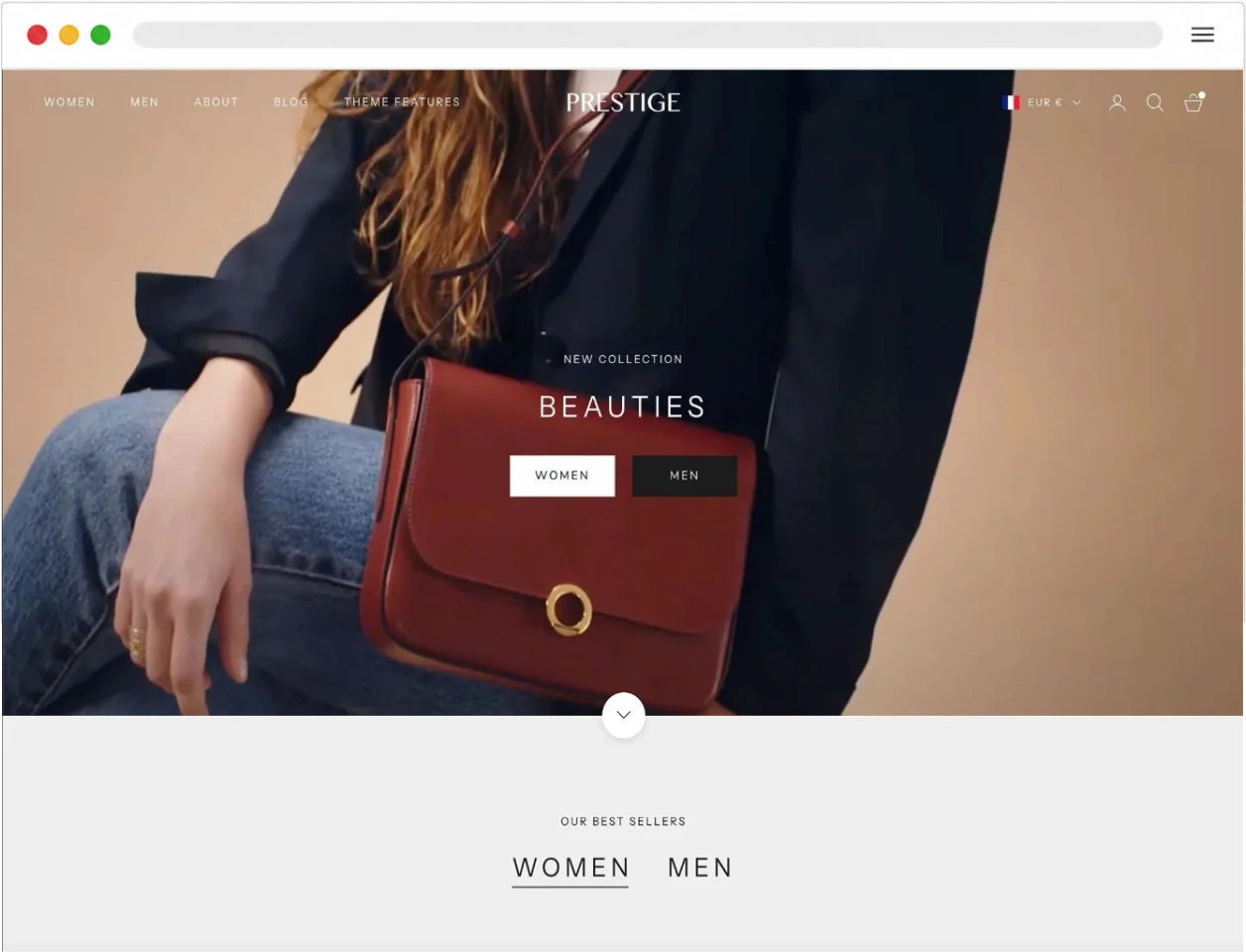
Prestige — editorial sections that save 20-40 hrs of custom dev for luxury brands
3. Gravity
Verdict: Image-forward and deliberately stripped back. Gravity gives your photography the entire stage — there’s nothing competing with it.
Best for: Streetwear, athleisure, and brand-forward fashion labels
Price: ~$400 CAD / $290 USD
Rating: NEW
Key features:
- Full-screen video hero with text overlay controls
- Edge-to-edge image sections for campaign storytelling
- High-contrast typographic system
- Smooth scroll-triggered animations
EDP Insight
Gravity is one of the fresher themes on this list. We tested it on a client’s streetwear store and saw a 12% lift in time-on-site compared to their previous theme. The immersive layout keeps shoppers in the brand world longer.
Who should skip it: Stores with weak product photography. Gravity is an image-forward theme — if your photos aren’t strong, every design flaw gets amplified.
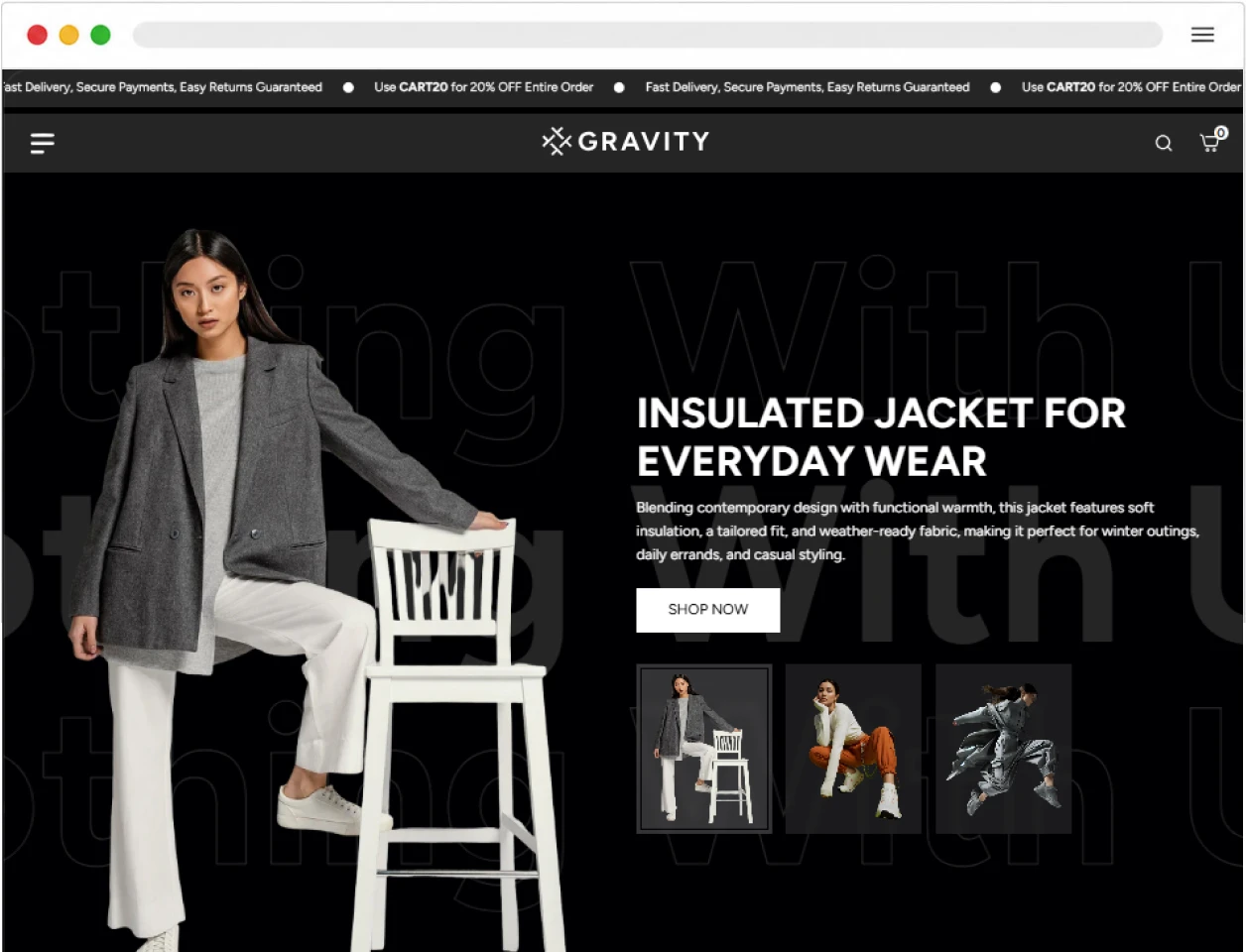
Gravity — immersive layout that keeps shoppers in your brand world longer
4. Lykke
Verdict: Scandinavian-inspired minimalism. Clean, fast, and deliberately understated.
Best for: Minimalist fashion labels and capsule collections
Price: ~$450 CAD / $320 USD
Rating: 100%
Key features:
- Ultra-clean typographic grid system
- Whitespace-focused product layouts
- Subtle micro-animations on scroll
- Built-in editorial blog layout for brand storytelling
EDP Insight
Lykke is the theme we recommend when a client says “We want it to feel like COS or Everlane.” Minimal doesn’t mean featureless — its product pages are deceptively well-structured. It just doesn’t shout about it.
Who should skip it: Stores with large, complex catalogs. Lykke’s minimal navigation works beautifully for 20-80 products. Past 200+, you’ll outgrow it.
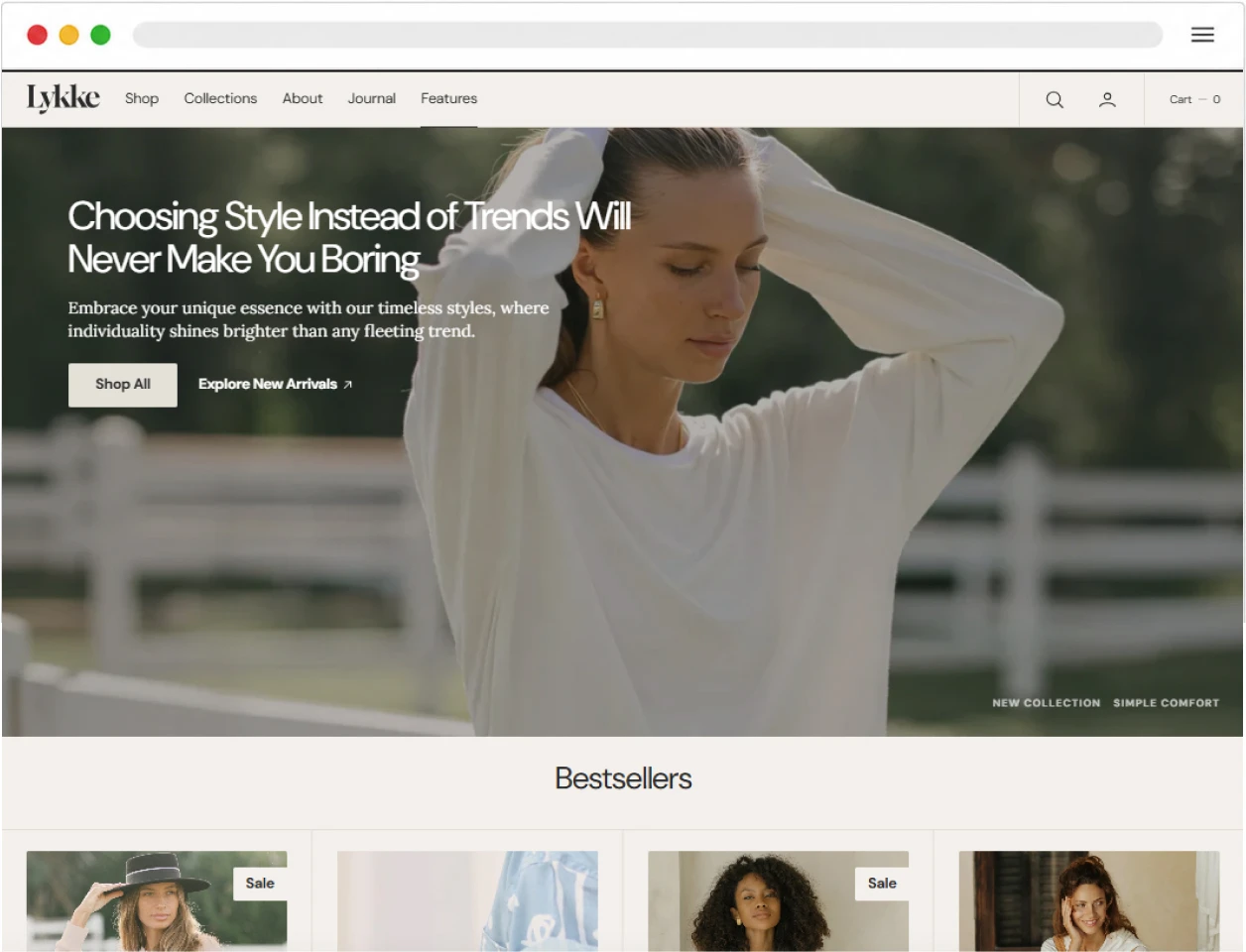
Lykke — quiet minimalism for COS- and Everlane-style brands
5. Palo Alto
Verdict: A strong all-rounder from Presidio Creative with exceptional lookbook layouts and reliable performance.
Best for: Premium boutiques and multi-category fashion brands
Price: ~$590 CAD / $420 USD
Rating: 94%
Key features:
- Lookbook-style collection pages with editorial grid
- Advanced product filtering with sidebar and tag-based options
- Built-in promotional pop-ups and announcement bars
- Clean, well-documented codebase for developer customization
EDP Insight
Palo Alto has been one of our most-recommended themes for 3+ years running. Its codebase is unusually clean, which means custom development on top of it costs less and breaks less. That matters more than most merchants realize until they’re six months into a project.
Who should skip it: Brands looking for a dramatic, high-impact visual experience. Palo Alto is refined but not flashy — if you want full-bleed video heroes and animation-heavy pages, Gravity or Aurora are better fits.
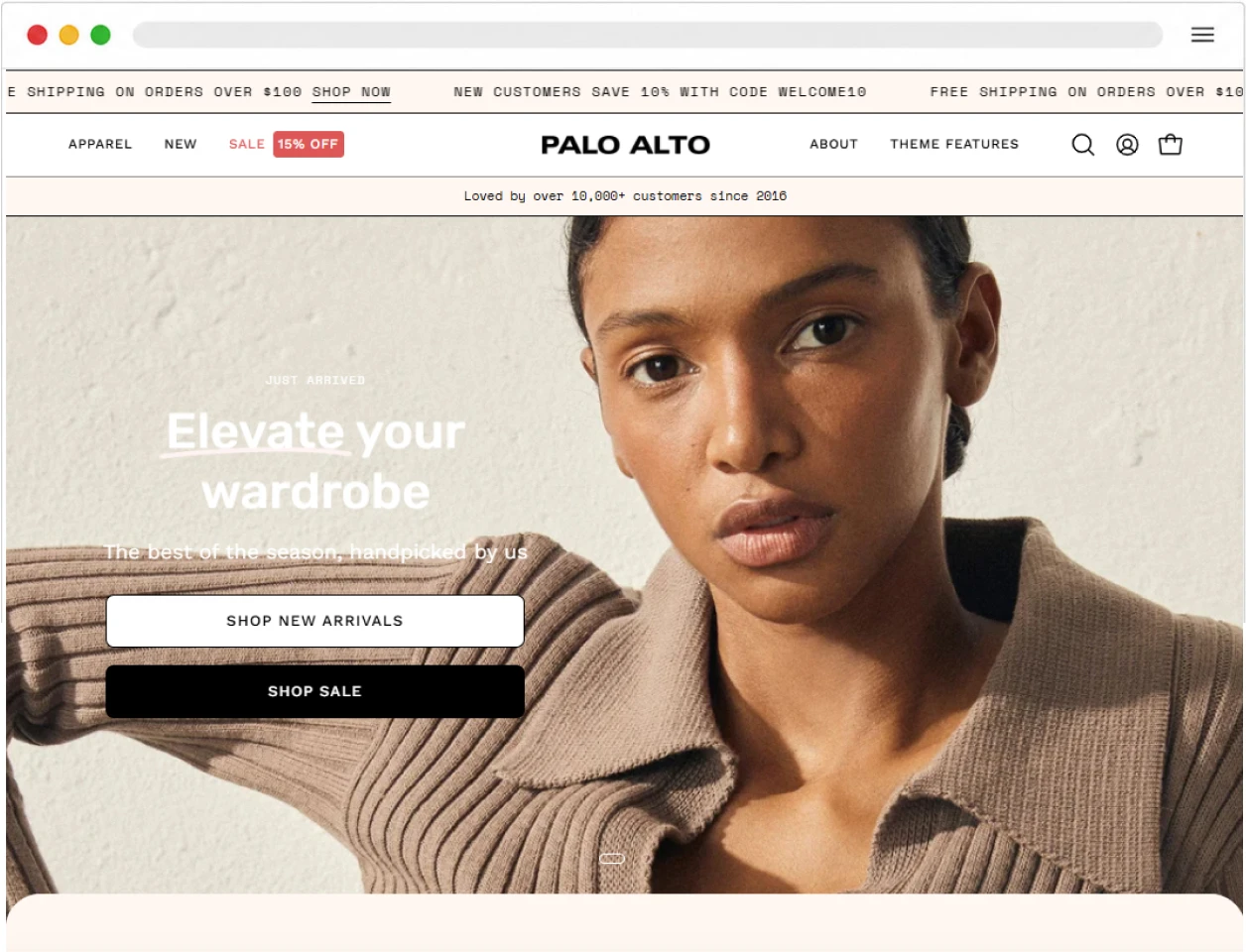
Palo Alto — unusually clean code, so customization costs and breaks less
6. Release
Verdict: Built for drop culture. Countdown gates, coming-soon product modes, and early-access password walls — all baked into the theme instead of duct-taped via apps.
Best for: Streetwear drops, seasonal capsule launches, limited-run fashion labels
Price: $560 CAD / ~$400 USD
Rating: 94%
Key features:
- Countdown timers with launch-day gating built into the section
- Product pages that flip to coming-soon mode before drop day
- Password-gated early-access sections for VIP lists
- Layout presets designed around hype and urgency
EDP Insight
Release fills a gap most themes ignore. We’ve had clients duct-tape countdown apps and password gates onto generic themes — it never works well. Having these built into the theme’s architecture makes the entire launch workflow smoother.
Who should skip it: Brands with evergreen catalogs and no seasonal urgency. The countdown and launch features are Release’s entire value proposition. If you don’t do drops, you’re paying for features you’ll disable.
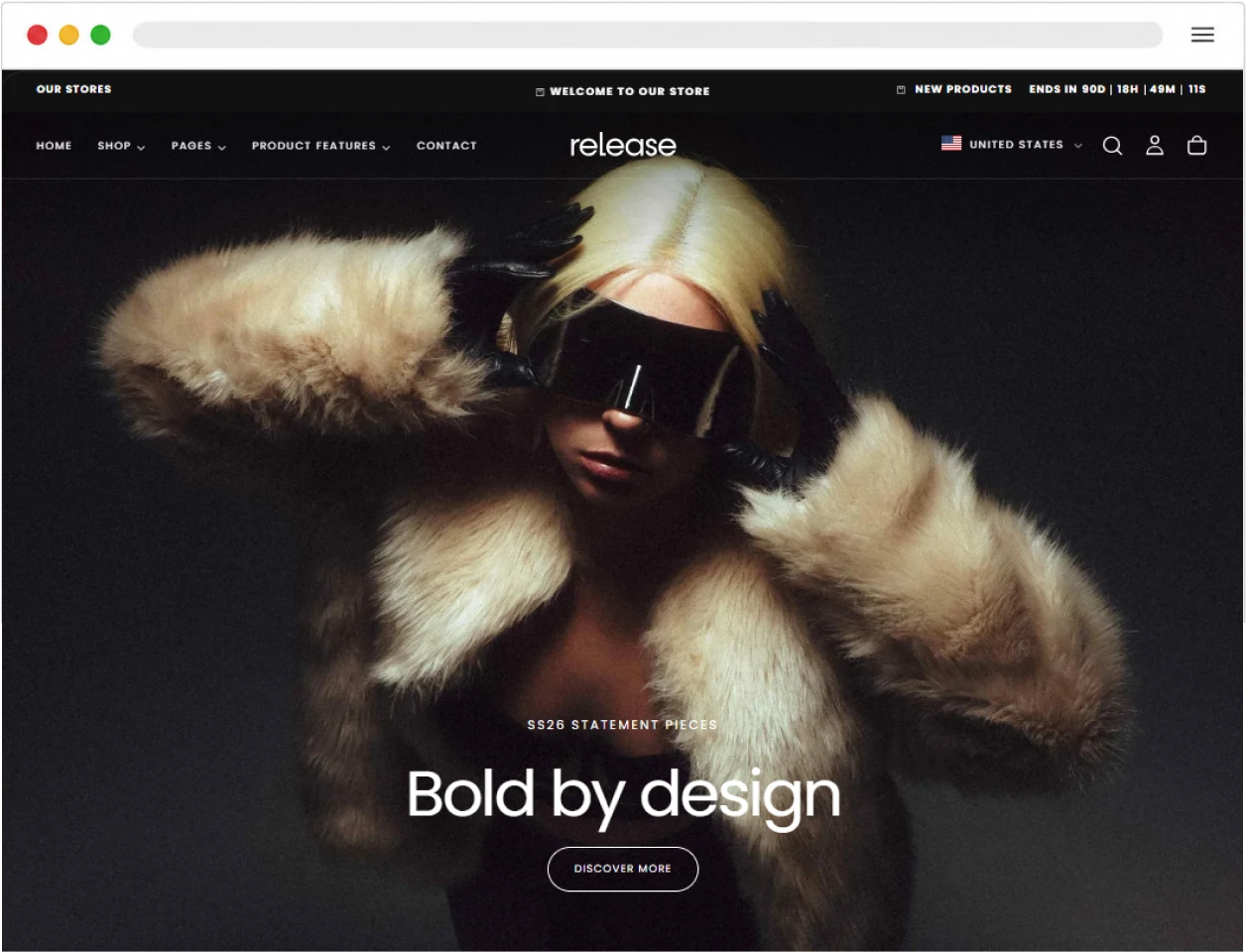
Release — countdown gates and early-access walls built in, not bolted on
7. Reformation
Verdict: Story-first design that lets brands lead with mission, values, and editorial content alongside product.
Best for: Sustainable fashion brands that lead with story and mission — not just product
Price: ~$600 CAD / $430 USD
Rating: 93%
Key features:
- Story-driven product page layouts with long-form content sections
- Impact/sustainability metrics display sections
- Editorial collection pages with narrative flow
- Integrated journal/blog with magazine-style layout
EDP Insight
Sustainable fashion brands consistently underinvest in storytelling on their actual storefront. Reformation makes it structurally easy. The brands that convert best in this space are the ones that weave their “why” into the shopping experience — not just a standalone “About Us” page.
Who should skip it: Brands that want to keep the focus purely on product. Reformation’s layout assumes you have a story to tell. If your brand isn’t narrative-driven, the empty content sections will look unfinished.
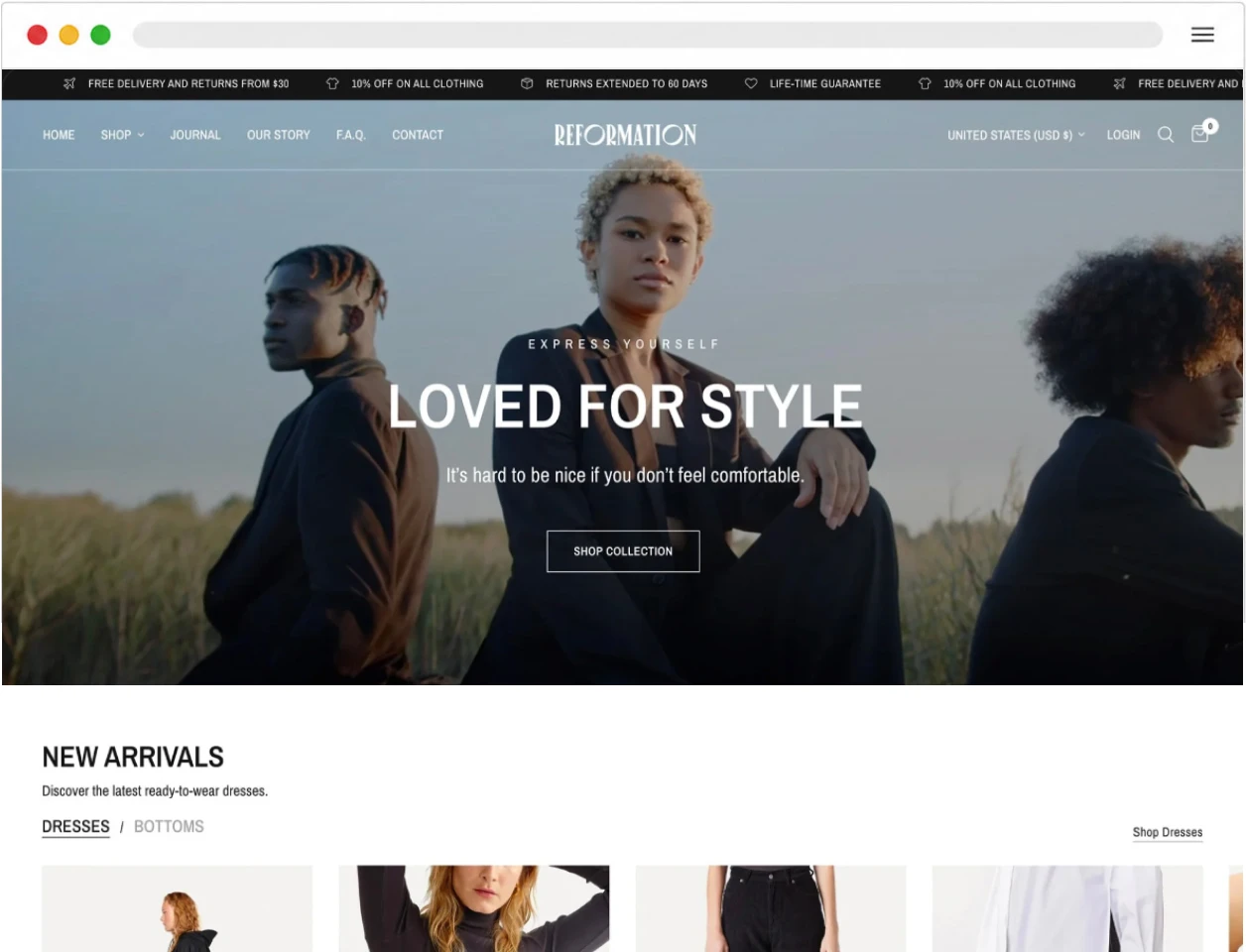
Caption – Reformation — clean, conversion-focused layout for everyday clothing brands
8. Zest
Verdict: Loud, colorful, and deliberately playful. If every other theme on your shortlist looks the same, Zest is the pattern-breaker.
Best for: Youth-focused fashion, Gen Z apparel, colorful streetwear that refuses to whisper
Price: ~$460 CAD / $330 USD
Rating: 100%
Key features:
- Dynamic color-block section layouts
- Playful animation and hover effects
- Bold typographic presets designed for personality-driven brands
- Instagram-style social feed integration
EDP Insight
Zest is polarizing — and that’s exactly the point. For the right brand, it converts. We’ve used it for a youth-focused streetwear client, and it tested significantly better with their under-25 demographic than the “safer” theme they were previously running.
Who should skip it: Luxury, formal, or minimalist brands. Zest’s personality is loud. If your brand voice is quiet and refined, this will clash.
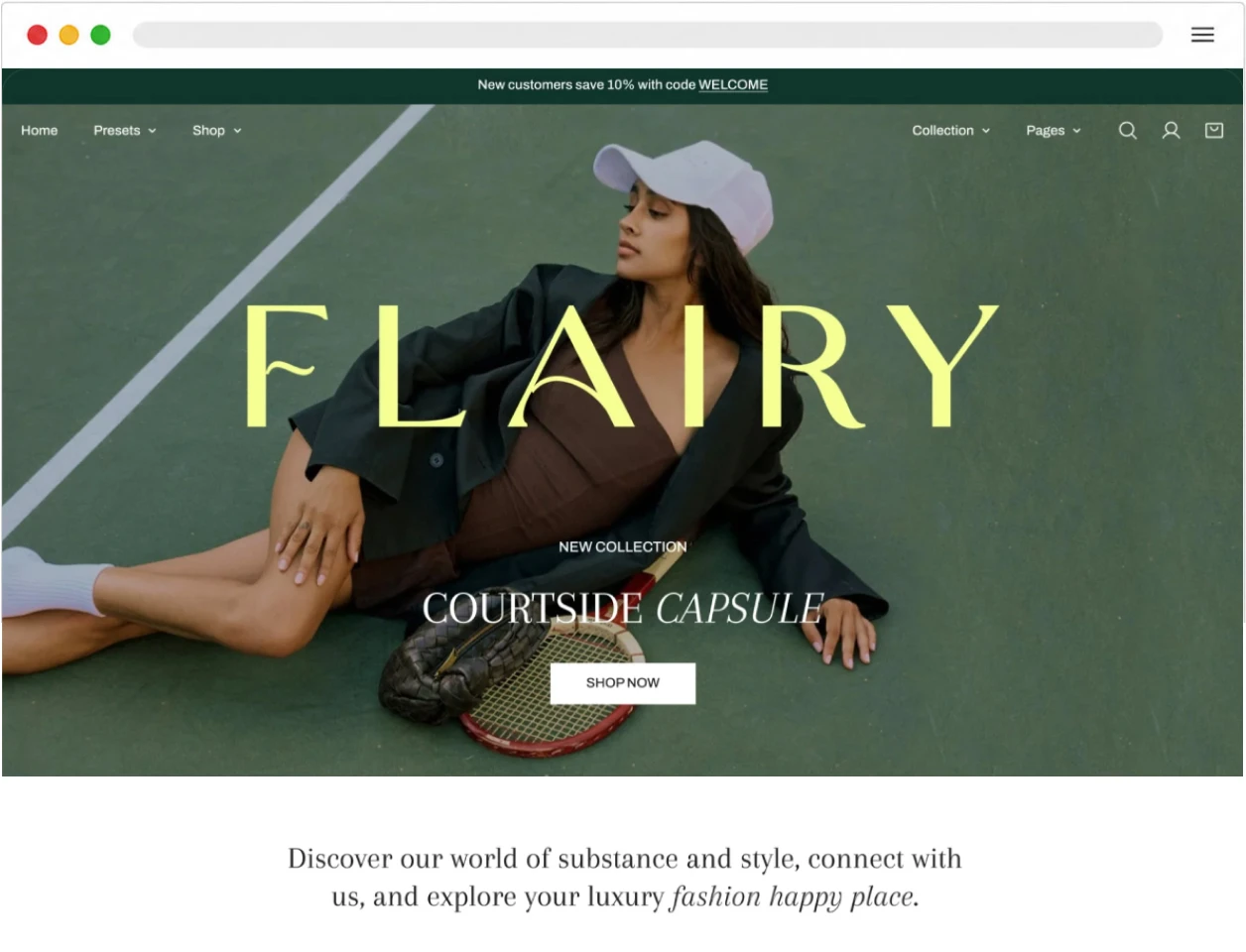
Zest — loud and playful; the pattern-breaker for younger audiences
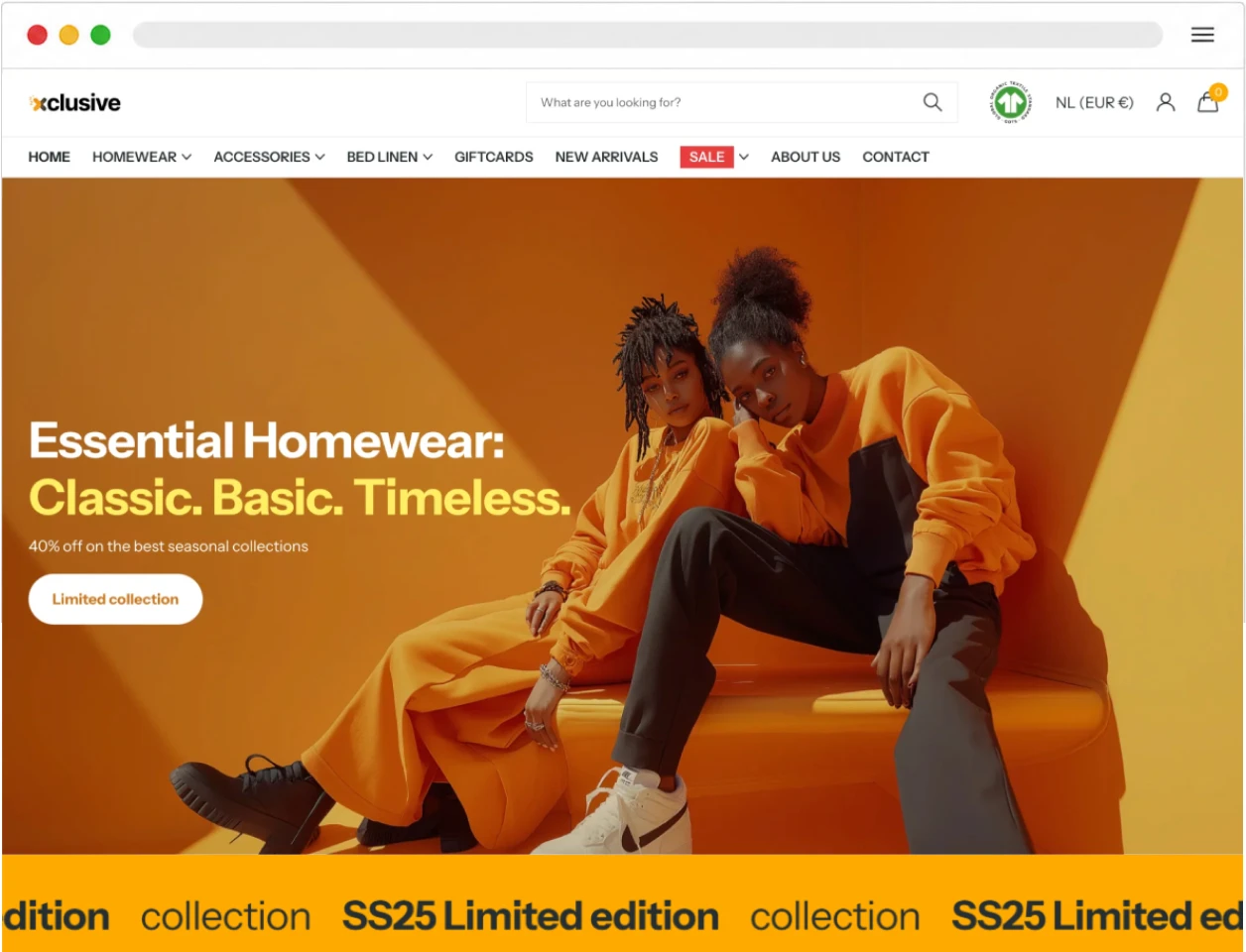
9. Xclusive
Verdict: The theme you need when your catalog outgrows your navigation. Enterprise-grade filtering and mega menu built for 500+ SKU stores.
Best for: Multi-brand fashion retailers managing 500+ SKUs across categories
Price: ~$700 CAD / $500 USD
Rating: 98%
Key features:
- Multi-column mega menu with image slots and featured collection links
- Product filtering by color, size, price range — filters actually work fast
- Landing page sections built for multi-brand merchandising
- Quick view that includes full variant selection (not just name and price)
EDP Insight
We’ve audited stores running 1,000+ SKUs on minimalist themes — bounce rates consistently sit around 70%. The issue isn’t the products. It’s navigation. Xclusive gives you the filtering and menu infrastructure that large catalogs demand, without a custom build.
Who should skip it: Small boutiques with under 50 products. Xclusive’s navigation features become overhead rather than an advantage at small catalog sizes.
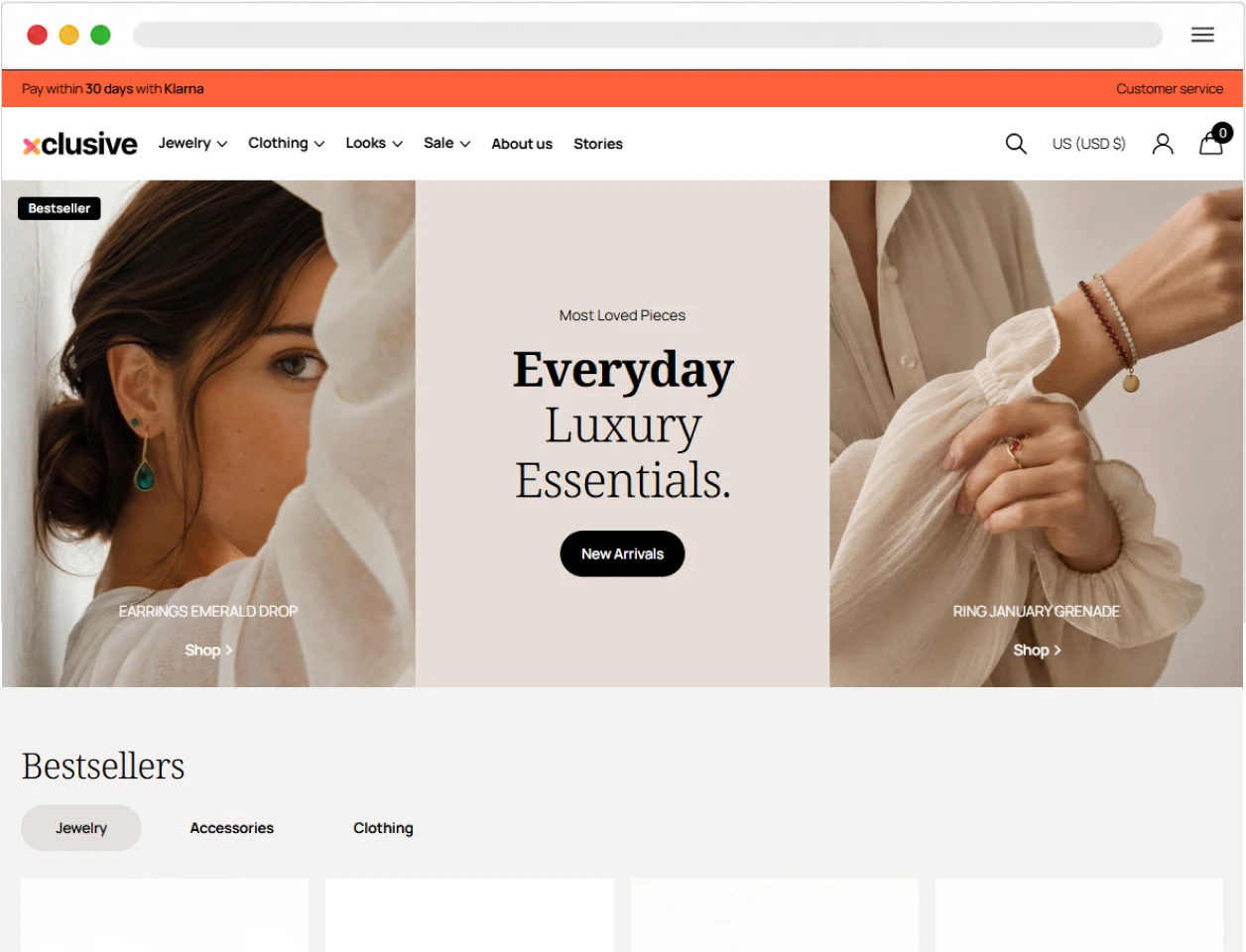
Xclusive — enterprise filtering and mega menu for 500+ SKU catalogs
10. Aurora
Verdict: Animation-rich without the speed penalty. Aurora uses CSS-driven effects instead of heavy JavaScript, so the visual polish doesn’t wreck your Core Web Vitals.
Best for: DTC fashion brands that want scroll-triggered animations without tanking their Lighthouse score
Price: ~$550 CAD / $390 USD
Rating: 97%
Key features:
- Scroll-triggered animations via CSS, not JavaScript — that’s why it stays fast
- Parallax image sections that don’t murder your page speed
- Product grid with hover-reveal second images on desktop
- Announcement bar with slide-in transitions (no app required)
EDP Insight
Aurora gets the speed-versus-aesthetics trade-off right. Most animation-heavy themes tank your Core Web Vitals. Aurora uses CSS animations instead of JavaScript-driven ones, which means the visual effects don’t come at a performance cost. That’s a technical distinction most merchants won’t notice — but their Google rankings will.
Who should skip it: Brands that prefer a static, editorial feel. Aurora’s animations are tasteful but always present. If you want a calm, newspaper-like layout, Lykke or Prestige are better choices.
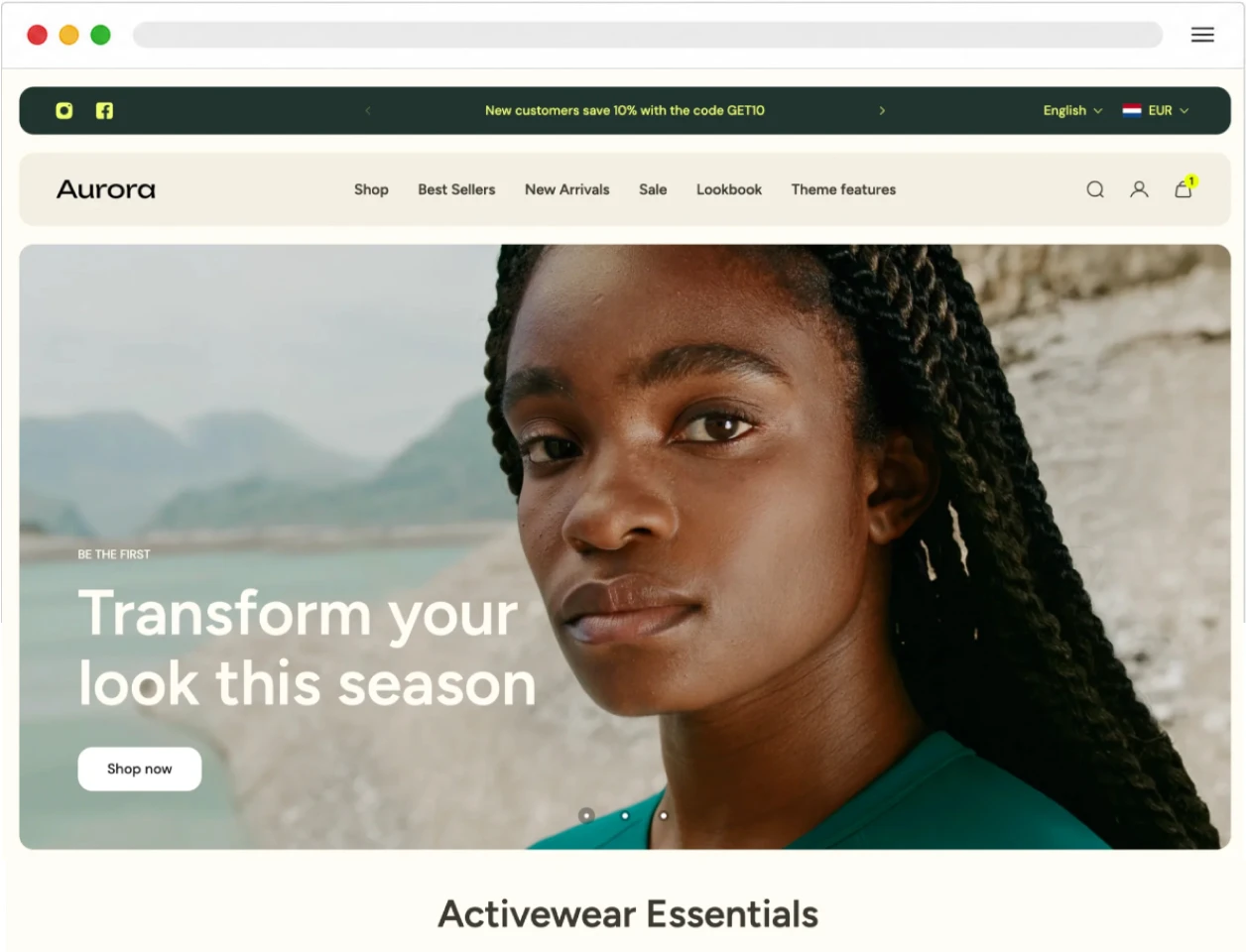
Aurora — CSS-driven animation that won’t tank your Core Web Vitals
11. Monaco
Verdict: Built for accessories and curated fashion with image-heavy merchandising tools.
Best for: High-end accessories, jewelry-adjacent fashion, and curated boutiques
Price: ~$530 CAD / $380 USD
Rating: 97%
Key features:
- Image hotspot sections for outfit/accessory breakdowns
- Editorial grid layouts with mixed-size tiles
- Product highlight carousels with editorial captions
- Refined color palette system for brand consistency
EDP Insight
Monaco’s hotspot feature is genuinely useful for accessories and jewelry brands. We’ve built custom hotspot sections for clients before — it’s 15-20 hours of development. Getting it built into the theme saves real money.
Who should skip it: Stores that don’t sell look-based or outfit-based products. The hotspot and editorial features are Monaco’s differentiator. If you’re selling basics and commodity apparel, the features go unused.
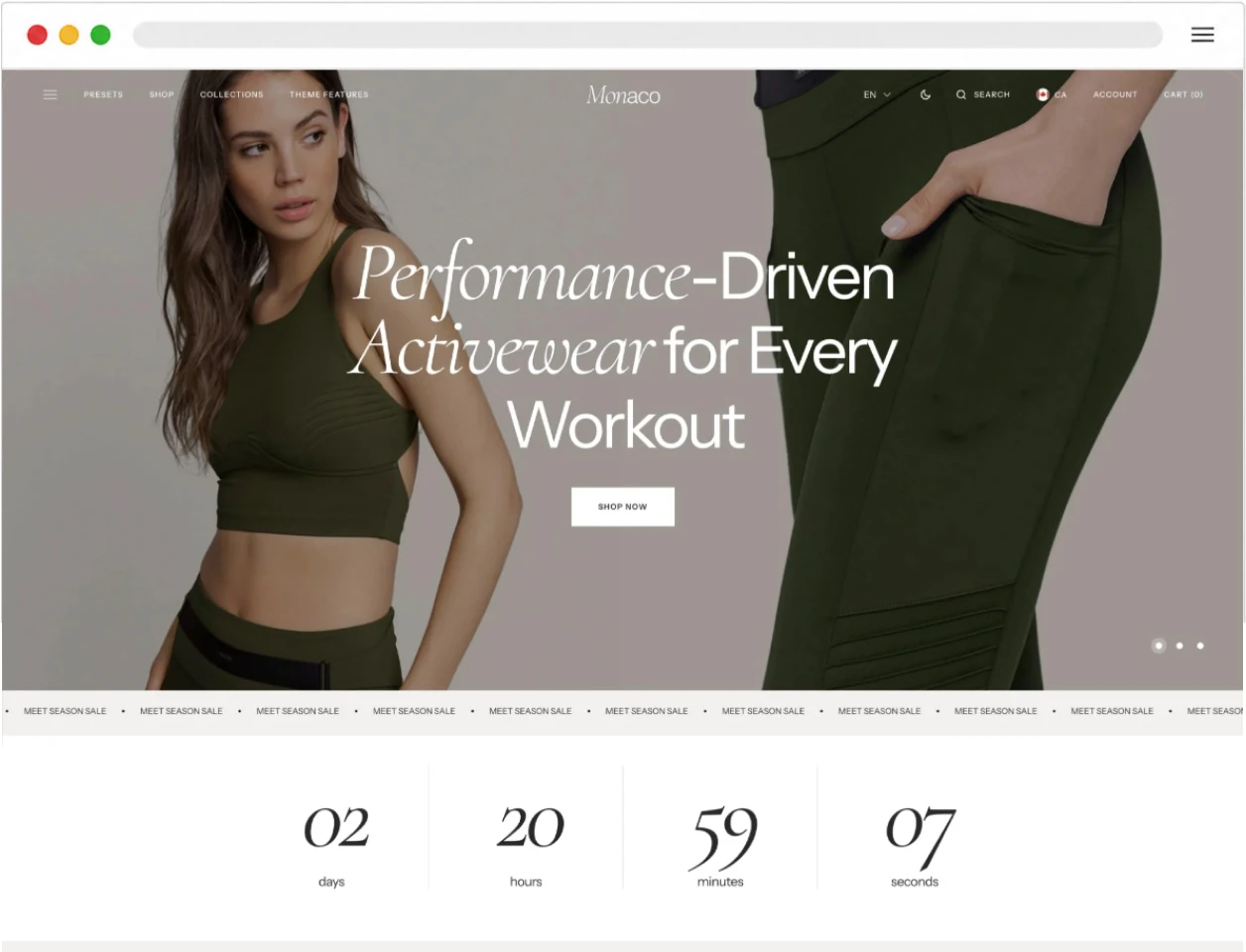
Monaco — built-in product hotspots for accessories and jewelry
12. Dune
Verdict: Warm, organic, textured. Designed for brands with an earthy, natural aesthetic.
Best for: Linen brands, organic cotton labels, and earth-tone fashion where the aesthetic is warm rather than sharp
Price: ~$630 CAD / $450 USD
Rating: 94%
Key features:
- Earthy color presets and a textured design system that feels warm immediately
- Rounded UI elements and organic shapes throughout
- Hero sections that prioritize lifestyle photography over product grids
- Background grain and texture overlays — subtle, not gimmicky
EDP Insight
Natural-fiber brands have had a theme problem for years. Everything on the market pushes them toward stark minimalism or a generic multipurpose layout. Dune actually matches the warmth these brands need. We’ve recommended it to three linen/organic clients in the last six months — all of them stopped looking after seeing the demo.
Who should skip it: Bold, high-contrast brands. Dune’s warmth and softness are its identity. If your brand uses neon accents, sharp geometry, or dark mode aesthetics, you’ll fight the theme instead of working with it.
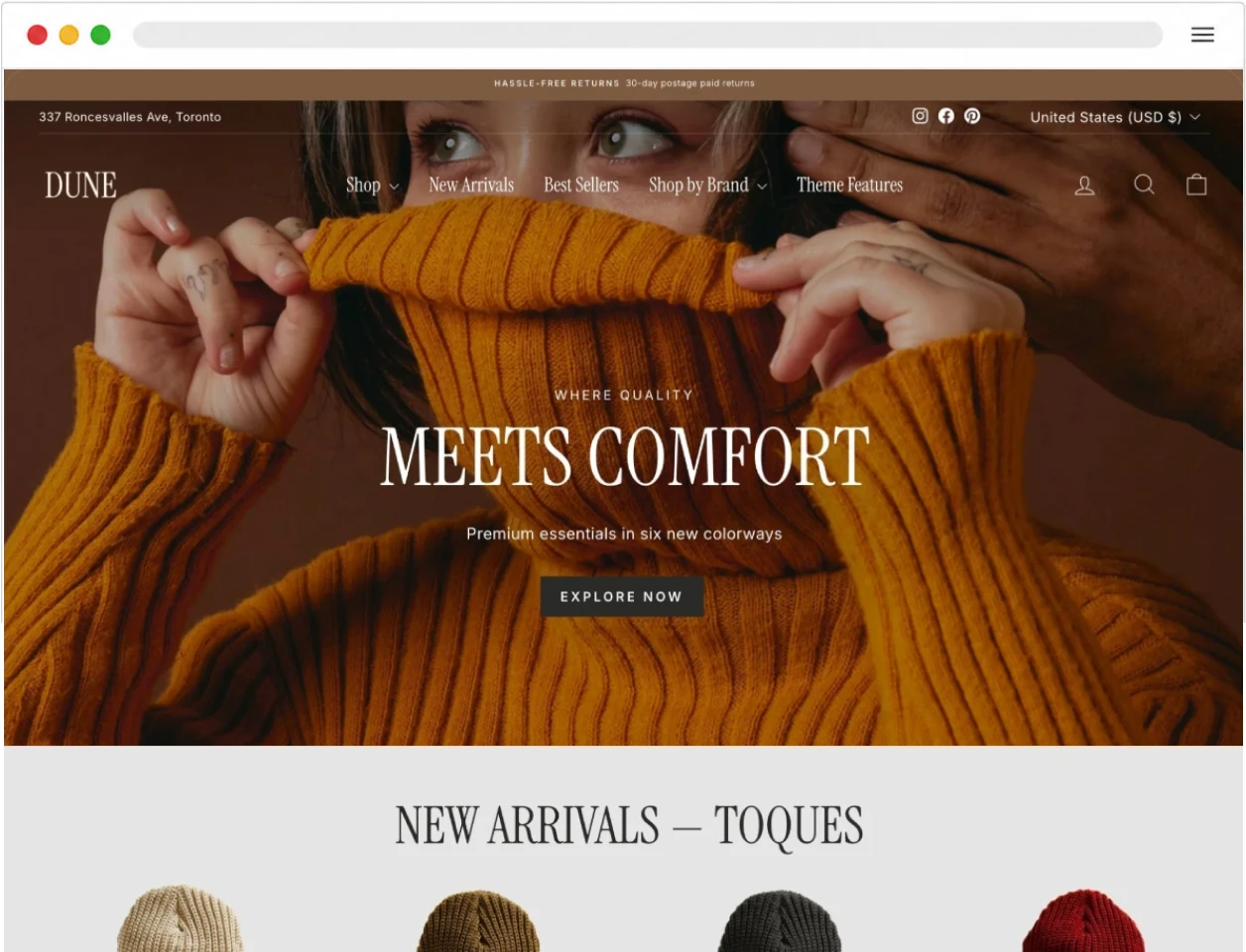
Dune — warmth-forward design for linen and natural-fiber brands
13. Cozy
Verdict: The only theme on this list designed specifically for comfort-driven fashion. Soft UI, lifestyle imagery front and center, and fit-guide integration where it matters most — on the PDP.
Best for: Loungewear, intimates, sleepwear — brands where the purchase decision is emotional, and fit is everything
Price: $700 CAD / $500 USD
Rating: 98%
Key features:
- Soft UI design system with rounded corners and warm tones
- Lifestyle imagery-first product sections
- Size and fit guide integration at the PDP level
- Comfort-focused promotional section templates (bundles, sets)
EDP Insight
Loungewear and intimates have UX problems that most themes don’t solve. Returns are expensive, sizing questions kill conversion, and the purchase decision is almost entirely emotional. Cozy puts lifestyle imagery and fit information exactly where they need to be — above the fold on the product page, not buried in a tab.
Who should skip it: Formal or structured fashion brands. Cozy’s rounded, soft aesthetic won’t work for tailoring, suiting, or sharp menswear.
Cozy — soft, comfortable aesthetic for loungewear and casual labels
14. Phantom
Verdict: Dark-mode-first design for brands with an edgy, high-contrast identity.
Best for: Tech-wear, dark streetwear, and any brand whose identity lives in high-contrast darkness
Price: $500 CAD / $360 USD
Rating: 98%
Key features:
- Color system designed dark-first, with a light mode toggle if you need it
- Typography and UI built for high contrast on dark backgrounds
- Full-bleed image sections where dark product photography actually pops
- Product images presented cinematically — think gallery, not grid
EDP Insight
Dark-mode themes are surprisingly rare on Shopify. Most brands that want a dark aesthetic end up customizing a light theme and fighting it the whole way. Phantom is built dark from the ground up — colors, contrast ratios, image treatment, and hover states all designed for dark backgrounds. That saves significant development time.
Who should skip it: Brands with light, airy, or pastel aesthetics. Phantom is built for darkness — forcing a light palette onto it defeats the purpose.
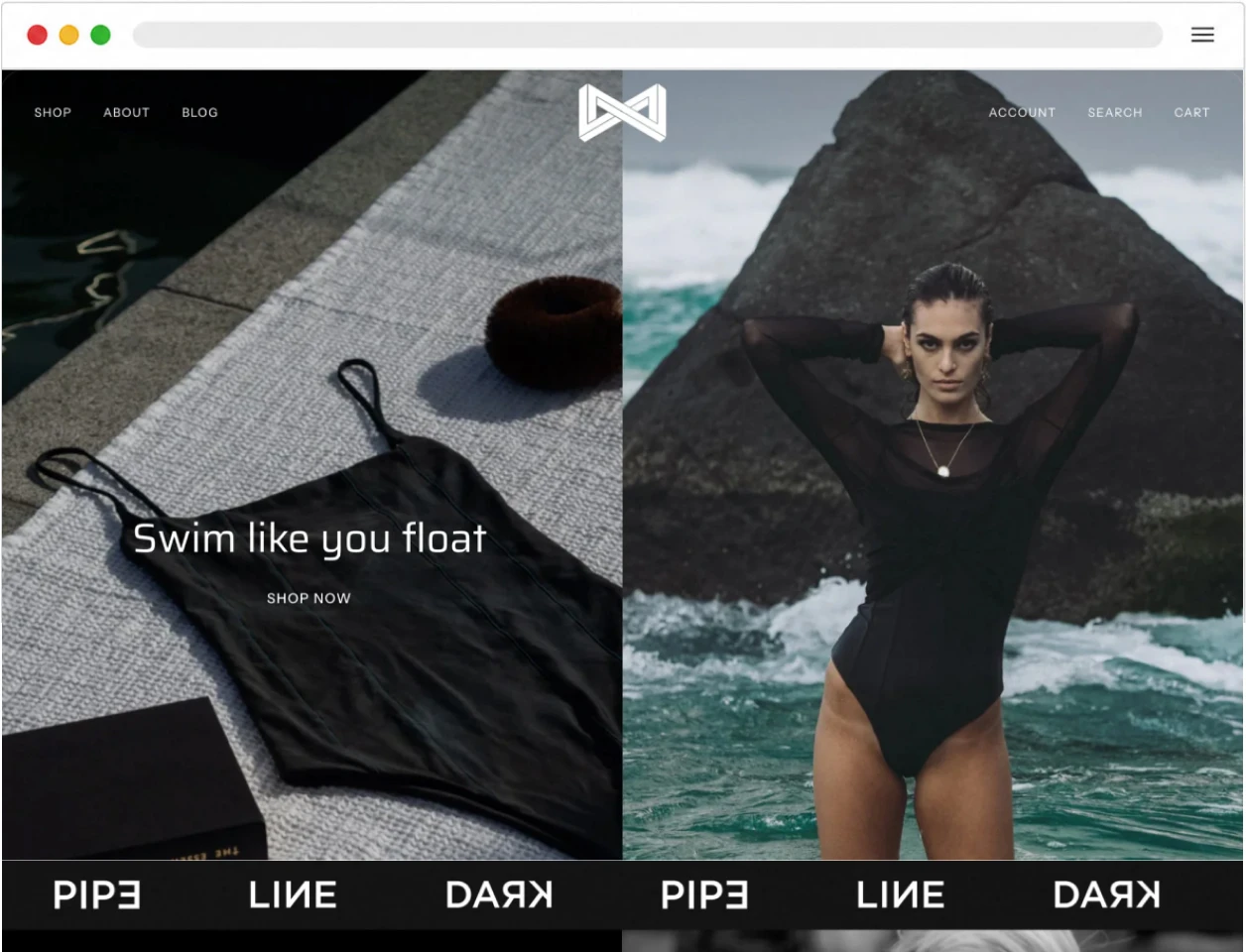
Phantom — sleek, high-contrast design for modern fashion stores
15. Etheryx
Verdict: Experimental, asymmetric, and art-directed. For brands that refuse to look like every other Shopify store.
Best for: Art-fashion hybrids, concept-store brands, and labels that treat the website as part of the creative output
Price: ~$520 CAD / $370 USD
Rating: 100%
Key features:
- Asymmetric grid layouts that break from standard Shopify patterns
- Art-directed collection pages with mixed media support
- Experimental typography options
- Gallery-mode product presentation
EDP Insight
Etheryx is the most visually distinctive theme on this list. It’s not for everyone, and that’s the point. For fashion brands where the store itself is part of the brand expression — think concept stores or gallery-retail hybrids — it eliminates weeks of custom development.
Who should skip it: Stores prioritizing conversion optimization over brand expression. Asymmetric layouts can create friction. If maximizing add-to-cart rate matters more than visual impact, pick something more conventional.
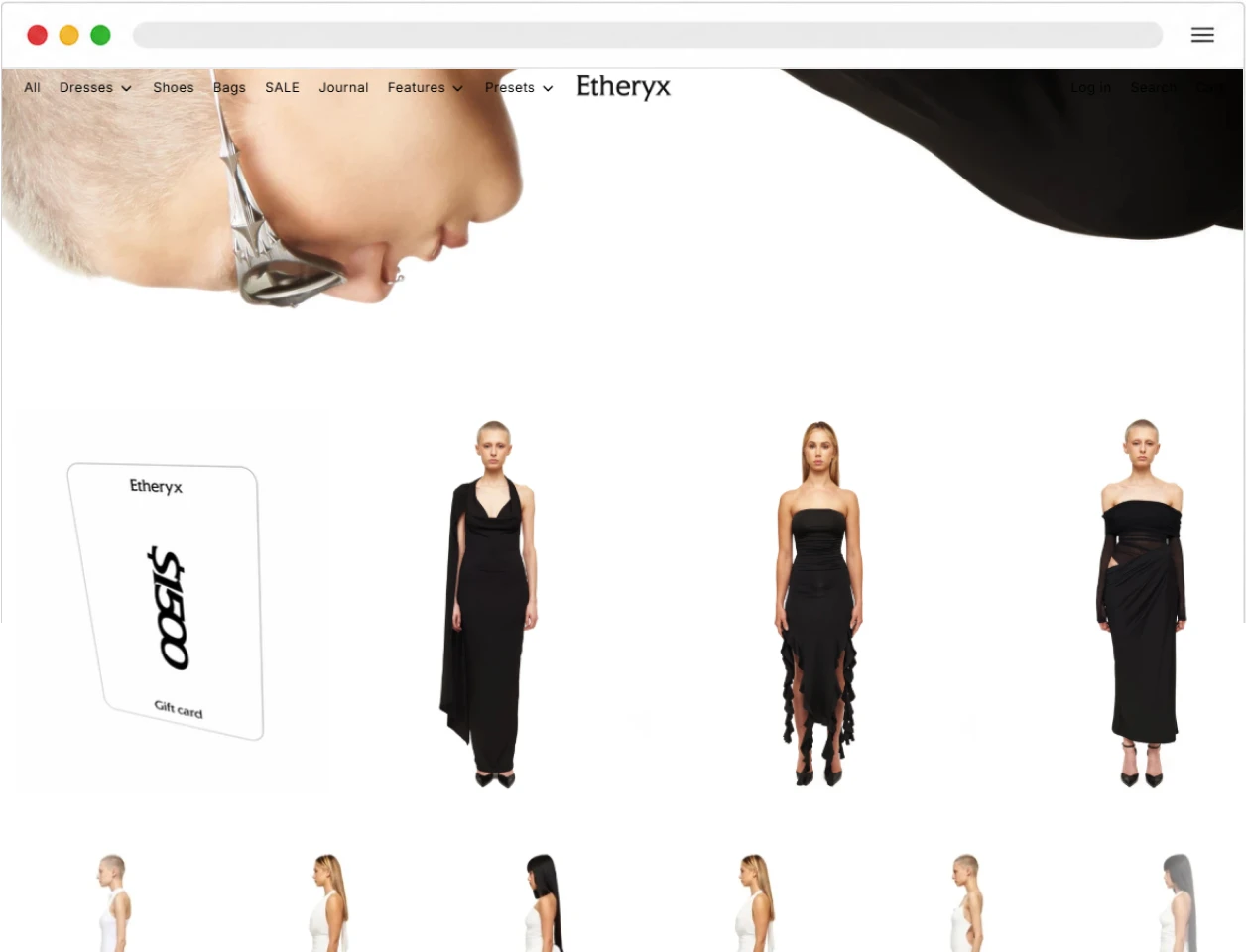
Etheryx — contemporary layout for design-led clothing brands
16. Borders
Verdict: The theme to pick if you’re selling into multiple countries and tired of duct-taping currency converters and translation apps onto a generic layout.
Best for: Fashion brands selling cross-border into 3+ markets who need currency, language, and shipping UX built into the theme
Price: $530 CAD / $380 USD
Rating: 94%
Key features:
- Built-in multi-currency display with geolocation detection
- Language-aware layout adjustments
- International shipping information sections
- Market-specific promotional banner support
EDP Insight
Cross-border selling is messy. We’ve seen stores bolt on currency converters, translation apps, and market-specific banners through 3-4 separate apps. Borders consolidates the core UX patterns into the theme itself. It doesn’t replace Shopify Markets, but it works with it far more cleanly than a generic theme plus apps.
Who should skip it: Brands selling in a single market. If you’re only selling domestically, Borders’ international features are unnecessary complexity.
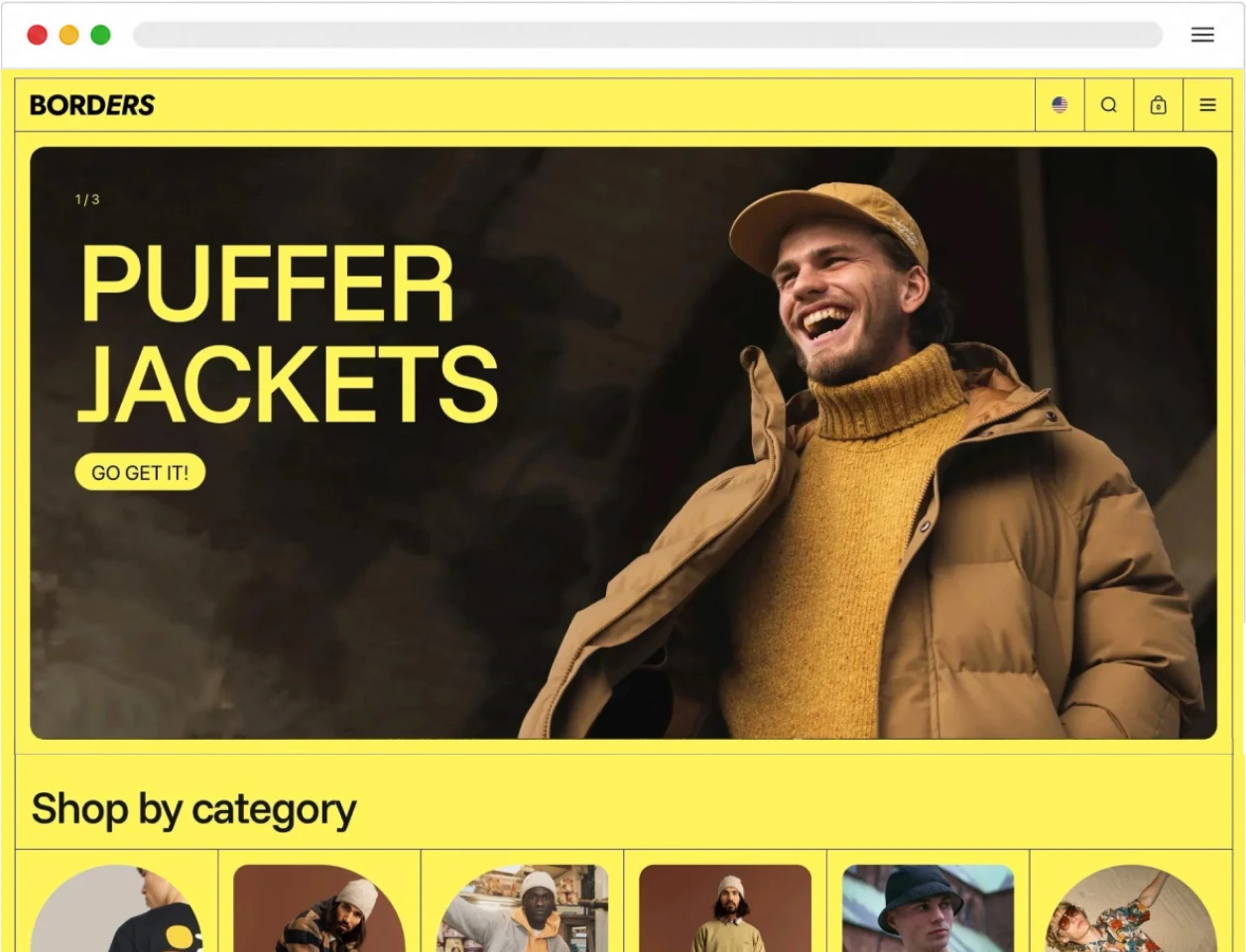
Borders — structured, editorial-style theme for curated catalogs

Not Sure Which Theme Fits Your Brand?
We’ve helped 30+ fashion brands choose, configure, and customize the right Shopify theme. If you’re stuck between options — or wondering whether custom makes more sense — we’ll give you a straight answer in a free 15-minute call.
Best Free Shopify Fashion Theme
Horizon (Free)
Verdict: The strongest free fashion theme in Shopify’s library. Clean product grids, quick view, and enough design flexibility to launch without looking like a template.
Best for: Brand-new fashion stores validating product-market fit before investing in a premium theme
Price: Free
Key features:
- Collection grid that keeps image ratios consistent (no cropping surprises)
- Quick view modal so shoppers don’t leave the collection page
- Color swatch support without needing an app
- Product pages that actually work well on mobile, not just “responsive
EDP Insight
Free themes have improved dramatically since Shopify’s Online Store 2.0 rollout. Horizon is genuinely usable for a launch. The catch: you’ll hit customization walls faster than with a premium theme. Plan to upgrade once you’re past $10K-15K CAD / ~$7.5K-11K USD monthly revenue — that’s typically when the limitations start costing more than an upgrade would.
Who should skip it: Brands that already have revenue and need features like mega menus, advanced filtering, or lookbook layouts. Free themes save money at launch but create technical debt that costs more to fix later.
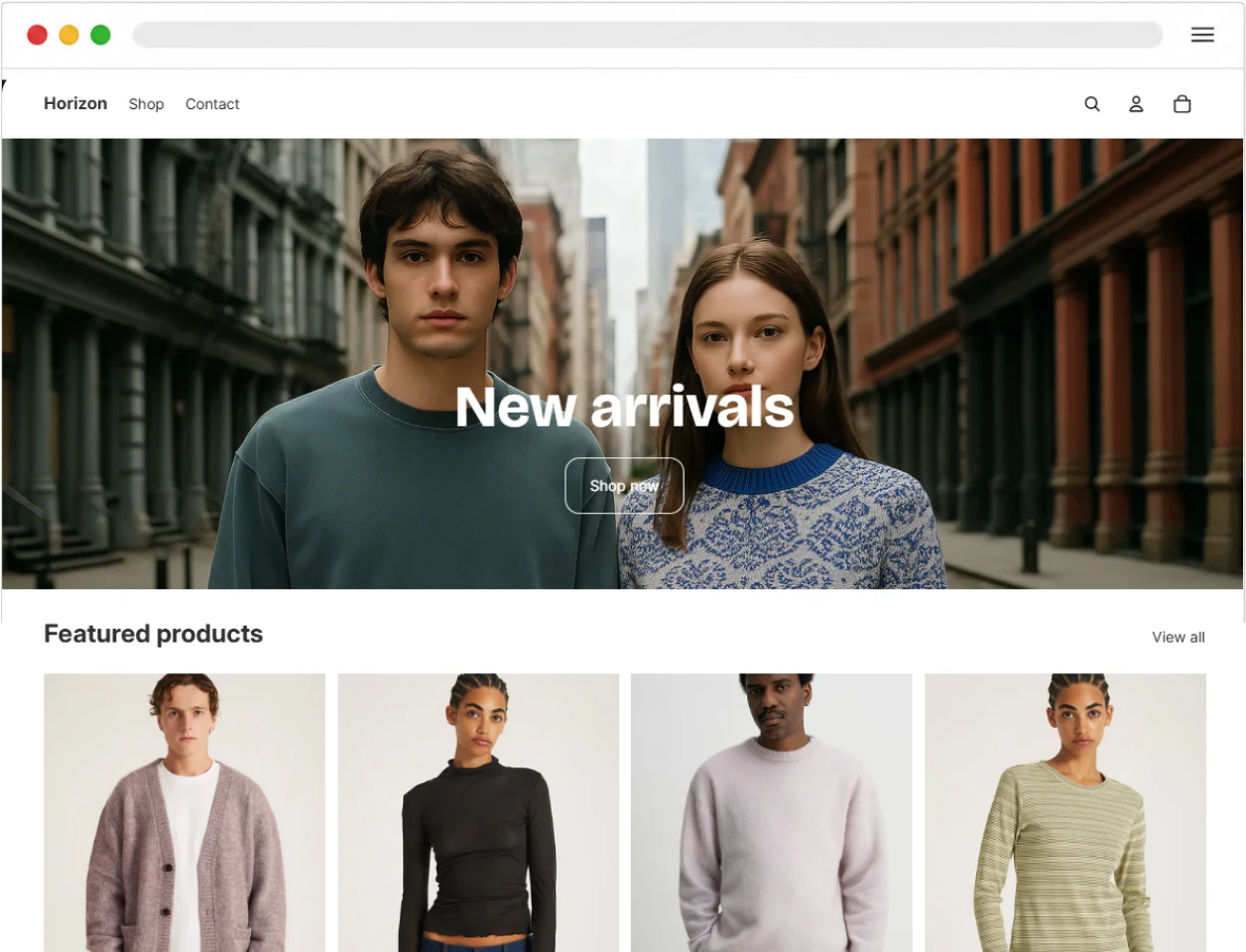
Horizon — the strongest free fashion theme for launching new stores
A note on Dawn. Shopify’s Dawn is the most-searched free theme, and it works for fashion in a pinch. But it’s a general-purpose starter theme — it lacks the fashion-specific layouts and merchandising sections that Horizon provides out of the box. If you’re choosing between the two for a clothing store, Horizon is the better starting point. For a deeper comparison of free versus paid options, see our free vs. paid vs. custom Shopify themes guide.
When to Go for a Custom Theme Instead
Pre-built themes handle 80% of fashion stores well. The other 20% need custom work. Here’s when a theme — even a great one — won’t cut it:
- Your brand requires a unique shopping experience. If your competitive advantage is the buying experience itself (virtual try-on, custom product builders, unique sizing workflows), no theme supports that. It needs to be built.
- You’re running a complex multi-brand or B2B operation. Themes with wholesale features exist, but they’re limited. If you need custom pricing tiers, account-specific catalogs, or B2B ecommerce workflows, custom is the path.
- You’ve outgrown your theme’s architecture. When you’re spending more on custom workarounds and apps than a ground-up build would cost, the math has flipped. We typically see this around $500K-$1M+ CAD / ~$370K-$740K+ USD annual revenue.
Custom Shopify builds for fashion brands typically run $15,000-$80,000 CAD / ~$11,000-$59,000 USD, depending on complexity. For a breakdown of what drives that range, see our Shopify website design cost guide. You can also estimate your own costs with our Shopify cost calculator.
EDP Insight
The biggest cost of going custom isn’t the build — it’s ongoing maintenance. Every custom feature is a custom maintenance obligation. We advise clients to start with a premium theme, push it as far as it goes, and only go fully custom when the theme is clearly the bottleneck. That’s not a sales pitch; it’s how we keep projects profitable for our clients.
If you’re not sure where your store falls, we offer free consultations. Or start with our guide on how to select the right Shopify theme for your brand.
Frequently Asked Questions
What is the best Shopify theme for a fashion store?
It depends on your brand, catalog size, and budget. Impulse is the industry benchmark for high-volume fashion. Prestige dominates the luxury segment. But newer themes like Gravity, Lykke, and Aurora are outperforming the usual recommendations on speed and design flexibility. Use the comparison table above to match your specific use case.
How do I choose a Shopify theme for a clothing brand?
Focus on six things: mobile performance, color/variant swatches, size chart integration, lookbook or editorial layouts, page speed scores, and mega menu support. Test any theme on a real mobile device before purchasing and check its Lighthouse speed score on the demo store. Our full criteria breakdown is in the “What to Look For” section above.
Are free Shopify themes good enough for fashion stores?
For a brand-new store on a tight budget, yes — Horizon is the strongest free option for fashion. The trade-off: limited customization, no mega menu, and you’ll end up adding apps to cover feature gaps. Most stores outgrow a free theme around $10K-15K CAD monthly revenue. Plan the upgrade before the limitations start costing more than a premium theme would.
How much do Shopify fashion themes cost?
Premium fashion themes run $400-$500 CAD / ~$300-$380 USD, one-time. Horizon is the best free option. If you need a fully custom build, expect $15,000-$80,000 CAD / ~$11,000-$59,000 USD depending on scope and complexity.
Which Shopify theme is best for luxury fashion?
Prestige. It dominates the luxury fashion segment on Shopify — editorial layouts, parallax sections, and typography that communicates premium immediately. If your brand leans more toward accessories than apparel, Monaco is worth a serious look, too.
Which Shopify theme is best for high-volume clothing stores?
Impulse is the standard pick. It handles large catalogs well — predictive search, promotional tiles, robust variant options. If you’re running 500+ SKUs, Xclusive gives you deeper mega menu and filtering capabilities that Impulse doesn’t match.
Free Download: Shopify Fashion Theme Scorecard
Choosing between 16+ themes is overwhelming. We built a Shopify Fashion Theme Scorecard that scores each theme across the criteria that actually matter for clothing stores: mobile speed, swatch support, navigation depth, lookbook layouts, customization flexibility, and total cost of ownership.
Fill in your priorities, score each theme you’re considering, and the right choice becomes obvious.

Ready to Launch or Redesign Your Fashion Store?
Picking the right theme is step one. Getting it configured, customized, and optimized for conversions is where most brands stall.
We’ve launched 30+ Shopify fashion stores — from fresh startups to seven-figure migrations. If you want a team that knows fashion ecommerce inside out, book a free consultation, and we’ll tell you exactly what your store needs.