


 647-812-5125


Most Buy Now, Pay Later guides are written for shoppers. This one is for the store owner who pays the fee.
BNPL can lift sales. It also takes a bigger cut of every order, and the real cost isn’t obvious until returns enter the picture.
So before you switch it on, or assume it’s working because conversion went up, it’s worth doing the math.
Here’s what BNPL costs your customer and what it costs you. Then the part most guides skip: whether the extra sales cover the extra fee, and when your store is better off without it.
The short version
- BNPL costs you roughly 5–8% of order value, against 2–3% on a standard credit card transaction.
- That fee isn’t refunded when an order is returned, and Shopify states this plainly in its own documentation.
- Pay-in-four is interest-free for your customer. Longer monthly financing is not — in Canada it runs 0–31.99% APR, subject to provincial limits.
- All six major providers now serve Canadian stores, at order limits from $30 to $30,000 CAD.
- Whether it’s worth it comes down to three numbers you already have:
- Your margin
- Your average order value
- Your return rate
What Is Buy Now, Pay Later (BNPL)?
Buy Now, Pay Later (BNPL) is a checkout financing option that lets a customer receive their order immediately and repay it in scheduled instalments. The provider pays the merchant the full order value upfront, minus a transaction fee, and takes on the risk of collecting from the customer. Short-term plans are typically interest-free for the shopper; longer monthly plans may carry interest.
What Buy Now, Pay Later (BNPL) Costs Merchants
According to the Federal Reserve, BNPL merchant fees range from 5% to 8% of the order value, compared with about 2% to 3% for credit card transactions through a standard payment gateway.
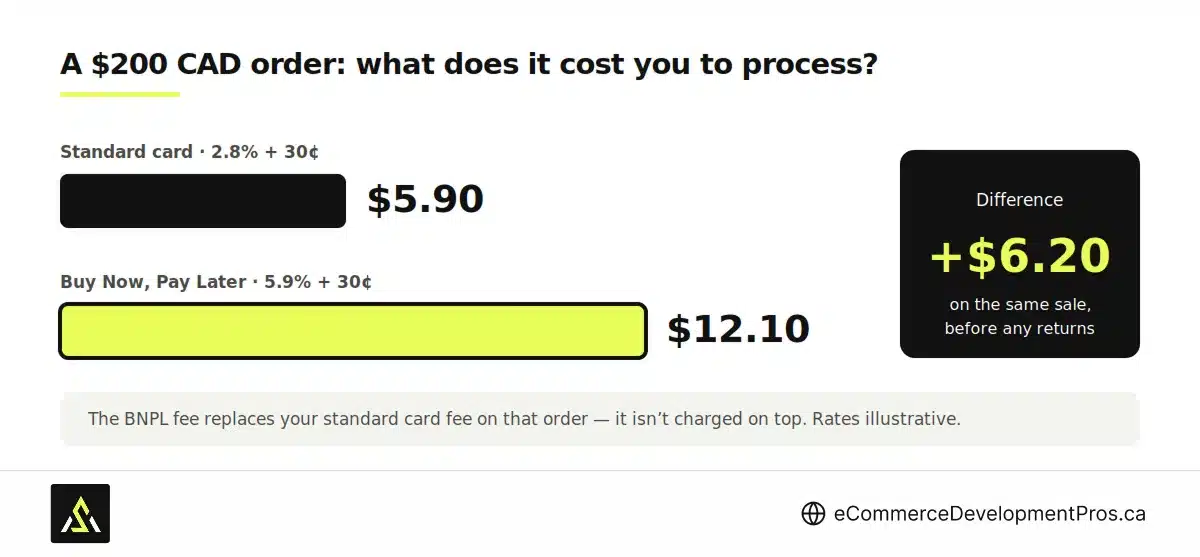
That can roughly double your payment-processing cost. On a $200 CAD order:
- Standard Shopify Payments at 2.8% + $0.30: $5.90 CAD
- Shop Pay Installments at a reported 5.9% + $0.30: $12.10 CAD
That’s $6.20 more to process the same $200 order through BNPL. The fees don’t stack: the $12.10 BNPL fee replaces the $5.90 standard card fee.
EDP Insight
Shopify won’t tell you what Shop Pay Installments costs until you’re inside the activation flow. It isn’t on the pricing page, it isn’t in the help docs, and it isn’t visible to agencies working inside client stores — we’ve looked. The figures circulating publicly span 5.9% to 7.99%, which is a two-point spread on every BNPL order with no rate card to check against. Whatever number you’re shown, run it against your margin before you accept it.
What BNPL Costs Your Customer
Pay in 4 is generally interest-free when payments are made on time. The customer pays the purchase price in instalments rather than paying the full amount at checkout.
Longer-term financing is different. Depending on the provider and plan, customers may pay interest. Some providers may also charge late, failed payment, or rescheduling fees.
|
Provider |
Customer fee |
Interest |
|---|---|---|
|
Shop Pay Installments |
No late fees |
Pay in 2/4 is interest-free; monthly plans in Canada range from 0–31.99% APR, subject to provincial limits |
|
PayPal Pay Later |
No late fees |
None |
|
Afterpay |
Late fees may apply; total late fees capped at 25% of initial order value |
None on Pay in 4 |
|
Klarna |
Varies by plan/terms |
None on Pay in 4; longer-term options may carry interest |
|
Affirm |
No late fees |
Interest applies to some financing plans |
|
Sezzle |
Account reactivation and rescheduling fees may apply; exceptions apply in Quebec |
None on Pay in 4 |
Sources: Shopify · PayPal Canada · Afterpay · Klarna · Affirm Canada · Sezzle Canada User Agreement
EDP Insight
Not every BNPL option is interest-free. Pay in 4 typically is, while longer monthly plans may charge interest. If your product page promotes “interest-free instalments,” make sure customers know which plan that applies to. For longer-term financing, link to the provider’s terms so customers can check the rates and conditions before choosing a plan.
How BNPL Payment Plans Work
BNPL payment schedules vary by provider. “Pay in 4” means the purchase is split into four payments, but the timing and available financing terms depend on the provider.
|
Provider |
Payment Structure |
Payment Period |
|---|---|---|
|
Afterpay |
25% at checkout, then three payments every two weeks |
6 weeks |
|
Sezzle |
25% at checkout, then three bi-weekly payments |
6 weeks |
|
PayPal Pay Later |
Four equal payments |
6 weeks |
|
Shop Pay Installments |
Bi-weekly or monthly, depending on order size |
Up to 24 months |
|
Klarna |
Pay in 4, pay in 30 days, or monthly financing |
Varies by plan |
|
Affirm |
4 payments every 2 weeks, or monthly payments |
Up to 60 months, depending on the plan |
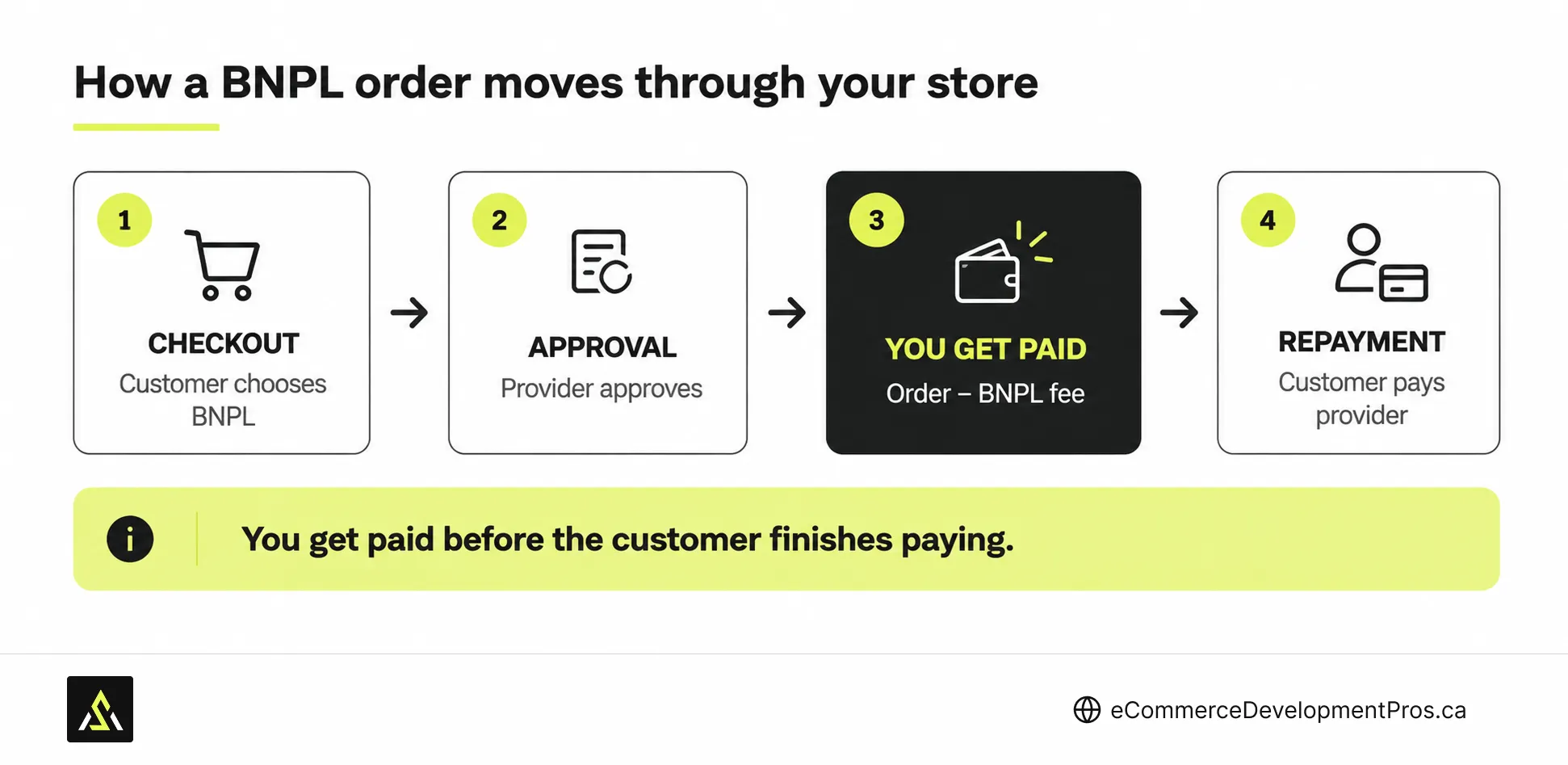
The table describes what happens on the customer side. For the merchant, the process is different:
- The customer chooses BNPL at checkout. The provider checks eligibility and approves or declines the payment.
- You receive payment for the order, minus the applicable BNPL fee, according to the provider’s settlement terms. You don’t wait for the customer to complete all their instalments.
- The BNPL provider collects the remaining payments from the customer. You don’t manage the customer’s repayment schedule.
Which BNPL Providers Serve Canadian Stores
Major BNPL providers now serve Canadian stores, but their purchase limits and financing options vary significantly. A store selling $80 CAD gifts and one selling $3,000 CAD furniture may not need the same provider.
|
Provider |
Merchant fee |
Eligible purchase amount |
|---|---|---|
|
Shop Pay Installments |
~5.9% + 30¢ (varies by merchant) |
$35 – $30,000 CAD |
|
PayPal Pay Later |
4.90% + fixed fee |
Pay in 4: $10–$2,000 CAD; Pay Monthly: $49–$10,000 CAD* |
|
Klarna |
~5.99% + 30¢* |
Varies by plan and customer eligibility |
|
Sezzle |
6.1% + $0.30 standard rate |
Varies by customer and merchant |
|
Afterpay (Clearpay) |
~6% + 30¢* |
Varies by customer spending limit |
|
Affirm (standalone) |
~5.99–6% + 30¢* |
$50 minimum; up to $10,000 standard financing limit** |
*Not published. Reported US rates, negotiated per merchant and lower at high volume — confirm yours in writing.
**Affirm’s standard financing limit is $10,000 CAD. Larger eligible purchases may require the customer to pay the difference upfront.
Match Your BNPL Provider to What Customers Spend
Start with your average order value and order distribution. If most customers spend $80, a $10,000 financing limit isn’t much of an advantage. If you regularly sell $1,000–$3,000 products, higher limits and longer monthly payment options matter more.
EDP Insight
Before choosing a provider, pull your last 90 days of Shopify orders and see where most order values fall. Then compare the fees, purchase limits, and payment options of providers that fit that range.
Does Buy Now, Pay Later (BNPL) Increase Sales?
BNPL can increase sales, conversion rates and average order value, but the results vary by store. It works when giving customers the option to spread out payments helps them complete a purchase or spend more than they otherwise would.
According to Shopify’s data on Shop Pay Installments, one in four merchants saw a 50% increase in average order value, while merchants that switched from a third-party installment solution saw 28% fewer abandoned carts. These are Shopify-reported results and should not be treated as typical results for every store.
What Do Returns Really Do to Your BNPL Cost?
Returns can make BNPL cost more than the headline fee. With Shop Pay Installments, Shopify states that when an order is refunded, the transaction fee isn’t returned to the merchant.
Take $100,000 CAD in BNPL sales at an illustrative 5.9% fee, with a 19.3% online return rate as estimated by NRF for 2025.
|
BNPL Example |
Amount |
|---|---|
|
Gross Sales |
$100,000 |
|
Fees paid on gross BNPL volume |
$5,900 CAD |
|
Revenue refunded at a 19.3% return rate |
$19,300 CAD |
|
Fees recovered on those refunds |
$0 |
|
Sales retained after returns |
$80,700 CAD |
|
Effective fee on revenue you keep |
7.3% |
The headline BNPL fee is 5.9%. But because transaction fees aren’t refunded on returned orders, the effective fee on the sales you actually keep rises to 7.3%.
Calculate Your Effective BNPL Cost
Your actual cost depends on your BNPL sales, provider fee and return rate. Use the calculator below to see how returns can change your effective BNPL fee.
Free tool
BNPL Returns Cost Calculator
What do returns really cost you on BNPL?
BNPL fees aren’t refunded when an order comes back. See what that does to the rate you actually pay.
Shopify Analytics → sales by payment method.
Not in your admin — check your provider agreement.
Enter your BNPL sales and fee to see your real rate.
BNPL fees you pay
$5,900Fees paid on returned orders
$1,139Real fee after returns
7.3%19.3% benchmark: NRF and Happy Returns, 2025 Retail Returns Landscape. Book a strategy call
When BNPL May NOT Be Worth It for Your Store
BNPL doesn’t make sense for every store. The higher payment fee has to generate enough additional sales or larger orders to justify the cost.
|
Your situation |
Why BNPL may not be worth it |
|---|---|
|
Thin margins |
The fee is charged on the order value, not your profit, so it takes a larger share of profit on lower-margin orders. |
|
Low average order value |
A fixed per-transaction component plus a higher percentage rate takes a bigger bite out of small orders, and several providers set minimum purchase amounts. |
|
High return rate |
Unrecovered transaction fees on returned orders can push your effective BNPL cost above the headline rate. |
|
Primarily B2B sales |
Buyers using purchase orders, invoicing, or net terms have little need for consumer instalment plans. |
|
Ineligible products |
Some providers restrict certain products. For example, Shop Pay Installments excludes gift cards and subscription products. |
The three numbers to watch most closely are:
- Average order value
- Gross margin
- Return rate
Together, they tell you more about whether BNPL makes financial sense for your store than simply looking at whether competitors offer it.
If BNPL isn’t lifting conversion or order value enough to cover its cost, the payment option probably isn’t the problem. Something earlier is losing people — product pages, shipping costs, checkout friction. Our Shopify CRO services find out which.
BNPL vs. Traditional Payment Methods
BNPL and traditional card payments both let customers complete a purchase, but the economics and payment experience are different.
|
Aspect |
Traditional card payment |
Buy Now, Pay Later |
|---|---|---|
|
Customer payment |
Full purchase amount paid at checkout |
Purchase split into instalments |
|
Merchant fee |
Typically 2–3% |
Typically 5–8% |
|
Repayment risk |
Merchant carries chargeback and fraud exposure |
Provider funds you upfront and pursues collection |
|
Returns |
Refund processing and fees depend on your payment processor |
Some BNPL transaction fees may not be returned after a refund |
|
Disputes |
Handled through your Shopify admin and payment processor Handled according to your card or payment processor’s dispute process |
Process varies by BNPL provider |
|
Customer experience |
Customer pays the full amount now |
Customer can spread the purchase cost over time |
|
Effect on basket |
Price objection at checkout on higher-ticket items |
Instalment framing reduces it |
Should You Offer BNPL Year-Round or Only During the Holiday Season?
If BNPL works for your store, run it year-round. Switching it on for November and off in January means paying integration costs for a two-month window.
The holidays make BNPL more visible, not more viable. More people reach for instalments when they’re buying under time pressure, but that doesn’t change whether the fee is worth paying — your margin and return rate decide that, and those don’t move because it’s December.
Why Can BNPL Be More Useful During Black Friday and the Holidays?
Holiday shoppers are often making several purchases within a short period, which can make the option to spread out payments more useful. That shows up in the spending data: Adobe Analytics recorded $20 billion in U.S. online BNPL spending between November 1 and December 31, 2025, up 9.8% year over year. Cyber Monday alone accounted for $1.03 billion.
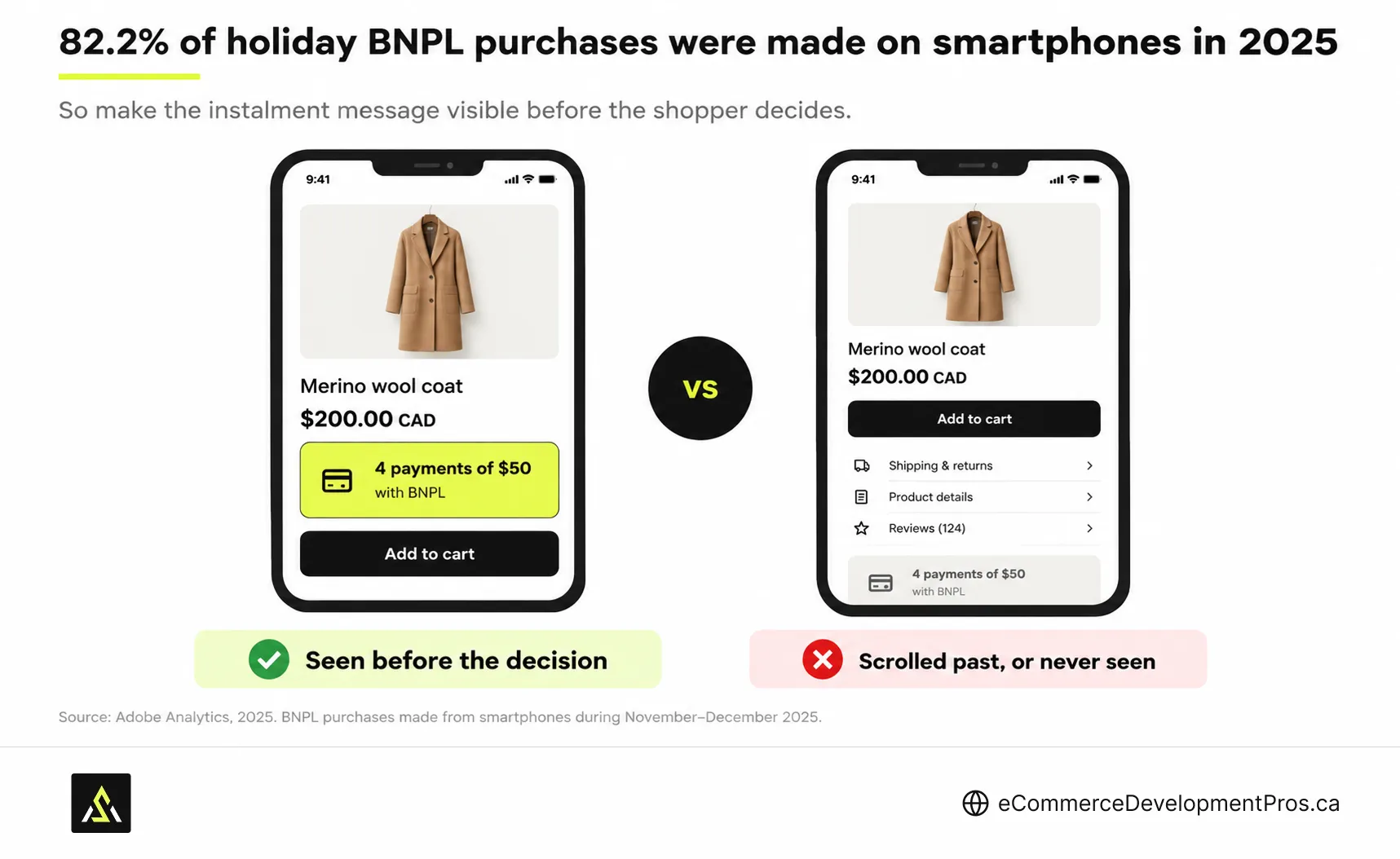
Most of that buying happens on a phone. Adobe found 82.2% of holiday BNPL purchases in 2025 came from smartphones. So if you’re promoting BNPL during Black Friday, make sure it’s easy to spot on a phone — not buried below the buy button.
BNPL can also complement your holiday offers rather than relying on deeper discounts alone. It gives customers another way to manage the purchase price while you protect more of your margin. Checkout is only one stage of that journey, though — our Shopify marketing strategy guide covers how the stages before it, from content to product pages, decide whether shoppers reach checkout ready to buy.
BNPL Frequently Asked Questions
What does Shop Pay Installments cost the merchant?
Shopify doesn’t publish the rate — it’s set per store. Third-party estimates cluster around 5.9% + $0.30 per order, with merchant reports as high as 7.99% + $0.30. The fee replaces your standard Shopify Payments card rate on instalment orders rather than adding to it, and it’s charged once per order, not per instalment.
Does using BNPL affect a customer’s credit?
Yes, BNPL can affect a customer’s credit, depending on the provider and payment plan. Affirm reports all loans issued from April 1, 2025, including Pay in 4, to Experian, and that extends to Shop Pay Installments. Creating an account doesn’t affect a score, but making a purchase and the subsequent payment history can.
Is BNPL interest-free for customers?
Pay-in-four plans are interest-free when payments are made on time. Longer financing isn’t — Shop Pay Installments monthly plans in Canada run 0–31.99% APR depending on the customer’s eligibility. Only describe your instalment option as interest-free if you mean the short plans.
What happens to the merchant fee when a BNPL order is refunded?
With Shop Pay Installments, the transaction fee isn’t returned when you refund an order. The customer’s payment plan is adjusted by the provider, but the fee you already paid stays paid. The same applies with Affirm and with standard card processing, so it isn’t a Shopify quirk — check your agreement for the provider you use.
Which BNPL providers work with Shopify stores in Canada?
Canadian Shopify merchants can use Shop Pay Installments, PayPal Pay Later , Klarna, Sezzle, Afterpay, and Affirm. Order limits run from $30 CAD at the low end to $30,000 CAD on Shop Pay Installments, so the right choice mostly comes down to what your products cost. Shop Pay Installments is the only one that needs no app.
Which products can’t use BNPL?
On Shop Pay Installments, gift cards and subscription products are excluded, and you can’t opt individual products in or out — it applies to everything in the eligible price range. Other providers commonly restrict digital goods, alcohol, and gambling-related products.
What happens if a customer stops making BNPL payments?
If a customer stops paying, the BNPL provider collects the remaining instalments. The merchant keeps the settlement already received. Afterpay and Klarna charge late fees up to 25% of the purchase amount; Shop Pay Installments charges none.

Not sure BNPL is your conversion problem?
Payment options are only one part of conversion. Before paying a higher transaction fee on BNPL orders, it’s worth knowing whether checkout friction, product page clarity, or another part of the buying experience is costing you more.