



 647-812-5125
 Summarize with AI



Shopify AI visibility means your store can be found by AI systems, understood for what it sells, trusted enough to recommend, and now, with agentic commerce, purchased on a shopper’s behalf. It goes beyond SEO. This guide covers the four disciplines every Shopify store needs to master in 2026:
- AEO (Answer Engine Optimization) — making your content usable in AI-generated answers
- GEO (Generative Engine Optimization) — getting your brand cited and recommended by AI
- AIO (AI Optimization) — making your store technically readable and trustworthy
- Agentic Commerce Readiness — enabling AI agents to actually purchase from your store
Most Shopify stores are optimized for the old version of search. This guide explains what the new version looks like — and what to do about it.
What Does AI Visibility Actually Mean for a Shopify Store?
Most Shopify stores today are built to rank on Google. Optimize the page, target the right keyword, earn some backlinks, get to page one — and traffic follows.
That model still works. But it’s no longer the full picture.
A growing number of shoppers now discover products through AI tools — ChatGPT, Google AI Overviews, Perplexity, Gemini — before they ever visit a traditional search result. They’re not clicking through ten blue links. They’re reading a generated answer, and either acting on it or asking a follow-up question.
That shift changes what visibility actually means.
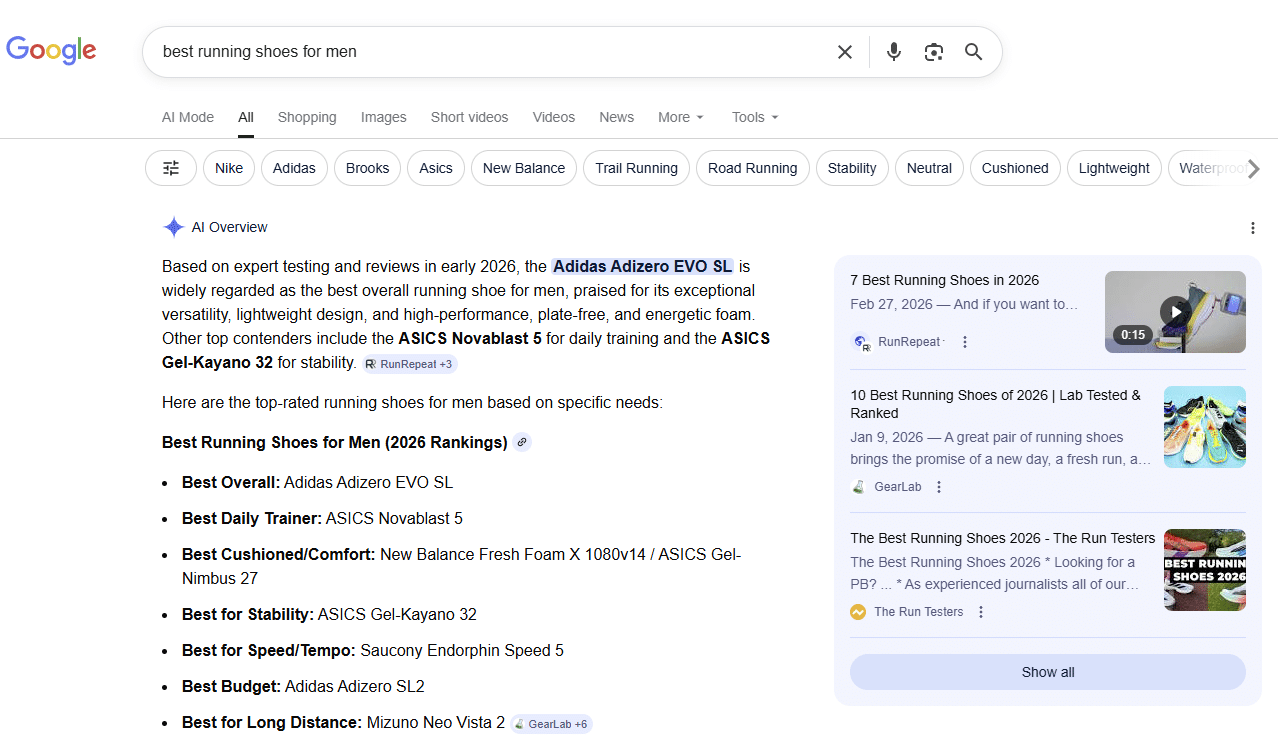
Example: Google AI Overview summarizing product recommendations instead of showing traditional search results.
In plain terms: three things now have to be true
- Your store can be found — AI systems can crawl and index your content
- Your store can be understood — AI can extract what you sell, who it’s for, and why it matters
- Your store can be trusted — AI has enough external signals to cite you as a reliable source
If any of those three fail, your store doesn’t appear in AI-generated responses — even if it ranks on page one of Google.
And in 2026, a fourth condition is emerging
Shopify launched its Agentic storefronts channel in March 2026. AI agents — powered by tools like ChatGPT and other LLM-based assistants — can now browse Shopify stores, compare products, and complete purchases on behalf of users. No human clicking required.
That adds a fourth requirement:
- Your store can be purchased from — AI agents can navigate product pages, read structured data, and complete a transaction without friction
One simple way to think about it
- Traditional SEO gets you ranked
- AI visibility (AEO + GEO + AIO) gets you recommended
- Agentic readiness gets you purchased — even when no human is actively shopping
The stores that win over the next two years will master all three levels.
Why Traditional SEO Alone Is No Longer Enough
For years, Shopify’s growth had one playbook: rank on Google. Target keywords, optimize pages, build links, and reach page one.
That playbook is still valid — but it’s now table stakes, not a competitive advantage.
The shift is in how users ask questions. Instead of typing short keyword phrases, they’re asking full questions — inside AI tools, not search bars:
Instead of: “running shoes men”
They’re asking: “What are the best running shoes for flat feet that work well for long distances?”
Instead of: “protein powder”
They’re asking: “Which protein powder is cleanest for someone with a dairy sensitivity who works out 3x a week?”
AI tools generate direct answers to those questions — pulling from sources they consider clear, reliable, and relevant. If your content doesn’t match how those questions are phrased, and if your store doesn’t have theauthority signals AI looks for, you won’t be included.
This is what “AI visibility” means in practice — and why stores that only optimize for traditional SEO are increasingly invisible to a growing portion of their potential customers.
Understanding the Four Disciplines: AEO, GEO, AIO & Agentic Commerce
These four terms get used interchangeably online, which creates a lot of confusion. Here’s what they actually mean — and how they work together for Shopify stores.

The New Shopify Visibility Stack (2026): From Rankings to AI Recommendations to Agentic Purchases
What Is Answer Engine Optimization (AEO)?
AEO is about making your content usable as an answer — not just rankable as a page.
AI tools don’t just rank pages. They extract information from pages and reconstruct it into a response. For that to work, your content needs to be written in a way that’s easy to extract and repurpose.
For a Shopify store, AEO shows up in:
- Product descriptions that explain use cases, not just specs
- Category pages that help users make decisions, not just browse
- Blog content that mirrors how customers actually ask questions
- FAQ sections that answer the exact questions AI tools are looking to resolve
In our experience building Shopify stores, most product pages are written for humans scanning visually — not for AI systems trying to extract meaning. That gap is where the AEO opportunity lives.
What Is Generative Engine Optimization (GEO)?
If AEO is about how your content is written, GEO is about whether your brand gets selected in the first place.
AI tools don’t just look for clear content. They look for sources they can trust. GEO is about building the signals that tell AI: this brand is credible, consistent, and worth recommending.
GEO is influenced by:
- How consistently your brand is described across the web
- External mentions — press, directories, forums, industry sites
- Reviews and user-generated content that validate your products
- Backlinks from relevant, authoritative sources
Many smaller Shopify stores have great content but weak GEO signals. The result: they have the right answers, but AI doesn’t know to trust them enough to cite them.
What Is AI Optimization (AIO)?
AIO is the combined view. It’s what happens when AEO, GEO, and technical performance all work together — so your store becomes something AI systems can confidently discover, understand, and reference.
In practical terms, AIO means:
- Content clarity (AEO layer)
- Brand authority (GEO layer)
- Technical accessibility — schema, speed, structure, crawlability
When all three align, your store stops being just another ecommerce website and becomes a source AI tools actively rely on.
What Is Agentic Commerce?
This is the newest shift — and the one most Shopify store owners haven’t planned for yet.
Agentic commerce means AI agents don’t just recommend products. They shop. An AI agent, acting on behalf of a user, can browse your Shopify store, evaluate products, compare options, add to cart, and complete a purchase — without the user ever clicking through your store manually.
This is what Shopify built the agentic channel to enable. The implications are significant:
- If your product data isn’t fully structured, an agent can’t reliably evaluate your products
- If your checkout has friction points that an agent can’t navigate, the purchase fails
- If your pricing or inventory data isn’t real-time accurate, the agent moves on
The key distinction from AI visibility: a store can be AI-visible but not agent-ready. Being recommended is one thing. Being purchased through an agentic workflow is another.
|
Discipline |
Primary Goal |
Shopify Focus |
Success Metric |
|---|---|---|---|
|
SEO |
Rank pages in search results |
Keywords, backlinks, technical SEO |
Page rankings |
|
AEO |
Get content used in AI answers |
Content clarity, question-matching, and FAQ structure |
Being quoted or summarized in AI responses |
|
GEO |
Get brand cited and recommended |
External mentions, reviews, and brand consistency |
Being recommended or referenced by AI tools |
|
AIO |
Combine all three into one strategy |
Schema, speed, authority, content |
AI visibility across all platforms |
|
Agentic Readiness |
Enable AI agents to purchase from your store |
Structured data, checkout accessibility, and real-time inventory |
Completed transactions through an agentic channel |
How they build on each other:
- Without SEO: you’re hard to find
- Without AEO: you’re hard to use
- Without GEO: you’re hard to trust
- Without Agentic Readiness: you’re hard to buy from
How ChatGPT, Google AI, Perplexity & Gemini Actually Work — and Why It Matters
One of the biggest mistakes Shopify stores make is optimizing for “AI search” as if it were a single thing. It isn’t. ChatGPT, Google AI Overviews, Perplexity, and Gemini each discover and evaluate content differently. Understanding those differences helps you prioritize where to focus first.
|
Platform |
How It Discovers Your Store |
What to Prioritize |
|---|---|---|
|
ChatGPT (GPT-4o + SearchGPT) |
Training data + live web browsing for current queries. Favors brands that are consistently described across many sources over time. |
Content quality, external brand mentions, and long-term GEO signals. Be described the same way everywhere online. |
|
Google AI Overviews (SGE) |
Deep integration with Google’s search index. Strongly favors pages that already rank on Google + E-E-A-T signals. |
Your existing SEO foundation + structured data + Experience/Expertise signals. Strong Google rankings = AI Overview candidate. |
|
Perplexity AI |
Live web crawling on every single query. Highly citation-heavy — it actively links to the sources it pulls from. |
Technical accessibility, crawlability, fast load speed. If Perplexity can’t scrape you cleanly in real time, you won’t appear. |
|
Gemini |
Tightly integrated with Google’s Knowledge Graph. Strong entity recognition — it knows brands that appear consistently and authoritatively. |
Entity SEO — consistent brand name, description, and category across Google Business Profile, structured data, and third-party mentions. |
You don’t need four separate strategies. The fundamentals overlap almost entirely.
Where it gets interesting is the timeline.
- If you have reasonable SEO already, Google AI Overviews are your fastest win.
- Perplexity is mostly a technical problem — sort out crawlability and speed, and you’re largely there.
- ChatGPT and Gemini are different; they reward brands that have been consistently visible across the web for a while. That one takes time, not just optimization.

AI Platforms That Drive Shopify Visibility: ChatGPT vs Gemini vs Perplexity vs Google AI Overviews
How AI Systems Evaluate Your Shopify Store
When a user asks an AI tool for a product recommendation, the AI doesn’t pick a store at random. It evaluates sources based on a consistent set of signals. Here’s what those signals are — and where most Shopify stores fall short on each one.
1. Content Understanding — What Is This Store About?
If a product page is vague or generic, AI has nothing solid to work with. It may crawl the page — but it won’t confidently use it in an answer.
Pages that perform well in AI answers typically do three things:
- Explain clearly what the product is and what it does — not just its features
- Define who the product is for — specific use cases, not generic audiences
- Provide context that helps a shopper make a decision, not just a purchase
In practice, we see this break down most often on collection pages. Product pages at least have specs and images. Collection pages often say almost nothing about what makes a category relevant or how to choose within it — and AI can’t use a page it can’t understand.
2. Data Signals — Can AI Extract What It Needs?
Content clarity tells AI what your store is about. Data structure tells it whether to trust what it found.
AI systems need to extract specific information quickly and reliably — product names, pricing, availability, variants, specifications. When that information is clean and consistent, it gets used. When it’s scattered or buried, AI moves on to a source that’s easier to work with.
The patterns we see most often across Shopify stores:
- A catalog where similar products are named differently — “Blue Wool Scarf” on one page, “Scarf – Blue – Wool” on another. To a human, obvious. To an AI parsing hundreds of pages, a reliability problem.
- Pricing mentioned inside a description paragraph rather than sitting in a defined price field
- Variants labeled “Option 1” and “Option 2” instead of “Size: Medium” and “Size: Large”
- Specs written in a different format on every product — some in bullet lists, some in paragraphs, some not at all
None of these feels like a big deal in isolation. Across a catalog of 50 or 100 products, they add up to a store that’s genuinely harder for AI to interpret than a competitor who simply kept things consistent.
3. Authority Signals — Why Should AI Trust This Source?
Content and data get you in the door. Trust is what keeps you there.
AI systems don’t just evaluate what your pages say about you — they look for what the rest of the web says. Links from relevant sites, brand mentions in articles and directories, consistent descriptions across platforms. External validation that your store is worth citing, not just indexing.
Reviews sit in their own category here. They add something no amount of brand-written copy can replicate — the actual words real customers use to describe your product. Not the polished version. The honest one. What worked, what surprised them, what they’d tell someone who asked.
That unfiltered language is exactly what AI systems use to understand a product beyond its official description. A page with 40 substantive reviews reads very differently to an AI than the same page with none.
4. Context Matching — Does Your Content Answer the Right Questions?
There’s an important distinction between ranking for a keyword and answering a question.
Traditional SEO pushed stores to optimize for “men’s running shoes.” But someone asking ChatGPT isn’t typing that — they’re asking “what’s the best running shoe for someone with knee problems who runs on pavement three times a week?”
Those are different problems requiring different content. A page optimized for the keyword has nothing useful to say to the question. A page written around the use case — who it’s for, when it applies, what problem it solves — does.
In practice this means writing product and collection content that addresses specific situations, not just general categories. A collection page titled “Men’s Running Shoes” with a one-line description isn’t answering anything. A collection page that explains who each shoe type suits — road running vs trail, high arch vs flat, beginner vs high mileage — is.
The more closely your content mirrors how customers actually describe their problem, the more surface area you have to match real queries.

How AI Systems Evaluate Your Shopify Store Product Pages
5. User Experience — What Happens After the Click
AI doesn’t operate in isolation from what users do on pages. If users consistently land and leave, that signal matters over time. Pages that help people find answers quickly — logical layout, clear information hierarchy, mobile-friendly — tend to also be the pages AI prefers to recommend.
This is where CRO and AI visibility directly overlap. A page that converts well usually communicates clearly and removes friction — which are also exactly the traits AI systems evaluate. From our experience withShopify CRO projects, the stores that see the biggest improvements in conversion rate are almost always the same ones that see the biggest improvements in AI visibility.
6. Entity Consistency — How AI Models Learn About Your Brand
Most stores focus on what’s on their website. Entity consistency is about what’s everywhere else.
AI models don’t learn about your brand from a single source. They build a picture over time — your website, Google Business Profile, industry directories, press mentions, social platforms, third-party reviews. When those sources are consistent, AI develops a confident understanding of who you are. When they contradict each other, that confidence erodes.
For smaller Shopify brands this is often the hidden reason they don’t get cited. The content is solid, the products are good — but the brand is described as a home goods store on one platform, a lifestyle brand on another, and a gift shop on a third. AI sees all of it, and when it can’t reconcile the picture, it defaults to a brand it understands more clearly.
The fix isn’t complicated. Define your business name format, primary category, and one-line value proposition — then make sure every platform uses the same language. It’s the closest thing to a machine-readable identity your brand has.
7. Agent Accessibility — Can AI Complete a Transaction?
This is the newest evaluation criterion, and it applies specifically to the Shopify Agentic sales channel.
An AI agent evaluating your store asks a different question than a human shopper:
Not “Is this easy to read?” But “Can I programmatically extract product data, compare variants, and complete a checkout without breaking?”
Stores that score well here have:
- Complete, machine-readable structured data on every product page
- Checkout flows without CAPTCHA or complex human-verification steps
- Accurate, real-time inventory and pricing — stale data causes agent failures
- Schema markup that explicitly describes all purchasable attributes
A store can rank well on Google, be cited by ChatGPT, and still fail this test — because agent-readiness is a separate technical layer that most stores haven’t addressed yet.
Why Most Shopify Stores Are Invisible in AI Search
Most Shopify stores aren’t being ignored because they’re bad. They were built for a different version of search — one that rewarded keyword optimization, page rankings, and click-through rates. That version of search isn’t gone, but it’s no longer sufficient.
Here are the seven reasons stores consistently fall through the cracks in AI search — and what each one looks like in practice.
1. Content That Sounds Right but Doesn’t Say Much
Ask yourself this: if someone landed on your best-selling product page with no prior knowledge of your brand, would they know within 30 seconds who it’s for and why they should choose it over a similar option?
For most Shopify stores, the honest answer is no. The page looks great. But the description restates what’s already in the title. The category page lists products without context. There’s no guidance on when to choose one option over another.
A human will scroll, click around, and eventually figure it out. AI won’t. If a page doesn’t clearly answer anything, it won’t be used to answer anything — and a competitor page that does will be used instead.
2. Optimized for Keywords, Not Questions
Traditional SEO pushed stores toward exact-match keyword optimization.
So pages end up targeting “men’s running shoes” — but that’s not how people interact with AI tools. They ask: “What running shoe is best for someone with knee issues who runs on pavement?”
Those are different problems requiring different content. If your content doesn’t address how people actually ask questions, it becomes very hard to match it to real AI queries.
This is the biggest structural gap between SEO-optimized and AI-optimized content.
3. Inconsistent Product Data
Most Shopify stores aren’t missing product data — it’s just inconsistent. Similar items named differently. Specs formatted in different ways across the catalog. Key details buried inside long description blocks. Variants labeled generically.
AI systems rely on patterns. When product data structure breaks — even slightly, even inconsistently — interpretation gets harder, and the store becomes less reliable as a source.
4. No External Signals
Many Shopify stores exist entirely within their own domain. No press mentions. No directory listings. No forum references. No external links.
Even strong content can fail to get cited when there’s nothing outside your store confirming it. This is especially common with newer brands — they have good products and decent content, but no GEO footprint.
5. Reviews That Are Missing or Underused
Some stores don’t collect reviews at all. Others have them, but they’re thin, generic, or buried. Both are missed opportunities.
Reviews add a layer of context that brand-written content can’t replicate — the authentic language customers use to describe a product — which is exactly what AI systems use to understand it beyond the official description.
6. Pages Designed to Look Good, Not Explain Clearly
Design often wins over information architecture. Key details get pushed below the fold. Important context gets hidden behind tabs or accordions. Content is broken into visual sections that look great but don’t read well.
A well-designed page that buries its most important information is still a poorly structured page from a machine-readability standpoint.
7. Nothing That Signals “This Is the Best Source on This Topic”
This is the hardest one to diagnose — and the most common.
A store can have decent content, some schema, a reasonable layout — and still not show up in AI results. Because nothing clearly signals depth of expertise or topical authority.
When everything is average, AI has no reason to choose your store over a competitor that’s even slightly more authoritative. Building topical clusters — like the AEO, GEO, AIO, and Agentic clusters we’re building on this site — is how you create that signal.

Is your store invisible in AI results?
If any of the above felt familiar, you’re not alone. These are fixable gaps — but they require looking at your store from a different angle than traditional SEO.
How to Improve Your Shopify Store’s AI Visibility: A Step-by-Step Process
Most improvements fall into a clear sequence. Trying to fix everything at once usually leads to scattered results. Here’s the order that produces the most impact, and what each step actually involves.

The 7-Step Shopify AI Visibility Process
Step 1: Start With Content Clarity
Everything else builds on this. Schema, internal linking, external signals — none of it compensates for content that doesn’t clearly explain what you sell and who it’s for.
Start with your highest-traffic product and collection pages. Read them as if you know nothing about your brand. Ask three questions:
- Does this description explain when and why someone would choose this product — or just what it is?
- Does this collection page help someone decide, or just show them options?
- Would AI understand who this is for and what problem it solves?
If the answer to any of those is uncertain, that’s where to start. A content clarity problem and an AI visibility problem are almost always the same problem — and fixing one fixes both.
Step 2: Standardize Your Product Data
Look across your catalog — not one page at a time. You’re checking for:
- Consistent naming conventions across similar products
- Specs written in the same format across the catalog
- Variants labeled with actual attributes, not generic labels
- Key information (price, availability, material) visible at the page level, not buried
Small inconsistencies in isolation seem harmless. Across a catalog of 50+ products, they accumulate into real AI visibility problems.
Step 3: Add and Verify Structured Data (Schema)
A well-written product description helps humans understand your product. Schema helps AI systems extract it — cleanly, reliably, at scale. Without it, even strong product content requires AI to make inferences about what the data means. Those inferences introduce uncertainty, and uncertainty reduces citation likelihood.
For every product page, implement at minimum:
- Product schema — name, description, brand, SKU, image URL
- Offer schema — price, availability, currency, priceValidUntil
- AggregateRating schema — star rating and review count, if you have reviews
- BreadcrumbList schema — for category navigation context
Once implemented, verify with Google’s Rich Results Test — on your actual product pages, not just the homepage. An incomplete schema is almost as unhelpful as no schema. A missing priceValidUntil or a review count of zero signals unreliable data to the exact systems you’re trying to impress.
On Shopify, schema can be added through theme code, a structured data app, or custom Liquid in your product template. Our Shopify SEO checklist covers the full setup.
Step 4: Build Internal Connection
Your store should guide both users and AI through a logical structure:
- Products link to their parent collection
- Collections explain what makes that group relevant and how to choose within it
- Blog content links to relevant products and collections
- Each piece of content connects to at least 2–3 related pieces
When pages are connected properly, the store becomes much easier to understand as a whole — not just as isolated pages.
Check out our guide with more information on how internal linking supports AI visibility and enhances SEO.
Step 5: Build External Signals (GEO)
Make sure your brand has a footprint beyond your own domain:
- Consistent Google Business Profile with accurate category and description
- Listings in relevant industry directories
- Brand mentions from partner sites, press, or industry publications
- Social platforms with a consistent brand name and description
This doesn’t require a PR campaign. Even small, consistent signals compound over time into the entity recognition that drives AI citation.
Step 6: Collect and Leverage Reviews
Most stores treat reviews as social proof for humans. They’re also one of the strongest AI visibility signals on your entire site — if you’re collecting the right kind.
The specific language customers use — use cases, comparisons, results — is something brand-written copy can’t replicate. It’s also exactly what AI uses to evaluate a product beyond its official description. One honest review that says “I bought this for hiking with bad knees and it’s the only thing that’s helped” does more for AI visibility than a perfectly optimised product description.
Ask for written reviews, not just ratings. A single follow-up question in your review prompt — “What would you tell a friend about this product?” — dramatically improves the quality of what you get back. And make sure reviews are visible on the page — not hidden behind a tab or loaded dynamically. If AI can’t access review content on page load, it won’t factor it in.
Step 7: Prepare for Agentic Commerce
This step is new — and specific to the Shopify Agentic channel.
- Enable the Shopify Agentic Storefronts in your admin settings
- Audit your checkout flow for steps that require human interaction — CAPTCHA, complex verification, non-standard inputs
- Verify that the product schema includes all purchasable attributes (size, color, material, compatibility)
- Ensure pricing and inventory are accurate in real time across all variants
- Test whether the product data that an agent would parse accurately reflects what’s purchasable
Stores that complete this step early have a meaningful window before the majority of Shopify stores catch up. The agentic channel is new — the competitive landscape is still open.
Why Your Product Pages Play a Much Bigger Role Than You Think
Most store owners think of product pages as the final step.
Someone lands → checks details → decides → buys.
But in AI-driven search, product pages often play a role much earlier—sometimes before a user even visits your site.
AI tools rely on product pages to understand what you’re selling, compare options, and generate recommendations.
If those pages aren’t clear, detailed, and structured — your store may never be considered.
What a Real AI Product Query Looks Like
A user opens ChatGPT and asks: “Which protein powder is best for beginners who want something without artificial sweeteners?”

ChatGPT doesn’t return a list of links. It generates a response that:
- Names specific products and explain why they fit the query
- Describes who each product is for
- Notes trade-offs between options
The product pages that get included are the ones that provide that level of context. Not the ones with the best keywords.


What Makes a Product Page AI-Visible
- Explains when and why to choose this product — not just what it is
- Clearly defines who it’s for and who it isn’t for
- Highlights meaningful differences from similar options in your catalog
- Includes real customer reviews with substantive language
- Uses proper structured data so product attributes are machine-readable
Related Reading:
Full breakdown: Is your Shopify product page optimized for AI?
What Makes a Product Page Agent-Purchasable
Agent readiness goes further than AI visibility. An AI agent completing a purchase on behalf of a user needs to:
- Extract product attributes reliably — size, color, material, compatibility — all labeled specifically
- Identify and select the correct variant without ambiguity
- Confirm real-time availability and accurate pricing before initiating purchase
- Navigate to checkout without encountering steps that require human interaction
If any of those steps fail, the agent abandons the purchase and moves to a competitor store that’s easier to work with. It doesn’t retry.
Where Most Shopify Product Pages Fall Short
The most common pattern we see:
Stores using manufacturer-supplied descriptions or copying the same description structure across products. Multiple pages end up saying almost identical things.
For AI, identical-sounding pages have no clear winner. When it can’t differentiate between options on your store based on content quality, it picks based on authority signals — which tends to favor the larger brand.
The solution isn’t to game the algorithm. It’s to write product pages that actually explain your products better than anyone else does.
Reviews Add a Layer AI Actively Uses
Beyond brand-written content, AI can see how customers describe and evaluate products in their own words. That authentic language — the specific vocabulary real users use — makes a page more credible and more useful for both recommendation and purchase decisions.
A product page with 40 substantive reviews will almost always outperform an identical product page with zero reviews in AI evaluations — even if every other factor is equal.
This is Where Visibility — and Conversions — Improve Fastest.
Product pages are the highest-leverage place to invest in both AI visibility and conversion rate. The same improvements that make a page easier for AI to use also make it easier for shoppers to decide.
SEO vs AEO vs GEO vs Agentic Readiness — A Practical Comparison
|
Factor |
SEO |
AEO |
GEO |
Agentic Readiness |
|---|---|---|---|---|
|
Primary goal |
Rank pages in search results |
Get content used in AI answers |
Get brand cited by AI |
Enable AI agents to purchase from your store |
|
Focus |
Keywords, backlinks, technical SEO |
Content clarity, question-matching |
Brand authority, external signals |
Structured data, checkout accessibility, and real-time data |
|
Output |
Search rankings |
Being quoted/summarized in answers |
Being recommended or referenced |
Completed agent-initiated transactions |
|
Optimization type |
On-page + off-page SEO |
Content structure + formatting |
Brand mentions + entity consistency |
Schema + frictionless checkout + inventory accuracy |
|
Success looks like |
Page 1 rankings |
Appearing in ChatGPT/Perplexity responses |
Brand named in AI recommendations |
Store purchasable via the Shopify Agentic channel |
These aren’t competing approaches — they stack.
- SEO without AEO gets you ranked but not quoted.
- AEO without GEO gets your content noticed but not trusted.
- GEO without agentic readiness gets you recommended but not purchased.
The goal is to build all four layers.

How SEO, AEO, GEO & Agentic Commerce Work Together
How to Test Whether Your Shopify Store Is Visible in AI Search
You don’t need special tools for an initial assessment. A few structured checks give you a clear picture of where you stand — and what to fix first.
Test 1: Ask the Questions Your Customers Ask
The fastest way to understand where your store stands is to do what your customers are already doing.
Open ChatGPT (or any AI tool) and ask the questions your ideal customer would ask — not keyword searches, but actual questions:
- “What’s the best [product type] for [specific use case]?”
- “Which [product] is good for [customer profile]?”
- “What should I look for when buying [product]?”
Pay attention to two things: whether your category comes up at all, and whether your brand is mentioned within it. If your category shows up but your brand doesn’t — that’s your first visibility gap. It means AI understands the space you’re in, but doesn’t consider your store a reliable enough source to cite.
Note: Are your products or brand mentioned? If your category shows up but your brand doesn’t — that’s your first AI visibility gap.
Test 2: Look at How Your Category Is Being Described
Separately from your products, study how the AI describes your product category.
- Which features come up repeatedly?
- What benefits are emphasized?
- What language is used?
Now compare that to your own product pages. If your content doesn’t match that level of clarity and specificity — it explains why you’re not being selected.
Test 3: Run Platform-Specific Tests
Test the same query on ChatGPT, Perplexity, Google (for AI Overviews), and Gemini separately. Your results will differ — and each gap points to a different problem:
|
Not appearing in… |
Likely root cause |
What to fix first |
|---|---|---|
|
Perplexity |
Crawlability or page speed issues |
Technical accessibility audit |
|
Google AI Overviews |
Weak existing SEO or missing structured data |
SEO foundations + schema |
|
Gemini |
Inconsistent brand entity across the web |
Entity consistency across all platforms |
|
ChatGPT |
Thin content or weak external brand signals |
Content depth + GEO signals |
Test 4: Review Your Own Store Objectively
Go through your product pages and honestly ask:
- Would this page actually answer the question I just searched?
- Is it clear who this product is for?
- Is there enough context to make a decision without leaving the page?
If the honest answer is “not really” — that’s why you’re not being included. The page wasn’t written to answer questions. It was written to describe a product.
Test 5: Check Agent Accessibility
To assess agentic readiness specifically:
- Use Google’s Rich Results Test to verify Product schema is complete and error-free on your top 10 product pages
- Walk through your checkout as if you couldn’t interact with any UI element that requires human judgment — where would an agent fail?
- Check that pricing and availability shown on product pages match actual inventory in real time
- Look up the Shopify Agentic sales channel in your admin and check the configuration status
What to Do Next: A Prioritized Action Plan
Most of the stores we work with don’t need a full rebuild. They need a clear sequence — the right fixes in the right order, without trying to do everything at once.
Week 1–2: Quick Wins
Start with the changes that cost the least time and return the most signal:
- Rewrite your top 10 product descriptions to explain use cases, not just features
- Add FAQs to your top 5 collection pages
- Verify structured data on your top product pages using Google’s Rich Results Test
- Audit your Google Business Profile for accuracy and category consistency
Month 1: Foundation
Once the quick wins are in place, build the layer underneath them:
- Standardize product naming conventions across your full catalog
- Implement Product + Offer + AggregateRating schema across all product pages
- Build or improve internal linking between products, collections, and blog content
- Set up a system to collect written reviews, not just star ratings
If you want to go deeper on the SEO foundation that underpins all of this, our Shopify SEO guide covers it in full.
Month 2–3: Authority and Agentic
This is where the longer-term signals get built — and where most competitors won’t have gone yet:
- Build a GEO footprint: directories, partner mentions, industry references
- Create or expand your content cluster — the posts that link to and from this pillar
- Enable and configure the Shopify Agentic sales channel
- Audit your checkout for agent-blocking friction points
- Verify real-time inventory accuracy across all variants
Ongoing
- Revisit this pillar page and cluster posts when Shopify or AI platform behaviour changes
- Test new queries in AI tools quarterly — gaps appear as platforms evolve
- Add case examples and project observations to maintain E-E-A-T signals over time
Not Sure Where Your Store Stands?
We run an AI Commerce Readiness Audit for stores focused on Shopify AI optimization — covering product data clarity, schema completeness, AEO/GEO signals, entity consistency, and agentic commerce readiness. You get a clear breakdown of what’s wrong and the specific fixes that matter, not generic recommendations.
Common Questions About Shopify AI Visibility
How do I get my Shopify store to show up in ChatGPT?
There’s no single switch.
What consistently makes the difference is how easy your store is to understand and trust. Product pages that clearly explain what you sell, who it’s for, and why someone should choose it, backed by reviews and external signals, are far more likely to be included.
If your content is vague or generic, AI tools pass on it quickly.
If you’re not sure where your store stands, our Shopify AI services cover exactly these factors — and give you a clear picture of what to fix first.
Why is my Shopify store not showing up in AI search results?
In most cases, nothing is broken. It’s a combination of small gaps.
- Content that sounds fine but doesn’t answer specific questions
- Product data that’s slightly inconsistent across the catalog
- Very few external signals outside the store itself
- Pages built for visual appeal rather than information clarity
Individually, these don’t seem like a big deal. Together, they make a store easy to overlook.
What is Agentic Ecommerce, and how does it affect my Shopify store?
Agentic ecommerce means AI agents, powered by tools like ChatGPT, Gemini, or specialised shopping assistants, can browse and purchase from your store on behalf of users. The user doesn’t manually interact with your store; the agent does it for them.
Shopify launched Agentic Storefronts in March 2026 to support this. If your product data, schema, and checkout flow aren’t set up for agent accessibility, you’ll be passed over in favour of stores that are ready.
The opportunity window is open right now — most Shopify stores haven’t configured this yet.
If you want to know whether your store is ready today, our Shopify AI services audit covers agentic readiness as one of the first things we check.
Does SEO still matter for Shopify stores?
It does, and it’s the foundation that gets your store discoverable and indexed in the first place.
But landing in AI-generated answers takes more than rankings. It depends on content clarity, trust signals, structured data, and how consistently your brand is described across the web.
Think of SEO as the ground floor, with AEO, GEO, and agentic readiness built on top of it. You need the base before the upper floors hold any weight.
What is AEO in ecommerce?
AEO (Answer Engine Optimization) means writing content so that parts of it can be directly used in an AI-generated answer.
For Shopify, that means product descriptions and blog content that explain things clearly, answer real questions, and avoid generic descriptions.
If AI can lift a piece of your content and use it directly in a response, you’re doing AEO right.
How does Google AI decide which products to show?
Google AI Overviews don’t rank pages, they select them. The question Google is asking isn’t “which page scored highest?” but “which pages are clear, structured, and trusted enough to be useful in an answer?”
The selection criteria: content that matches query intent specifically, complete structured data, trust signals like reviews and external mentions, and strong existing organic rankings. If your pages already rank on Google, you’re already a candidate. The gap is usually content clarity and schema — not a separate AI strategy built from scratch.
Can smaller Shopify stores compete in AI search?
It often works in their favour. AI search is arguably fairer to smaller stores than traditional SEO has ever been.
Larger brands carry default authority that’s hard to compete with on Google. AI tools are more interested in whether your content actually answers the question. A smaller store with sharper descriptions, cleaner data, stronger reviews, and consistent brand signals can outperform a much larger competitor in AI recommendations.
Size matters less than how clearly you explain your products, how consistent your brand looks across the web, and whether AI has reason to trust you. Any store can build those.

Is your Shopify store ready for AI search — and agentic commerce?
Most stores we audit have the same handful of gaps: product content that’s too vague to be cited, inconsistent data that confuses AI systems, and no plan for the agentic channel. The fixes are usually more targeted than a full rebuild — but you need to know exactly where the gaps are first.