



 647-812-5125
 Back to Ecommerce Glossary
What Is Bundle Rate?
Bundle rate shows how often shoppers buy products as a bundle rather than individually. It looks at what portion of all orders include a bundled item.
What Counts as a Bundle in Ecommerce?
A bundle in ecommerce means selling more than one product together in a single offer. Stores use bundles to group items in different ways, depending on how customers buy.
- Fixed product bundles: include same products every single time
- Mix-and-match bundles: Customers pick products to build their own bundle
- Frequently bought together bundles: The store suggests items that shoppers often buy together
- Subscription bundles: Bundled products ship on a repeating schedule
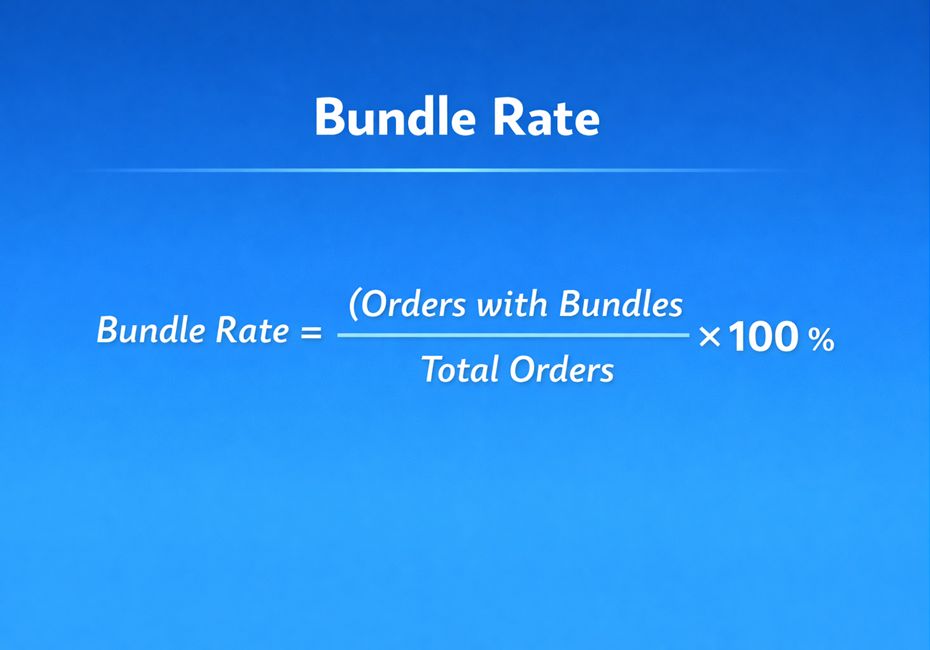
How Is Bundle Rate Calculated?
Bundle rate is calculated from order data over a specific time period.
Why Bundle Rate Matters for Online Stores?
The bundle rate shows whether customers choose grouped products instead of buying single items. It helps measure the success of your product bundles.
Why it’s important:
- Indicator of successful merchandising as customers buy more bundles
- Impact on Average Order Value (AOV): Bundles often increase how much customers spend per order
- Impact on Revenue per Visitor (RPV): More bundled orders usually raise revenue from each visitor
- Customer buying behaviour: Shows that customers are willing to buy multiple products together
How Is Bundle Rate Different From Average Order Value (AOV) and Upsell Rate?
Bundle rate, Average Order Value (AOV), and Upsell Rate track different parts of customer buying behaviour.
- Bundle rate shows whether customers choose grouped products.
- AOV shows how much they spend per order.
- Upsell rate shows whether customers accept add-on items.
Looking at them together helps explain how revenue grows, not just how much it grows.
Bundle rate, Average Order Value (AOV), and Upsell Rate Difference |
||||
|---|---|---|---|---|
|
Metric |
What it measures |
What it explains |
What it does not explain |
|
|
Bundle Rate (BR) |
Orders that include a bundled product |
How often customers choose bundles |
The value of individual orders |
|
|
Average Order Value (AOV) |
Average amount spent per order |
How much customers spend |
Why order value increase |
|
|
Upsell Rate (UR) |
Acceptance of add-on products |
Willingness to add extras |
Use of bundles |
|
|
Impact on revenue |
Multi-item purchases |
Higher order size |
Discount usage |
|
|
Common confusion |
Mistaken for discounts |
Assumed to explain AOV growth alone |
Interchangeable with upsells |
|
What Are the Common Reasons for a Low Bundle Rate?
A low bundle rate means customers are not choosing bundled products. This usually happens when bundles are hard to notice, hard to understand, or not appealing enough.
- Bundles not clearly visible: Customers do not see bundle options while browsing
- Poor perceived value or savings: The bundle does not feel worth choosing over single items
- Irrelevant product combinations: Products in the bundle do not make sense together
- Overly complex bundle setup: Too many steps or choices confuse customers
- Mobile user experience (UX) issues: Bundles are hard to view or select on mobile devices
- Lack of urgency or incentive: No clear reason to choose the bundle right now
How Can You Improve Bundle Rate?
Bundle rate improves when bundles are easy to see, easy to understand, and easy to select.
Key points to consider when creating product bundles:
- Group related products for a natural fit.
- Communicate savings to show the bundle’s advantage.
- Position strategically near purchase buttons.
- Use visual cues to connect items.
- Experiment constantly with design, text, and pricing.
- Design for mobile to simplify selection.
When Does Bundle Rate Become a Priority Metric?
Bundle rate becomes important when a store wants customers to buy more items per order. It helps show whether product groupings and bundle offers are actually working.
Bundle rate is especially useful when:
- Running efforts to grow average order value
- Scaling paid media and checking traffic quality
- Launching new products that rely on cross-selling
- Making CRO and merchandising improvements
- Running seasonal or promotional bundle campaigns