



 647-812-5125
 Summarize with AI


Client
Soccer City
Platform
X-Cart → Shopify
Timeline
5 Weeks
Location
Vancouver, BC
Executive Summary
Soccer City is a Vancouver-based soccer retailer serving both direct-to-consumer (DTC) shoppers and sports teams across Canada. After years of growth on X-Cart, the platform had become a bottleneck — limiting catalog management, slowing performance, and making day-to-day operations increasingly difficult to manage.
eCommerce Development Pros migrated Soccer City from X-Cart to Shopify Grow in five weeks, delivering a complete systems rebuild: a redesigned storefront, a clean catalog architecture for 2,000+ SKUs, AI-powered search and product recommendations, and a custom shared-inventory solution for their team store business — all with zero downtime and no significant impact to search rankings.
2,000+
SKUs Migrated
4,000+
Orders Migrated
5 Weeks
End-to-End Delivery
Zero
Downtime at Launch
The finished Soccer City storefront: soccercity.ca
About Soccer City
Soccer City is one of British Columbia’s leading specialty soccer retailers. Soccer City sells to two different kinds of buyers. There are the everyday shoppers — boots, balls, apparel, training gear — and there are the sports teams ordering branded kits, bags, and customized products in volume.
Most retailers only have to worry about one. Managing both from the same platform means a larger catalog, team-specific product pages, and inventory logic that has to work across multiple storefronts simultaneously. That operational weight adds up fast.
The Challenge: Outgrowing X-Cart
X-Cart had done the job for years. The problem was that Soccer City kept growing and the platform didn’t grow with them. No single breaking point — just a catalog that kept expanding, a team store model that kept getting more complicated, and a list of daily operational workarounds that kept getting longer.
The legacy X-Cart store — before migration
What was breaking down:
- Catalog management had become unmanageable. With over 2,000 SKUs and 100+ collections, organizing, updating, and merchandising products on X-Cart required significant manual effort and was increasingly error-prone.
- Platform performance could not keep pace with catalog size. Slow page loads were creating friction for shoppers and affecting the store’s ability to compete online.
- The team store model had no clean solution. Soccer City runs multiple team-specific storefronts where different teams can order the same underlying product — for example, an equipment bag — under their own branded page. On X-Cart, there was no way to link these products to shared inventory. Every sale on one team page required manual inventory updates across every other team page listing the same product. This was slow, error-prone, and not scalable.
- Day-to-day operations were consuming too much time. Staff were spending hours on tasks that should have been automated or streamlined, limiting the team’s ability to focus on growth.
- The spring season and the FIFA World Cup were approaching. Soccer City needed a fully operational new store live within four to five weeks — a non-negotiable deadline with real revenue consequences.
The Core Problem
The challenge was not simply migrating a store. It was rebuilding the operational foundation of a business — under a hard deadline, without disrupting live sales.
Why Shopify Grow
Shopify was the clear platform choice for Soccer City. No other platform offered the same combination of performance out of the box, ecosystem of apps for extending functionality, ease of catalog and merchandising management, and long-term scalability for a growing retailer.
Shopify Grow (formerly Shopify Advanced) specifically was selected to give Soccer City the flexibility and reporting capabilities needed to operate at their catalog size and transaction volume, while keeping the platform manageable for a non-technical team.
Our Approach: A Systems Rebuild, Not Just a Redesign
From the first scoping conversation, it was clear that Soccer City did not need a cosmetic upgrade. They needed a rebuilt foundation — one that could handle a large catalog cleanly, support a unique dual-audience business model, and eliminate the manual operational overhead that had built up on X-Cart.
The project was structured around five core workstreams, executed in parallel to hit the five-week delivery window.
1. Data Migration: Orders, Customers, and Catalog
We migrated the full historical record from X-Cart to Shopify including:
- 2,000+ SKUs with full metadata, variants, pricing, and imagery.
- 4,000+ orders with complete purchase history.
- Every X-Cart URL mapped to its Shopify equivalent before a single visitor hit the new store.
That last part matters more than people expect. Organic rankings are not easy to rebuild — missing redirects on a migration this size can quietly wipe out years of SEO work. We mapped them all.
The new store was built and tested while X-Cart stayed live. Cutover was a single controlled window. Zero downtime, no interrupted sales.
2. Catalog Architecture and Collection Structure
One of the most time-intensive parts of the project was rebuilding the catalog architecture. 2,000+ SKUs spread across 100+ collections is not a small catalog — and the way that catalog is organized directly affects whether customers can find what they are looking for.
We restructured collections and navigation from the ground up, with the goal of making large-catalog browsing fast and intuitive. Products were organized into a logical hierarchy that serves both the DTC shopper quickly filtering by position or brand, and the team buyer navigating to a specific team’s product range.
Rebuilt collection architecture — 2,000+ SKUs, filterable by position, brand, and size
3. AI-Powered Search and Product Recommendations
Two thousand products are a lot to navigate. A shopper looking for a size 8 goalkeeper boot in a specific brand should not have to work for it — and if they do, they leave.
We implemented AI-powered search and filtering across the full catalog, and configured product recommendations to surface relevant items across both the DTC and team store collections. Find the right product faster, see what goes with it without hunting — that is what moves conversion at this catalog size.
Design Principle
AI was not an add-on in this project. It was a core part of how discovery and merchandising work at scale — essential when you have 2,000+ products and two distinct customer audiences.
4. Custom Shared Inventory Logic for Team Stores
This was the most technically complex requirement of the project — and the one with the most direct impact on Soccer City’s daily operations.
Soccer City runs a network of team stores, each serving a specific sports team with branded product pages. Many of these team stores sell the same underlying products — for example, a training bag that is listed under a dozen different team pages simultaneously.
On X-Cart, there was no way to connect these product listings to a single source of inventory. When a bag sold from one team page, staff had to manually update the stock count on every other team page showing the same bag. With dozens of team stores and hundreds of shared products, inventory errors were a regular occurrence — and fixing them manually was eating into staff time that should have been going elsewhere.
We tried several apps before finding one that actually handled the full scope of what Soccer City needed. Getting it configured across their entire team store network took time. But it works the way it needs to: one inventory pool per product, feeding every team page that sells it, automatically.
- A sale on any team page immediately updates the shared inventory pool
- No manual stock adjustments needed across team pages
- Inventory errors caused by missed manual updates are eliminated
- Adding a new team store no longer requires duplicating inventory management overhead
This single feature change has a compounding effect on operations: the larger the team store network grows, the more time and error-risk is saved.
Soccer City’s team store network — each club gets its own branded page
Team store product page — inventory shared automatically across all club pages
5. Performance Optimization and Theme Customization
We selected a premium Shopify theme and customized it to handle Soccer City’s merchandising complexity without the performance cost that usually comes with it. A large catalog with lots of filters and imagery can make a fast platform feel slow if the theme isn’t built carefully. That was not a trade-off we were willing to make.
Results
Core Web Vitals: A Transformation
The most measurable outcome of the rebuild is the improvement in site performance. Core Web Vitals — Google’s framework for measuring real-world page experience — tell a clear story:
| Before: X-Cart | After: Shopify Grow |
| LCP: 4.5 seconds | LCP: 1.2 seconds |
| INP: 1,500ms | INP: 139ms |
| Core Web Vitals: FAILED | Core Web Vitals: PASSED |
Largest Contentful Paint (LCP) measures how long it takes for the main content of a page — the product image, the collection header — to actually appear. At 4.5 seconds on X-Cart, Soccer City was well outside Google’s recommended threshold of 2.5 seconds — meaning shoppers were waiting far too long for pages to become usable. The Shopify rebuild brought this to 1.2 seconds.
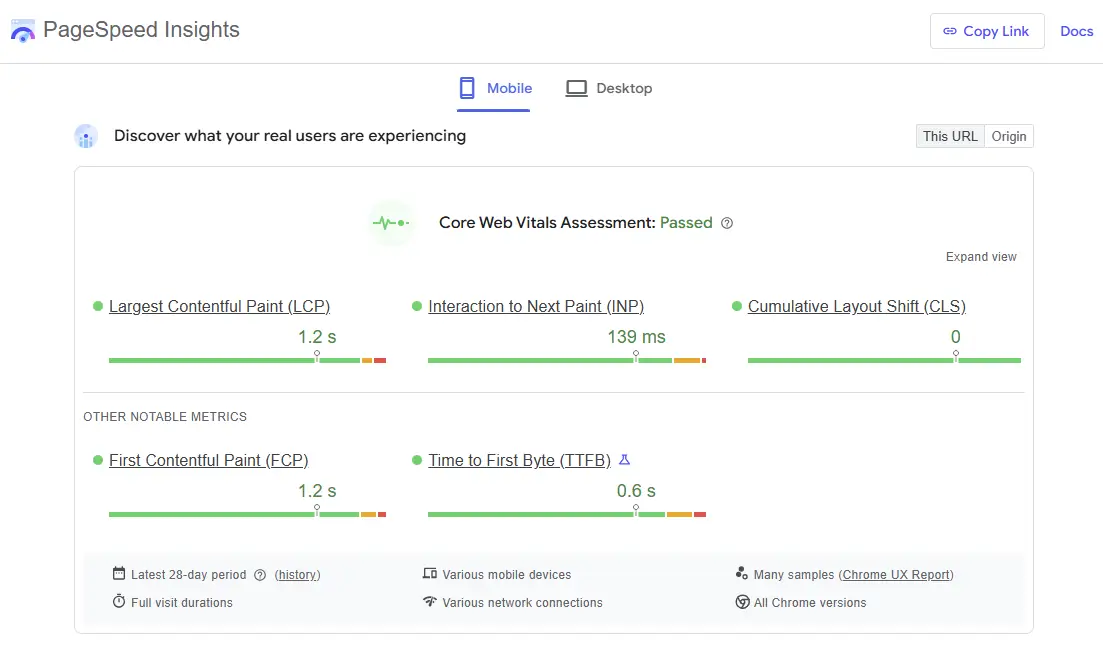
Core Web Vitals after migration — LCP 1.2s, INP 139ms, assessment passed
Interaction to Next Paint (INP) measures how quickly the page responds when a user clicks or taps — scrolling through products, selecting a size, adding to cart. At 1,500ms, the X-Cart store was failing this metric badly. Post-migration, INP dropped to 139ms: a response time that feels instantaneous to the user.
Why This Matters
An LCP improvement from 4.5s to 1.2s and an INP drop from 1,500ms to 139ms are not incremental gains. These are the kinds of performance improvements that directly reduce bounce rates, improve conversion rates, and signal to Google that the site deserves better rankings.
Engagement
Bounce rate dropped from 67% to 39%. Faster pages and cleaner navigation are the likely drivers — more visitors are staying long enough to actually find what they came for.
SEO Continuity
Rankings held. No significant drop post-launch. That outcome does not happen by accident on a migration this size — it happens because every X-Cart URL was mapped to its Shopify equivalent before the new store went live. Crawl errors, missing redirects, broken internal links — any of those can quietly erode rankings that took years to build. None of that happened here.
Operational Impact
The improvements that are harder to quantify are often the most valuable in practice:
- Team store inventory is now automated, eliminating a category of manual work and inventory errors that had been a persistent operational problem
- Catalog updates, collection management, and merchandising changes that previously required technical involvement can now be done directly in Shopify’s admin by non-technical staff
- The platform can accommodate continued catalog growth without degrading performance or manageability
Before vs. After: At a Glance
| Before: X-Cart | After: Shopify Grow |
| X-Cart — aging, inflexible platform | Shopify Grow — modern, scalable foundation |
| LCP: 4.5s, INP: 1,500ms (Core Web Vitals: FAIL) | LCP: 1.2s, INP: 139ms (Core Web Vitals: PASS) |
| Bounce rate: 67% | Bounce rate: 39% |
| 2,000+ SKUs in an unstructured, hard-to-manage catalog | Clean catalog architecture with AI-powered search & filters |
| Manual inventory updates across all team pages after every sale | Shared inventory logic — one sale updates all team pages automatically |
| X-Cart URL structure, redirects unmapped | Full redirect mapping, SEO rankings preserved |
| 4,000+ orders on legacy system only | Full order & customer history migrated to Shopify |
| Platform limiting daily operations and growth | Platform built to grow with the business |
How We Delivered in Five Weeks
A five-week timeline for a migration of this complexity is aggressive. Delivering it required three things working together:
- Process. We have a structured migration methodology that covers data migration, SEO, catalog architecture, app selection, testing, and cutover. Running workstreams in parallel — rather than sequentially — is what compresses the timeline without cutting corners.
- Team. Dedicated Shopify specialists, not a generalist agency splitting attention across five different platforms at once.
- Tooling. AI-assisted development and migration tooling handled the high-volume technical work — catalog restructuring, redirect mapping, QA — at a speed that would not have been possible manually.
The five-week delivery was not a compromise. The store that launched was fully built, tested, and optimized — not a minimum viable product that would require immediate follow-up work.
Is This Relevant to Your Business?
The Soccer City project is a strong reference point for any of the following:
- Retailers on X-Cart, WooCommerce, Magento, or another legacy platform who have outgrown it and are evaluating Shopify
- Mid-size retailers with large catalogs (500+ SKUs) who need a migration partner with experience managing complexity at scale
- Sports, outdoor, or specialty retailers with multi-audience business models — team buyers and direct consumers — who need a platform that can serve both without operational compromise
- Any retailer who needs a migration completed on a tight timeline without downtime or SEO risk
If your current platform is creating operational drag, limiting your ability to merchandise effectively, or underperforming on speed and search, the conversation is worth having.

Still Fighting Your Platform Every Day?
You shouldn’t have to. We migrate retailers to Shopify with zero downtime, protected SEO, and a process built for complex catalogs and tight timelines.
We’ve fixed that for Soccer City. We can fix it for your store, too.