



 647-812-5125
 Share
Share
 Share
Share
 Tweet
Tweet
 Email
Email
 Summarize with AI


What Does It Mean for a Shopify/eCommerce Store to Be Visible in ChatGPT and AI Search?
Most Shopify/eCommerce stores today are built to rank on Google.
But that’s no longer how many customers are discovering products.
A growing number of shoppers are discovering products through AI systems like ChatGPT, Google AI Overviews, and Perplexity—not by clicking through traditional search results, but by reading generated answers.
That shift changes what “visibility” actually means.
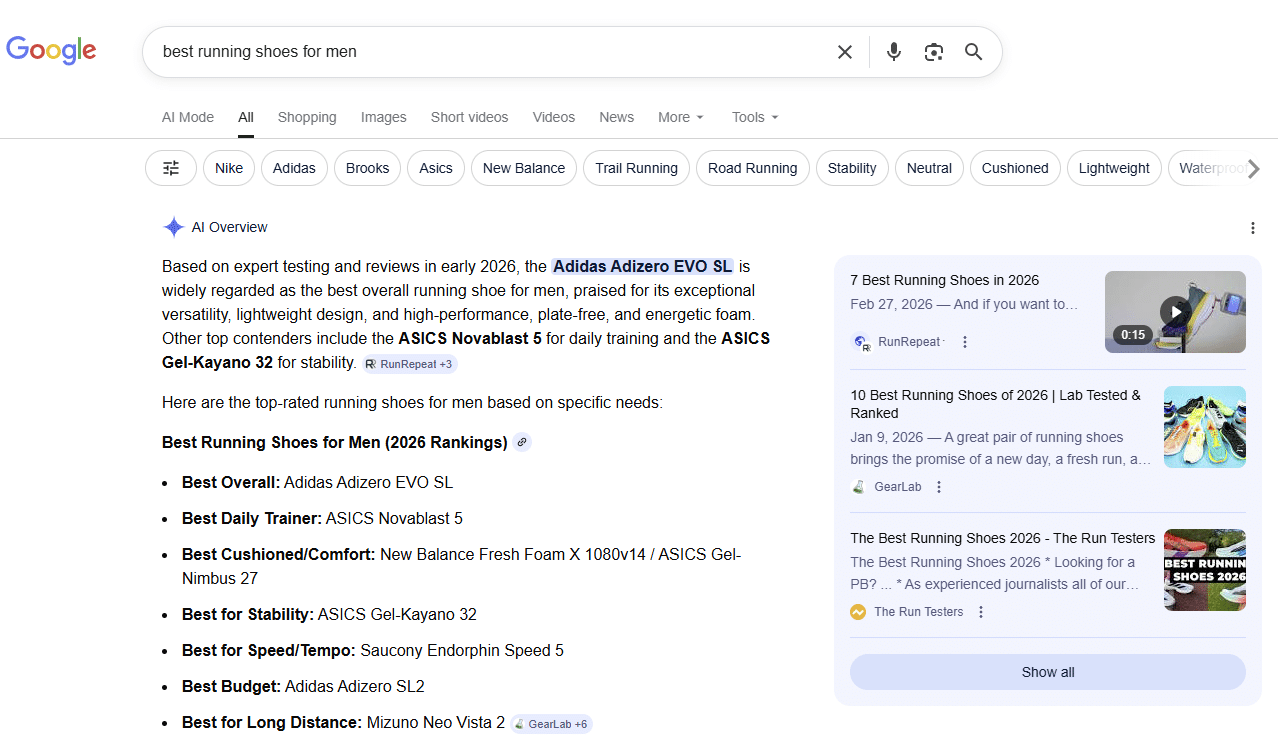
Example: Google AI Overview summarizing product recommendations instead of showing traditional search results.
So what does “AI visibility” actually mean now for your Shopify/eCommerce store?
In simple terms, Shopify AI Visibility means that when a Shopify store is considered visible in ChatGPT, Google AI, and other AI-driven search systems, its content can be:
- Found by AI systems
- Understood clearly (without guesswork)
- Trusted enough to be included in an answer
In other words, your store needs to be interpreted, validated, and selected as a reliable source when AI tools generate responses.
This goes beyond traditional SEO and includes how your store is structured, optimized, and positioned across different channels, including Shopify marketing strategies.
How AI systems decide what to show
Unlike Google’s traditional results (10 blue links), AI tools try to summarize the best possible answer.
To do that, they look for signals like:
- Clear product and content descriptions
If your product page is vague, AI simply skips it. - Structured and complete data
Pricing, availability, specs—AI prefers stores where this is easy to extract. - Context and meaning (not just keywords)
AI tries to understand what your product is, who it’s for, and when it’s relevant. - Trust signals
This includes backlinks, brand mentions, and, importantly, customer reviews.
Reviews give AI something it values highly: real user language and proof of use. - Site structure and internal linking
A well-connected store helps AI understand relationships between products, categories, and topics.
Why AI visibility for your Shopify store matters more than ever
Google has already started integrating AI-generated summaries directly into search results. Shopify itself is pushing AI tools for merchants through Shopify Magic and Sidekick, while ChatGPT is also expanding product discovery and shopping experiences.
That means:
- Users are getting answers without visiting multiple websites
- Fewer clicks are distributed across traditional search results
- Stores that are easier for AI to understand are more likely to be recommended
If your Shopify store isn’t optimized for this shift, it may not be considered at all—even if it ranks well today.
What happens when your store is visible in AI
When your Shopify/eCommerce store is properly structured for AI systems:
- Your products can appear inside AI-generated recommendations
- Your brand can be referenced when users ask for “best options.”
- You capture traffic earlier in the decision-making process
This isn’t just SEO anymore.
It’s about becoming a source that AI systems rely on.
One simple way to think about it
- Traditional SEO gets you ranked.
- AI visibility gets you recommended.
Why Traditional SEO Alone Is No Longer Enough for Shopify AI Visibility
For years, Shopify’s growth has been tied to one thing: ranking on Google.
- Optimize your pages.
- Target the right keywords.
- Build backlinks.
- Get to page one—and traffic follows.
That model still works. But it’s no longer complete.
Today, users are not just searching—they’re asking.
Instead of typing short keywords like “running shoes men,” they’re asking:
- “What are the best running shoes for flat feet?”
- “Which shoes are good for long-distance running?”
And increasingly, they’re asking these questions inside AI tools.
What’s changed in how results are delivered
Search engines and AI platforms are moving toward answer-first experiences:
- Google now shows AI-generated summaries (AI Overviews) above traditional results
- Tools like ChatGPT and Perplexity generate direct recommendations
- Users often get what they need without visiting multiple websites
This changes the game.
Because now, it’s NOT just about ranking—it’s about being included in the answer itself.
Google’s own guidance for AI search emphasizes creating unique, useful, satisfying content rather than relying on commodity pages alone.
Understanding AEO, GEO & AIO
We’re sure you are hearing new terms around this shift. Here’s what they actually mean in practice.
What Is Answer Engine Optimization (AEO)?
Answer Engine Optimization, or AEO, is about making your content easy for AI tools to pick up and use directly when they generate answers.
Think of it this way: instead of just trying to rank a page, you’re trying to make parts of your content usable as an answer itself.
That usually comes down to a few things:
- Explaining ideas clearly (no fluff or vague wording)
- Structuring content so it’s easy to scan
- Writing in a way that directly responds to real questions
For a Shopify/eCommerce store, this often shows up in places like:
- Product descriptions that actually explain use cases
- Collection pages that guide decisions
- Content that mirrors how customers ask questions
If AI can quickly understand what you’re saying, it’s far more likely to reuse it.
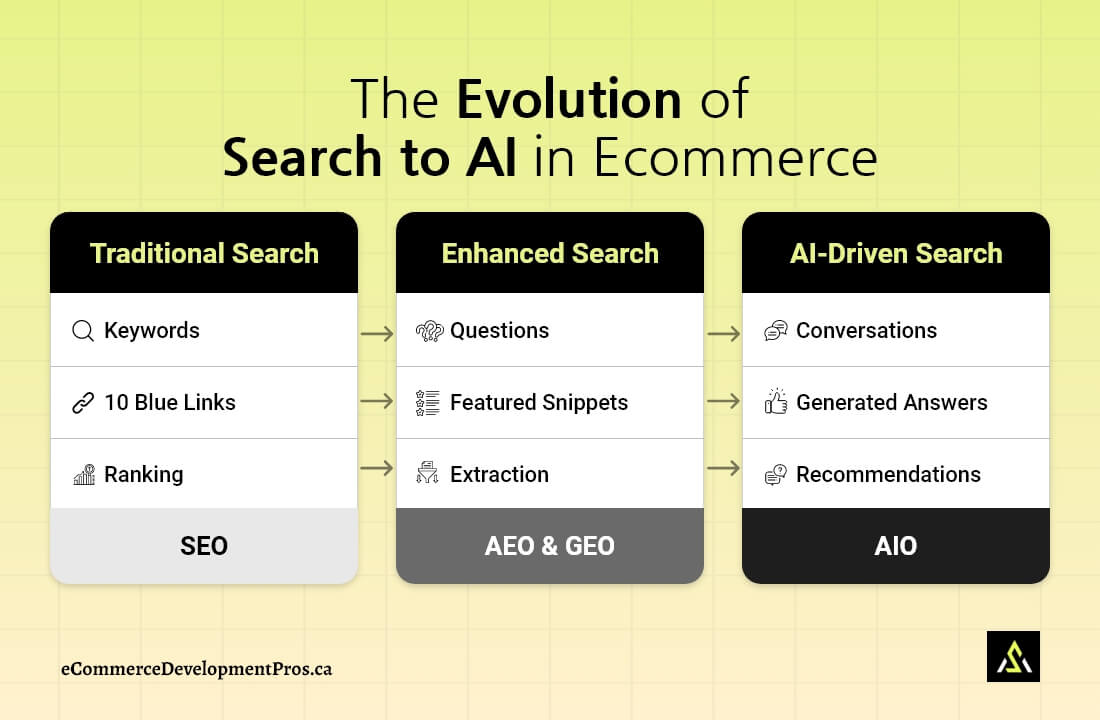
The evolution of search in ecommerce
What Is Generative Engine Optimization (GEO)?
If AEO is about how your content is written, GEO is about whether your store gets picked in the first place.
AI tools don’t just look for clear content—they look for sources they can trust.
That’s where GEO comes in.
It’s influenced by things like:
- How often your brand is mentioned across the web
- Whether your products and categories are consistently defined
- Signals that show credibility—like links, reviews, and references
For Shopify stores, GEO is what helps answer the question:
👉 “Should this brand be included in the response?”
You can have great content, but without these signals, AI may still skip over your store.
What Is AI Optimization (AIO)?
AIO is simply the bigger picture.
It’s what happens when everything starts working together—your content, your data, and your authority.
Instead of looking at AEO and GEO separately, AIO focuses on how your store performs as a whole:
- Is your content easy to understand?
- Is your store trustworthy?
- Is your data structured in a way that AI can access?
When those pieces are aligned, your store becomes much easier for AI systems to interpret and recommend.
In practical terms, AIO is what turns your Shopify store from just another eCommerce website into something AI tools can confidently use as a source.
SEO vs AEO vs GEO vs AIO — how they work together
Instead of replacing SEO, these approaches build on top of it.
- SEO helps your store get indexed and ranked
- AEO helps your content get extracted and reused
- GEO helps your brand get selected and referenced
- AIO brings everything together into a single strategy
This is not a shift away from SEO—it’s an expansion of it.
What this means for Shopify/eCommerce store owners
If your strategy is still focused only on traditional SEO:
- You may rank, but not be referenced
- You may get traffic, but miss early discovery
- You may be visible in search—but invisible in AI
On the other hand, stores that adapt to this shift:
- Show up in AI-generated answers
- Get recommended in conversational queries
- Capture demand earlier in the buying journey
What this shift really means
- SEO gets your store found in search results.
- AEO, GEO, and AIO, get your store included in answers.
How ChatGPT, Google AI & Perplexity Discover and Recommend Stores
When someone searches on Google, they get a list of results.
When someone asks a question in ChatGPT or sees a Google AI Overview, they get a generated answer.
That answer doesn’t come from a single website.
It’s built by analyzing multiple sources, comparing them, and selecting the ones that are clear, consistent, and trustworthy.
For Shopify store owners, this means one thing:
👉 Your store isn’t competing just for rankings anymore—it’s competing to be understood and selected by AI systems.
So, your Shopify store’s AI visibility is dependent on how well ChatGPT, Google AI & Perplexity can discover and recommend.
How AI Systems Evaluate Your Shopify Store
While each platform works differently, most AI systems follow a similar pattern when deciding what to include.
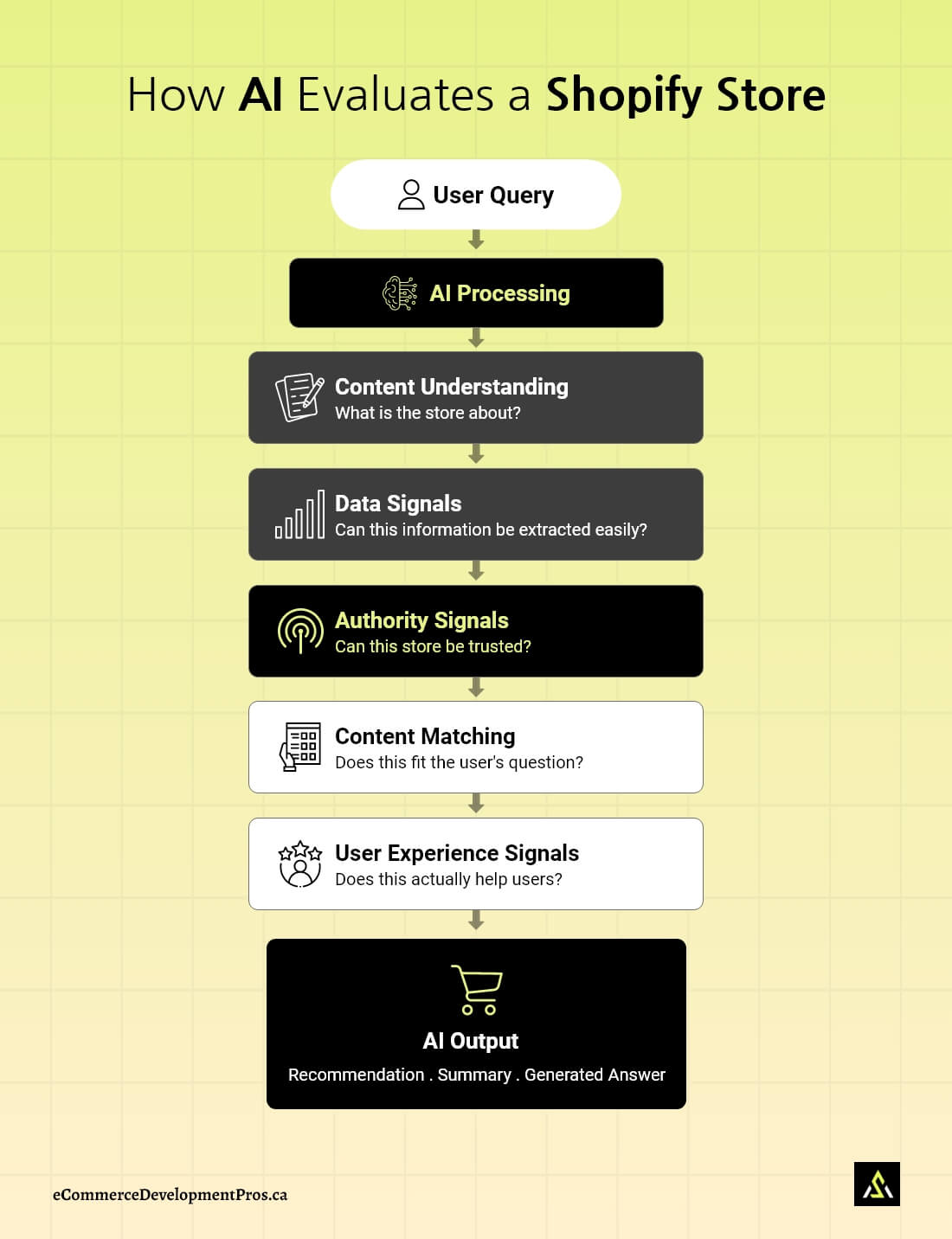
How AI platforms like ChatGPT and Google AI assess Shopify stores based on content, data, trust, and user experience signals.
1. Content Understanding (What is this store about?)
AI doesn’t “figure things out” the way a human would.
If a product page is vague, uses generic descriptions, or skips important context, the system has very little to work with. It may still crawl the page—but it won’t confidently use it in an answer.
Now compare that with a page that clearly explains:
- What the product is used for
- Who it’s designed for
- What makes it different
Those pages are far easier to interpret. And when something is easy to interpret, it’s far more likely to be reused.
That’s the difference between being indexed… and being selected.
2. Data signals — can AI actually pull the information it needs?
Once the meaning is clear, the next step is extraction.
AI systems look for structured, reliable details they can pick up quickly without guessing. Google uses structured data to understand page content and entities more clearly, which is one reason complete product and business markup matters.
This includes things like:
- product titles and descriptions
- pricing and stock status
- variants (size, color, etc.)
- specifications and attributes
- structured data (schema) behind the scenes
When this information is scattered, inconsistent, or missing, it creates friction.
For example:
- A product title says one thing, but the description says something slightly different
- Pricing is unclear or buried
- Variants aren’t labeled properly
These small gaps add up.
Stores that keep their product data clean, consistent, and complete are simply easier for AI systems to work with—and that often decides whether they’re included or ignored.
3. Authority signals — why trust matters more than ever
Even with perfect content and data, there’s still one big question:
👉 Can this store be trusted?
AI systems are cautious about what they include in answers. They don’t just look for information—they look for signals that others trust that information too.
This shows up in a few ways:
- links from relevant websites
- mentions of your brand outside your store
- consistency in how your products are described across platforms
- customer feedback and ratings
Reviews play a bigger role here than most people realize.
They don’t just help conversions—they help AI understand:
- how people describe the product in their own words
- whether the product delivers on expectations
- overall sentiment around it
That combination—language + validation—is incredibly valuable for AI systems trying to decide what to include.
4. Context matching — does your content actually answer the question?
Even strong stores get overlooked if they don’t match the intent behind a query.
AI tools aren’t just retrieving information—they’re trying to answer questions like:
- “What’s the best option for this situation?”
- “What should I choose if I need X?”
To be included, your content needs to align with that intent.
That usually means:
- addressing specific use cases
- providing clarity, not just features
- helping users make a decision
If your content stays too high-level or generic, it becomes hard to match it to a real question.
And if it can’t be matched, it won’t be used.
5. User experience — what happens after the click still matters
AI doesn’t operate in isolation from user behavior.
If users land on a page and quickly leave, struggle to read it, or can’t find what they need, that sends a signal.
Over time, systems learn which pages actually help—and which ones don’t.
For Shopify stores, this ties directly into how your pages are built:
- Is the layout easy to follow?
- Is the information clear without scrolling endlessly?
- Does it work well on mobile?
- Can someone quickly understand the product?
This is where conversion rate optimization (CRO) overlaps with AI visibility.
A page that converts well usually:
- communicates clearly
- removes friction
- answers questions upfront
Those are the exact same traits AI systems look for when deciding what to trust and recommend.
What this means in practice
To be included in AI-generated answers, your Shopify store needs to do more than exist.
It needs to:
- Explain products clearly
- Provide structured, complete information
- Build trust through authority and reviews
- Match real user questions
- Deliver a strong on-page experience
If even one of these is missing, your chances of being selected drop.
How AI actually decides what to show
AI systems don’t rank your store.
They evaluate it, compare it, and then decide whether to use it.
What Determines Whether Your Shopify/eCommerce Store’s AI Visibility?
By now, it’s clear that AI tools don’t randomly pull in stores.
They’re constantly filtering—trying to figure out which pages are easy to understand, which ones feel reliable, and which ones actually help answer the question being asked.
- If your store checks those boxes, it gets considered.
- If not, it’s usually skipped without a second thought.
Here are the factors that tend to make the biggest difference.
1. Product Page Clarity
This is where things often break down.
A lot of Shopify stores rely on short, generic descriptions that don’t really explain much. From a human perspective, that’s already a problem. For AI, it’s worse—it has nothing solid to work with.
Pages that perform better tend to answer simple questions upfront:
- What exactly is this product?
- Who is it meant for?
- When would someone choose this over another option?
The clearer the explanation, the easier it is for AI to interpret—and reuse.
2. Structured Data and Product Information
After the content, it comes down to how clean your data is.
Most Shopify stores have the right information somewhere—but not always in a way that’s easy to pick up. Pricing might be clear, but buried. Variants exist, but aren’t labeled properly. Specs are there, but inconsistent across products.
From the outside, it looks fine.
From a system’s perspective, it’s messy.
What works better is consistency:
- product titles that follow a pattern
- pricing and availability that are obvious at a glance
- variants that are clearly defined (not guesswork)
- specs that don’t change format from one product to another
Structured data helps here, but even without getting technical, just keeping things organized goes a long way.
3. Internal Linking and Site Structure
A lot of stores treat pages as standalone.
Product lives here. The category lives there. The blog sits somewhere else.
But AI doesn’t see pages in isolation—it tries to understand how everything connects.
If your products are properly linked to categories, and categories tie back to broader topics, it becomes much easier to follow that structure.
If not, everything feels disconnected.
A simple example:
- a product page that links back to its category
- a category that explains what makes that group of products relevant
- supporting content like blog posts or guides that add context
That chain makes your store easier to understand as a whole.
4. Content Depth and Context
This isn’t about writing more—it’s about saying something useful.
Many product pages repeat the same kind of information:
- features
- materials
- basic specs
But they stop short of explaining how those features actually matter.
The difference shows up when a page answers questions like:
- When should someone use this?
- Who is it best suited for?
- What problem does it solve in real life?
That extra layer of context is what helps AI connect your page to specific queries.
Without it, everything starts to sound the same.
5. Authority and Brand Signals
Even if your store is well put together, AI still looks beyond your site.
It’s trying to figure out whether your brand shows up anywhere else.
That could be:
- links from other websites
- mentions in articles, directories, or forums
- consistent naming and descriptions across platforms
It doesn’t have to be huge media coverage. Even smaller, relevant mentions help.
What matters is that your store doesn’t exist in isolation.
The more places your brand appears, the easier it is to recognize—and trust.
6. Reviews and Trust Signals
Reviews tend to be treated as a conversion tool, but they carry a different kind of value here.
They add something your own content can’t—how customers actually talk about the product.
You start to see:
- how people describe it in their own words
- what stood out to them
- whether it met expectations
That kind of input helps build a more complete picture.
It’s not just the rating—it’s the detail inside the reviews that makes the difference.
Over time, this becomes one of the strongest signals of product credibility.
7. Page Experience and Usability
What happens after someone lands on your page still matters.
If the layout is confusing, the content is hard to scan, or the page feels cluttered, users drop off quickly—and that doesn’t go unnoticed.
Pages that tend to perform better are the ones that:
- present information in a logical order
- are easy to read on both desktop and mobile
- help users find answers without digging
This is where CRO naturally overlaps with AI visibility.
A page that’s easier for a person to use is usually easier for AI to interpret as well.
What actually makes the difference
There isn’t a single switch that makes a Shopify store “visible” in AI search.
It comes down to how well everything works together—your content, your data, your structure, and the signals around your brand.
When those pieces line up, your store becomes much easier to understand—and much more likely to be used.
Why Your Shopify Store Isn’t Showing in ChatGPT or Google AI
Most Shopify stores aren’t being ignored because they’re “bad.”
They’re being ignored because they were built for a different version of search.
They’re optimized to rank pages—not to be used inside answers.
That gap is where visibility gets lost.
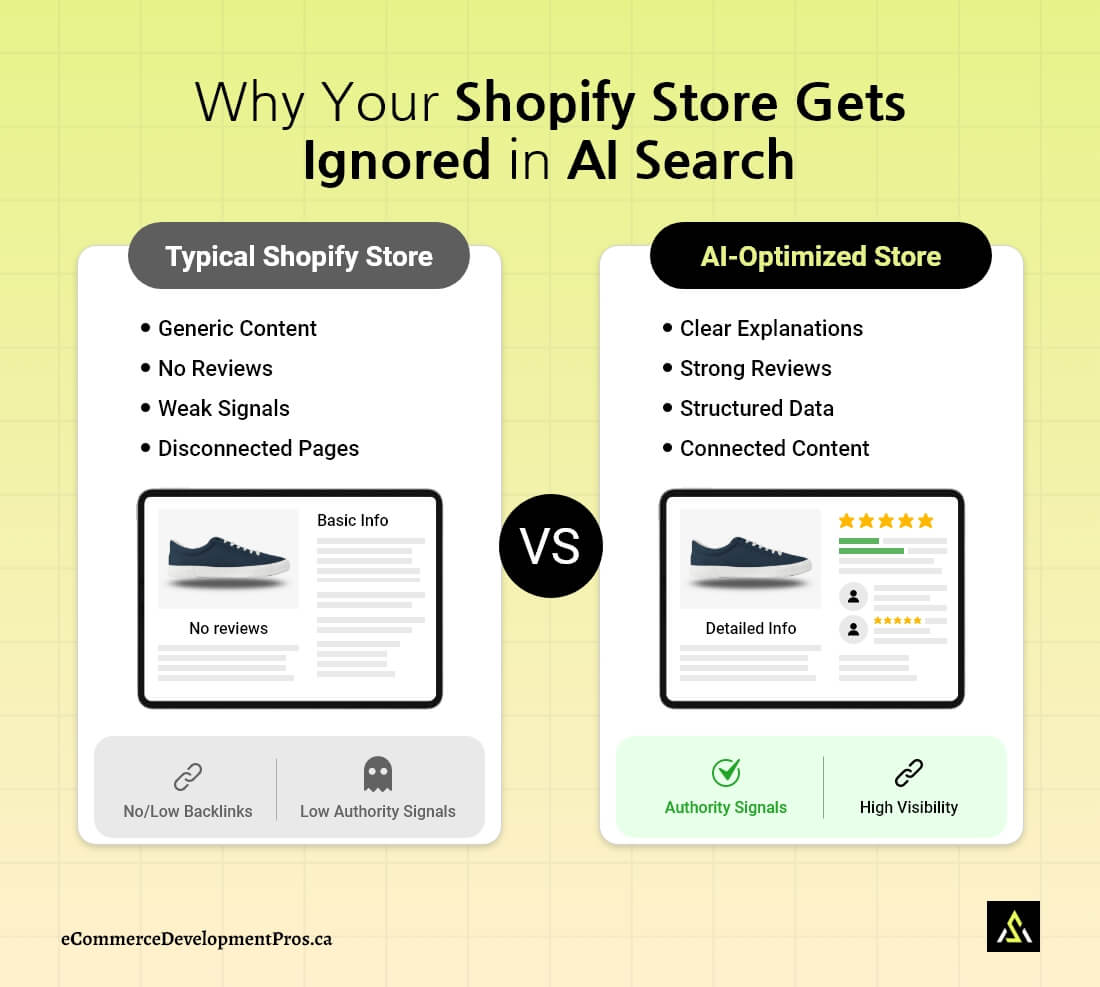
Comparison between a typical Shopify store and an AI-optimized store, showing the signals that influence visibility.
1. The content sounds right—but doesn’t say much
A lot of stores look polished on the surface. Clean layout. Nice images. Decent copy.
But when you read closely, the content is vague.
- Product descriptions repeat what’s already obvious
- Category pages don’t guide decisions
- There’s no clear explanation of when or why to choose a product
For a human, that’s frustrating.
For AI, it’s unusable.
If the page doesn’t clearly answer anything, it’s unlikely to be included in an answer.
2. Everything is built for keywords, not questions
Traditional SEO pushed stores toward keywords.
So you end up with pages optimized for phrases like:
- “men’s running shoes”
- “best protein powder”
But that’s not how people interact with AI tools.
They ask:
- “What’s the best running shoe for knee pain?”
- “Which protein powder is good for beginners?”
If your content doesn’t reflect how people actually ask questions, it becomes harder to match it to real queries.
3. Product data is there—but not consistent enough
Most Shopify stores aren’t missing product data.
Prices are listed. Variants exist. Descriptions are filled in.
At a glance, everything looks fine.
But once you move across a few products, small inconsistencies start to show:
- similar items named differently
- specs formatted in different ways
- key details buried inside long descriptions
- variants that aren’t clearly defined
For a customer, this is manageable.
For AI, it creates uncertainty.
AI systems rely on patterns—consistent naming, predictable structure, and clearly separated information. When that structure breaks, even slightly, it becomes harder to interpret what’s actually being offered.
4. No real signals outside the website
Many Shopify stores exist entirely within their own site.
No mentions. No references. No links from other places.
From an AI perspective, that is another factor creating uncertainty.
Even if your content is strong, there’s no external validation to support it.
This is often why smaller or newer brands struggle to appear in recommendations—there’s nothing confirming their credibility beyond their own pages.
5. Reviews are either missing or underused
Some stores don’t collect reviews at all.
Others have them—but they’re thin, generic, or buried.
That’s a missed opportunity.
Reviews add context you can’t easily create yourself:
- how customers describe the product
- what they actually experienced
- what stood out (good or bad)
Without that layer, your product page feels incomplete—not just to users, but to AI systems trying to evaluate it.
6. Pages are built to look good—not to explain clearly
Design often takes priority.
Which is fine—until clarity gets lost.
You’ll see:
- key information pushed too far down the page
- important details hidden behind tabs
- content broken into sections that look good but don’t read well
From a user’s point of view, it slows things down.
From an AI point of view, it makes interpretation harder.
A clean design helps—but only if the information is easy to follow
7. Everything works—but nothing stands out
This is the hardest one to spot.
A store can have:
- decent content
- structured data
- a working layout
…and still not show up anywhere.
Because nothing clearly signals:
👉 “This is a strong source for this topic.”
When everything is average, there’s no reason for AI to choose it over something else.
Where Most Stores Fall Short
Most stores aren’t invisible because of one major issue.
It’s usually a combination of small gaps:
- unclear content
- inconsistent data
- weak external signals
- lack of context
Individually, they don’t seem like a big deal.
Together, they make the store easy to overlook and impact Shopify AI visibility for the store.

Is Your Store Invisible on AI?
If your store felt familiar in any of the points above, you’re not alone.
Most visibility issues come down to a few fixable gaps.
We can map those out clearly for you.
How to Improve Your Shopify Store Visibility in AI Search?
By now, you’ve seen what affects visibility—and where most stores fall short.
The next step isn’t to “fix everything.”
It’s to approach this in a way that actually makes sense.
Most improvements fall into a few core areas. When you work through them in order, things start to come together much faster.
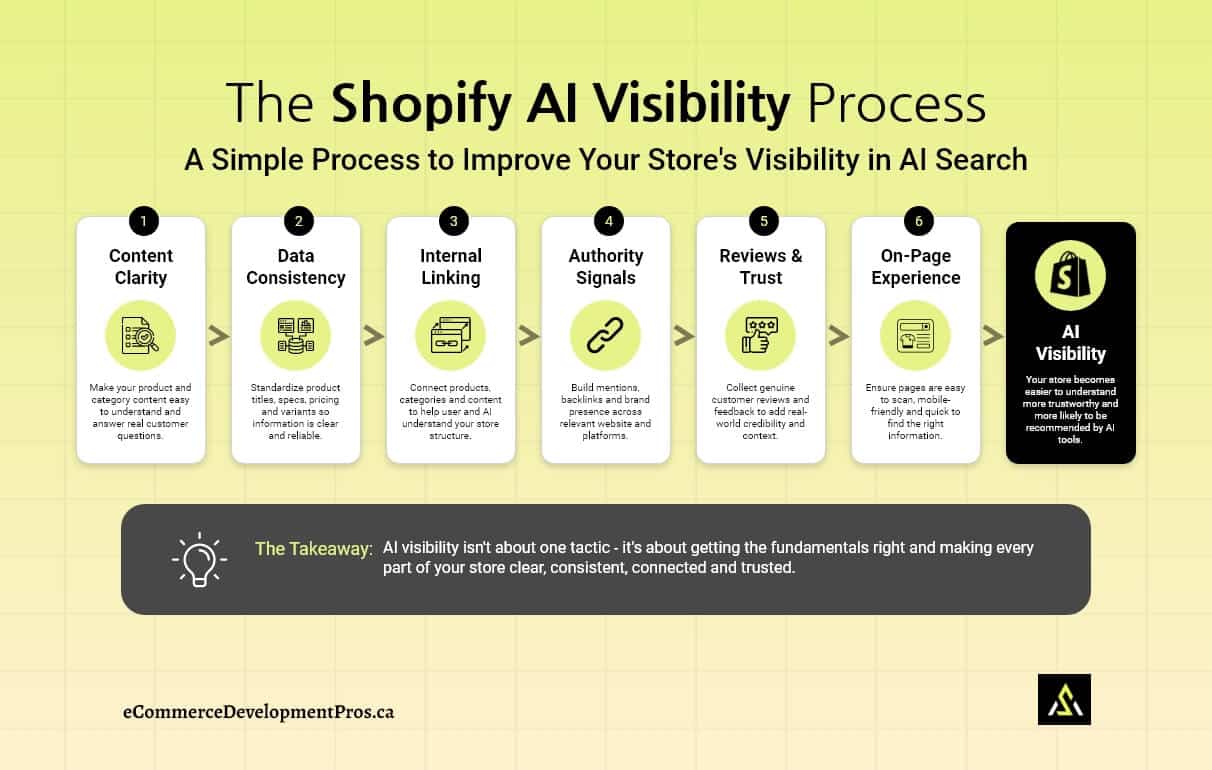
A simple process to improve your Shopify store’s visibility in AI search by aligning content, data, trust, and user experience.
Where to Start (and What to Fix First for Shopify AI Visibility)
1. Start with content clarity
Before anything else, your store needs to be easy to understand.
That usually means revisiting:
- product descriptions
- category pages
- key informational content (blog posts, buying guides, etc.)
The goal isn’t to add more words—it’s to remove ambiguity.
If someone lands on a page and still has basic questions—what the product is, who it’s for, and whether it’s the right choice—that’s usually where the problem starts. That same gap is what makes it harder for AI to use the page as well.
2. Clean up and standardize your product data
Once your content is clear, the next step is consistency.
Look across your products—not just one page at a time.
You’re checking for things like:
- naming patterns
- how specs are written
- how variants are presented
- where key information appears
Small inconsistencies don’t seem like a big deal individually.
Across a catalog, they add up quickly.
3. Strengthen internal connections
After content and data, focus on how everything links together.
Your store should guide both users and systems:
- from product → category
- from category → broader context
- from content (blogs, buying guides) → relevant products
When pages are connected properly, it becomes much easier to understand how your store is structured.
4. Build supporting signals outside your store
At some point, your store needs validation beyond itself. You need to build a consistent Shopify marketing strategy to drive visibility across channels.
This doesn’t mean aggressive link building.
It means making sure your brand shows up in places that matter:
- relevant directories
- partner mentions
- industry-related content
- consistent brand presence across platforms
Even small signals help reduce uncertainty.
5. Improve trust through reviews and real feedback
If your store doesn’t have reviews—or they’re minimal—you’re missing a layer of context.
Encouraging real customer feedback helps fill that gap.
Not just ratings, but actual written reviews.
They add detail, language, and perspective that your own content can’t replicate.
6. Refine the on-page experience
Finally, look at how everything comes together on the page.
This includes:
- how information is laid out
- how easy it is to scan
- how quickly someone can understand the product
Often, this is where small adjustments make a noticeable difference.
Where to Start (and What to Fix First)
To improve Shopify AI Visibility, you don’t need to do everything at once.
Most stores benefit from:
- starting with content
- then fixing the structure
- then building outward
Trying to tackle everything together usually leads to scattered results.
Working through it step by step tends to be far more effective.
Why Your Product Pages Play a Bigger Role in AI Search Than You Think
Most store owners think of product pages as the final step.
Someone lands → checks details → decides → buys.
But in AI-driven search, product pages often play a role much earlier—sometimes before a user even visits your site.
That’s because AI tools frequently rely on product pages to:
- understand what you’re selling
- compare options
- recommend specific products
So if your product pages aren’t clear, detailed, and structured, your store may never be considered in the first place.
What this looks like in a real AI search
Let’s take a simple example.
A user opens ChatGPT and asks:
👉 “Which protein powder is good for beginners?”
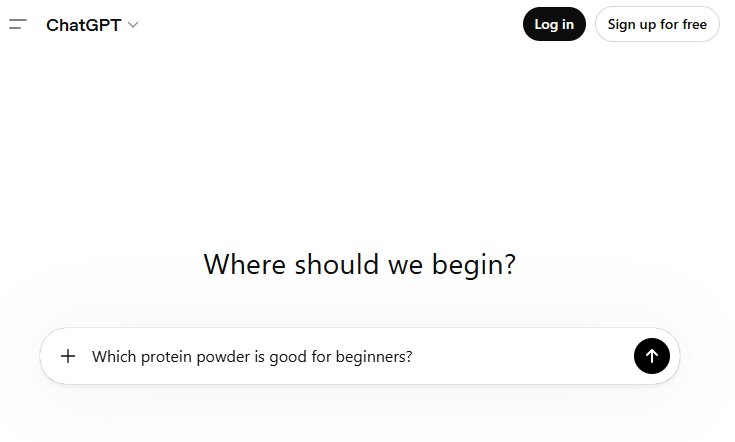
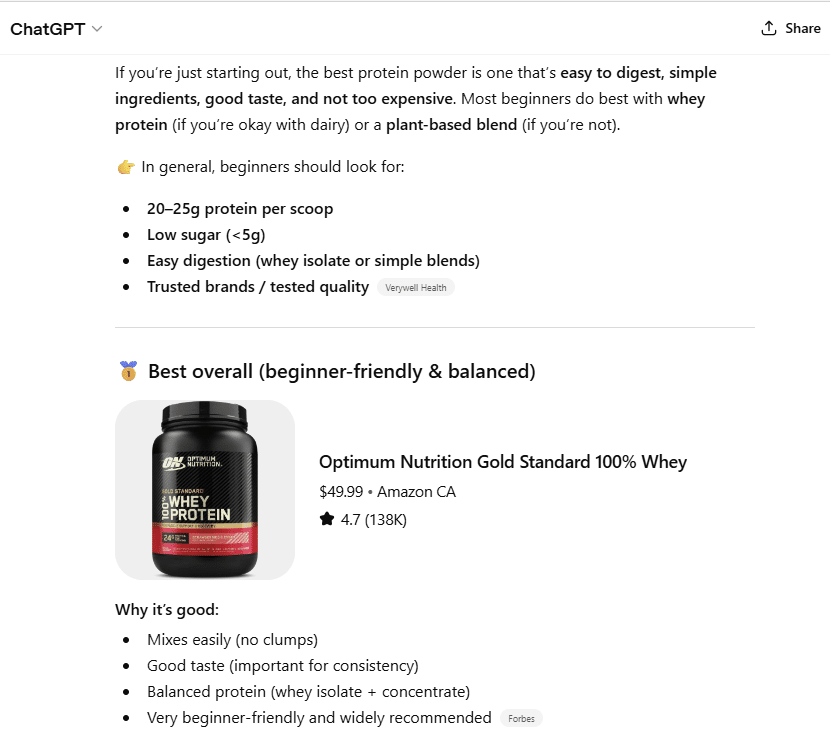
Instead of showing a list of links, ChatGPT generates a direct answer.
It doesn’t just suggest products—it explains:
- Why a product is a good fit
- Who is it suitable for
- What makes it beginner-friendly
What’s actually happening behind the scenes
When AI systems generate recommendations, they need specific, grounded information.
Product pages provide that.
They include:
- product names and categories
- descriptions and features
- pricing and availability
- reviews and ratings
In many cases, this is the most “complete” view of a product available online.
If that page is strong, it becomes a usable source.
If it’s weak, it gets ignored.
What makes a product page usable for AI
Not all product pages are equal.
Some simply list information. Others actually help interpret it.
Pages that tend to get used more often:
- explain when and why to choose the product
- clearly define who it’s for
- highlight differences between similar options
- include real customer feedback
This gives AI enough context to match the page to specific questions—not just general searches.
Where most Shopify product pages fall short
This is where a lot of stores start to blend into each other.
Many rely on default templates or reuse manufacturer descriptions. It saves time, but it also means a lot of product pages end up sounding the same.
You’ll often see:
- similar phrasing repeated across products
- very little to separate one option from another
- descriptions that stop at basic specs
For someone trying to compare options, that slows things down.
And for AI, it creates another issue.
If multiple pages say roughly the same thing, there’s no clear signal about which one is worth using. Everything starts to look interchangeable.
That’s usually when your product gets skipped—not because it’s wrong, but because nothing stands out enough to be selected.
Reviews add a layer that AI actively uses
This is where product pages can stand out.
Reviews introduce:
- natural, unscripted language
- real use cases
- confirmation that the product delivers
For AI systems, this adds depth.
Instead of relying only on brand-written content, they can see how actual customers describe and evaluate the product.
That makes the page more credible—and more useful.
Product pages connect directly with CRO
There’s a clear overlap here.
The same things that improve conversions also improve AI visibility:
- clarity
- structure
- relevance
- ease of understanding
A page that helps someone decide faster is usually a page that’s easier for AI to interpret as well.
Focus on improving your Shopify conversion rate to maximize results.
Why Do Product Pages Carry So Much Weight?
If your product page isn’t clear, structured, and backed by real signals, AI will move on to something that is.
Your product pages aren’t just for converting visitors.
They’re one of the main ways AI systems understand, evaluate, and recommend your store.
Optimized product pages are critical not just for rankings/AI visibility, but also for Shopify conversion optimization.
This is Where Visibility (and Conversions) Improve Fastest
This is usually where the biggest gains come from to improve Shopify AI visibility.
Small improvements to product pages can change how both users—and AI systems—interpret your store.
How SEO, AEO, and GEO Work Together for Shopify AI Visibility
By now, you’ve seen that visibility is no longer just about rankings.
But these terms—SEO, AEO, GEO—often get used interchangeably, which creates confusion.
They’re related, but they solve different problems.
SEO vs AEO vs GEO: Quick comparison |
|||
|---|---|---|---|
| Factor | SEO | AEO | GEO |
| Primary goal | Rank pages in search results | Get the content used in answers | Get the brand selected in AI responses |
| Focus | Keywords and rankings | Questions and clarity | Authority and trust |
| Output | List of links | Extracted answers | AI-generated recommendations |
| Optimization type | On-page + backlinks | Content structure + formatting | Brand signals + external validation |
| What success looks like | Higher rankings | Being quoted or summarized | Being recommended or referenced |
How they actually work together
It’s not one versus the other.
Each builds on the previous layer.
- SEO gets your store indexed and visible in search
- AEO makes your content usable when AI extracts answers
- GEO increases the chances of your brand being chosen
Without SEO, you’re hard to find.
Without AEO, you’re hard to use.
Without GEO, you’re hard to trust.
Where AIO fits in
You’ll also hear the term AIO (AI Optimization).
Instead of being a separate layer, it’s better to think of it as the combination of all three.
AIO brings together:
- visibility (SEO)
- usability (AEO)
- trust (GEO)
When these align, your store becomes easier for AI systems to:
- discover
- interpret
- recommend
Breaking down SEO vs AEO vs GEO
- SEO helps you get listed.
- AEO helps your content get used.
- GEO helps your brand get chosen.
How to Test If Your Shopify Store Shows Up in ChatGPT and AI Search
At this point, the obvious question is:
👉 “Is my store even showing up anywhere in AI search?”
You don’t need any special tools to figure that out.
A few quick checks can give you a pretty clear answer.
1. Start by asking the same questions your customers would
Open ChatGPT (or any other AI tool) and type queries related to your products.
Not keywords—actual questions.
For example:
- “What’s the best [your product] for beginners?”
- “Which [your product] is good for [specific use case]?”
- “What should I look for when buying [your product]?”
Then look at the response.
- Are your products being recommended?
- Is your brand(s) being mentioned?
- Is anything close to your offering included?
If your category shows up—but your products don’t—that’s your first signal.
2. Look at how your product category is being explained
Don’t just focus on the products being recommended, but also look at how the category itself is described.
What stands out?
- Which features keep coming up
- What benefits are being emphasized
- How terms like “beginner-friendly” or “best” are being interpreted
There’s usually a pattern.
Now compare that to your own product pages.
If your content doesn’t reflect that same level of clarity—or doesn’t address those points at all—it becomes harder for your store to be matched to those kinds of queries.
3. Look for familiar brands vs unknown ones
In many cases, you’ll notice the same brands showing up repeatedly.
That’s not random.
It usually means those brands have:
- clearer content
- stronger signals across the web
- more consistent product information
If smaller or newer brands aren’t appearing, it’s often a visibility gap—not necessarily a quality issue.
4. Ask the same question in a few different ways
Don’t stop at one prompt.
People don’t all search the same way—and neither do AI systems.
Try a few variations:
- “Best option for beginners”
- “Affordable option for beginners”
- “Easy to use for first-time buyers”
The wording changes, but the intent is similar.
If your store doesn’t show up in any of them, that usually points to something deeper.
Either your content isn’t lining up with how these questions are being asked…
Or it’s not strong enough to be picked as a source in the first place.
5. Check Google AI Overviews as well
Run similar searches on Google.
If AI Overviews appear:
- See which products or brands are referenced
- Compare how those pages are structured
This gives you another perspective on what’s being picked—and why.
6. Look at your own store objectively
This is the hardest part.
Go through your product pages and ask:
- Would this page actually answer the question I just searched?
- Is it clear who this product is for?
- Is there enough context to make a decision?
If the answer is “not really,” that’s likely why your store isn’t being included.
How to check AI visibility for your Shopify store
You’re not just checking if your store appears.
You’re trying to understand:
- How AI is interpreting your category
- What signals it’s prioritizing
- Where your store falls short
If your Shopify store isn’t showing up in AI-generated answers, the gap is usually visible—you just need to look at it from the same perspective AI uses.
What to Do Next to Improve Your Shopify AI Visibility
By now, you’ve probably got a sense of where your store stands.
In some cases, the gaps are obvious.
In others, everything looks “fine”—but nothing is actually strong enough to stand out.
That’s usually the difference.
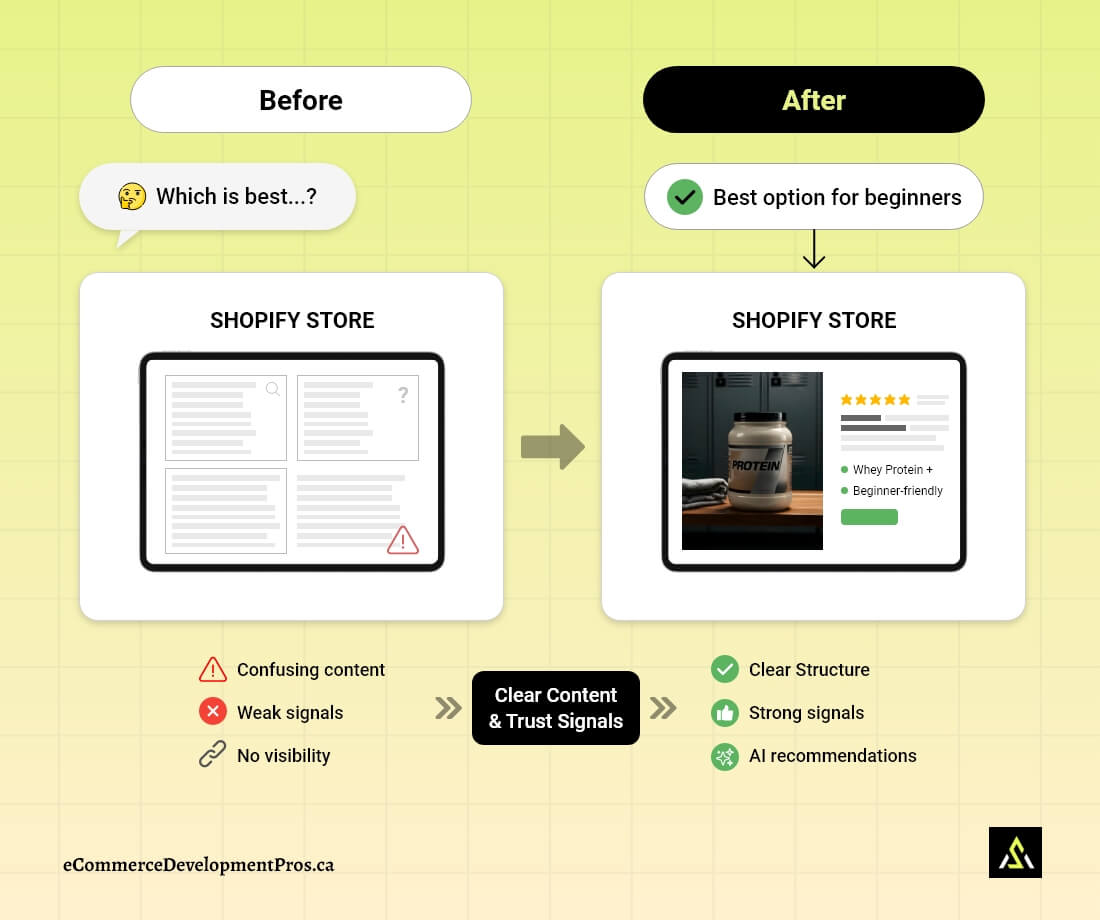
Start with what’s easiest to fix
You don’t need to overhaul your entire store overnight.
In most cases, the biggest impact comes from a few focused improvements:
- Rewrite product descriptions so they actually explain use cases
- Clean up inconsistent product data across your catalog
- Add or improve internal links between related pages
- Make sure key information is easy to find (not buried)
These are small changes—but they tend to compound quickly.
Then look at what’s missing
Once the basics are in place, the next step is filling the gaps.
This often includes:
- Adding real customer reviews
- Building mentions or links outside your store
- Improving how your product categories are explained
This is where your store starts to feel more complete—not just to users, but to AI systems as well.
Avoid trying to do everything at once
This is where most stores get stuck.
They try to fix:
- content
- SEO
- UX
- data
- authority
…all at the same time.
The result is usually scattered progress.
It’s far more effective to:
- fix clarity
- improve structure
- then build outward
If you want a clear starting point
The fastest way to move forward is to understand exactly what’s holding your store back.
Not in general—but specifically:
- where clarity breaks down
- where the data is inconsistent
- where signals are missing
That’s what a proper audit should give you.
Get an AI Commerce Readiness Audit for Your Shopify Store
If you’re not sure where your store stands, or you want a second set of eyes on it:
👉 We run an AI Commerce Readiness Audit for Shopify stores, where we look at:
- product data clarity
- structure and consistency
- trust and visibility signals
- gaps that affect AI recommendations
No fluff—just a clear breakdown of what’s working and what’s not.
Common Questions About Shopify AI Visibility
1. How do I get my Shopify store to show up in ChatGPT?
There isn’t a single switch you can turn on.
What usually makes the difference is how easy your store is to understand and trust.
If your product pages clearly explain:
- What you’re selling
- Who it’s for
- Why someone should choose it
…and if you have supporting signals like reviews or mentions, your chances go up.
If not, AI tools tend to move on pretty quickly.
2. Why is my Shopify store not showing up in AI search results?
In most cases, nothing is “broken.”
It’s usually a mix of small things:
- Content that sounds good but doesn’t say much
- Product data that isn’t consistent
- Little to no signals outside your website
- Pages that don’t really match how people ask questions
Individually, these don’t seem like a big deal.
Together, they make your store easy to overlook.
3. Does SEO still matter for Shopify stores?
It does—but it’s only part of the picture now.
SEO helps your store get discovered.
But being included in AI-generated answers depends on more than rankings. Your content needs to be clear enough to use, and your store needs to feel trustworthy enough to reference.
Think of it as:
- SEO gets you seen
- Everything else determines if you get picked by AI systems
4. What is AEO in ecommerce (in simple terms)?
AEO is just a different way of thinking about content.
Instead of writing to rank, you’re writing so that parts of your content can actually be used in an answer.
For a Shopify store, that usually means:
- explaining things clearly
- answering real questions
- avoiding generic descriptions
If AI can lift a piece of your content and use it directly, you’re on the right track.
5. How does Google AI decide which products to show?
It’s less about “ranking” and more about selection.
Google looks at:
- how clearly a product is described
- whether it matches what the user is asking
- signals that suggest it’s trustworthy (like reviews or mentions)
- how consistent the information is
If a product checks those boxes, it’s more likely to be included.
6. Can smaller Shopify stores show up in AI recommendations?
Yes, but they don’t get there the same way bigger brands do.
Larger brands often benefit from strong authority by default.
Smaller stores usually need to be sharper:
- clearer product pages
- better structure
- stronger use of reviews and real context
When that’s in place, size matters a lot less.

Not Sure Where Your Store Stands?
If you’ve made it this far and you’re still unsure where your store stands, that’s normal.
Most of these gaps only become obvious when you look at your store from a different angle.