



 647-812-5125



See What Shopify AI Can Do for Your Store
We work with merchants to implement Shopify Artificial Intelligence to improve conversion rates (CVR), average order value (AOV), and retention, and to reduce manual work that slows teams down. As a result, you will see measurable improvements at every stage of the customer journey and enhance your bottom line.
higher conversion rates with AI-driven personalization, smarter product recommendations, and automated CRO insights.
lift in average order value (AOV) driven by dynamic bundles, AI-powered upsells, and context-aware product suggestions that increase order size without friction.
reduction in manual workload with AI automation handling tasks that slow teams down — freeing time for higher-impact work.
improvement in customer retention. Predictive analytics and AI-powered customer journeys help you engage the right customers increasing repeat purchases and LTV.
Still Running Your Shopify Store Without AI?

What is Shopify AI, and what can it actually do for my store?
Shopify AI isn’t a separate tool or an add-on you need to install. It’s built directly into the Shopify platform and designed to make everyday store management easier.
For example, when you’re adding or updating products, Shopify Magic can help you write product descriptions or clean up existing copy. You still decide what stays and what goes, but instead of starting from scratch every time, you get a solid draft to work from. For stores with larger catalogs, this alone can save tens of hours.
Most store owners don’t have time to dig through every report, and Shopify AI can help with the decision-making. With Sidekick, Shopify’s AI assistant, you can ask plain-language questions like:
“Why did sales dip last week?” or
“Which products are performing best right now?”
Sidekick pulls insights from your store data and helps you act faster without digging through reports.
On the admin side, Shopify lets you automate a lot of the small, repetitive tasks that tend to pile up over time. Things like tagging customers and organizing products that eat into your time can be handled through native rules and workflows.

Where am I losing customers today that AI could help fix?
Most stores don’t lose customers all at once. They lose them quietly, step by step.
Some leave after landing on a collection page. Others view a product, scroll a bit, then disappear. Many add to cart and never reach checkout. These drop-offs don’t always show up as “errors,” which is why they’re easy to miss.
This is where Shopify’s data and AI-assisted insights help us focus. Instead of guessing, we look at where people are spending time and where they stop. A product might get plenty of views but no add-to-carts. That usually points to missing information, unclear pricing, or weak trust signals — not bad design.
In other cases, customers browse multiple products but don’t decide. They’re interested, just unsure. Without guidance, they leave. That’s often a sign that the store isn’t helping them choose, even though the products are good.
We also see drop-offs after promotions bring traffic in. Campaigns work, clicks come through, but sales don’t follow. That tells us the issue isn’t marketing — it’s what happens after the click. Messaging doesn’t line up, the offer isn’t clear, or the next step feels uncertain.
AI helps us spot these patterns faster. It doesn’t fix everything on its own, but it shows us where attention fades, and hesitation starts. Once we know that, the fixes are usually practical and focused — not a full overhaul.

Can AI help increase my conversion rate without redesigning my entire site?
Yes—often it can. In our experience, design is rarely the real problem.
Most Shopify stores that come to us already look good. The branding is solid, the layout is clean, and traffic is coming in. Yet conversions are low. That’s when store owners start questioning the design and assume a full redesign is the answer.
In many cases, what’s usually missing is clarity, confidence, or flow — not visuals. That’s why we start with a CRO audit before touching the design. We look at how real customers are moving through the store, where they hesitate, and where they drop off.
For example, we often see product pages getting plenty of views but very few add-to-carts. The design looks fine, but key information is buried too low, delivery details aren’t clear, or product copy doesn’t answer the questions shoppers actually have. Using Shopify Magic, we can tighten and restructure that content without changing the layout at all.
In other cases, traffic looks fine, but orders don’t follow. In such cases, it comes down to one step in checkout. Shipping surprises. Payment confusion, or people backing out right at the end.
Shopify analytics and Sidekick make it easier to spot where that happens. Once we see it, the fix usually isn’t a big one. We clean up the wording, remove things that distract people, or add a bit of reassurance where shoppers seem unsure. Those kinds of small tweaks often do more for conversion than bigger changes.
Sometimes shoppers browse multiple products but don’t buy because they’re unsure what to choose. AI-powered product recommendations apps show the products that users are likely interested in.
We also see stores running campaigns without knowing what truly converts. AI-driven insights let us focus on products and audiences already showing buying intent, rather than making changes across the entire site.

What’s the difference between Shopify’s built-in AI and third-party AI apps?
Shopify’s built-in AI helps you understand what’s happening in your store. Third-party AI apps focus on shaping what shoppers do next.
Built-in AI mostly lives in the admin. It gives you visibility into sales, traffic, and drop-offs through analytics, Sidekick, and basic recommendations.
For example, Shopify can show that shoppers are viewing several similar products but not buying.
Third-party AI tools act inside the shopping experience. They help guide decisions by narrowing choices, recommending the most relevant products, or adjusting what’s shown based on behavior.
For example, an AI tool can step in and help a shopper choose when they’re stuck between similar options.
Shopify’s AI provides the foundation. Third-party AI extends that foundation into real customer actions.
Our role is knowing where Shopify’s native tools are enough, where extra AI actually helps, and how to use both together without creating noise.

How do AI-powered Shopify apps improve CRO and increase AOV?
Most stores don’t struggle because people aren’t interested. They struggle because shoppers hesitate:
- They hesitate on product pages.
- They hesitate when choosing between similar items.
- They hesitate before checkout.
AI-powered Shopify apps help reduce that hesitation.
For example, when a customer lands on a product page and isn’t sure what to buy next, AI-powered recommendations can surface related or complementary products that actually make sense. Not random upsells — useful suggestions based on what people usually buy together. That alone can lift AOV without changing prices or running discounts.
In other cases, customers browse several products but leave without adding anything to the cart. AI tools can step in and guide that decision — highlighting bestsellers, narrowing choices, or helping customers compare options. When shoppers feel guided instead of overwhelmed, conversion improves.
AI also helps after the first purchase. Instead of sending the same follow-ups to everyone, AI-powered tools can identify which customers are likely to buy again, what they’re likely to buy, and when to reach out. That’s how repeat purchases and AOV grow without increasing ad spend.
What makes these tools effective is that they react to real behavior. They don’t rely on assumptions or static rules. They adjust based on how customers actually shop.
Used properly, AI-powered apps don’t make your store louder. They make it clearer. And clarity is what usually moves the needle on both conversion and order value.

How do I know which AI tools are right for my Shopify store?
Most store owners install AI apps because they sound useful. Over time, this leads to overlapping tools, extra costs, and features that never get used.
We look at it the other way around.
We start by understanding how your store actually performs today. Where customers hesitate. Where they leave. Where time is being wasted internally. A store struggling with product discovery needs something very different from a store struggling with checkout or retention.
For example, if customers browse but don’t decide, the right AI tool helps guide choices. If add-to-carts are strong but checkouts drop off, the focus shifts to reducing friction and building confidence. If repeat purchases are low, AI tools around segmentation and timing make more sense than adding more upsells.
The right tools depend on your catalog size, traffic quality, store maturity, and how your team works day to day. What works for a large DTC brand can be overkill for a growing store — and sometimes even slow things down.
Our role is to cut through the noise. We identify which AI capabilities your store actually needs, which tools add real value, and which ones you can skip. That way, AI supports your growth instead of becoming another layer of complexity.
AI for Shopify Growth — Our Core Service Framework
We work with Shopify brands like you in transforming AI from a passing fad into a genuine growth engine. Our approach emphasizes revenue-focused implementation. We blend automation, personalization, predictive insights, and intelligent optimization to boost conversions, elevate average order value, and refine operations. All of this is done in a manner that's both measurable and scalable.
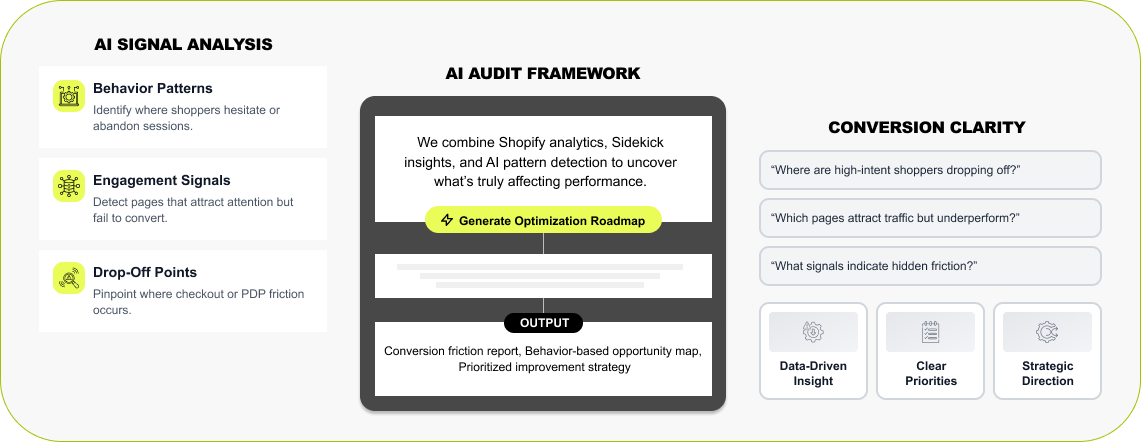

AI-Powered Shopify Store Audit
Every Shopify store is trying to improve conversion. An AI-powered Shopify store audit helps uncover what’s actually affecting conversion by looking at real behavior, not assumptions. We use Shopify analytics, Sidekick, and supporting AI insights to identify where customers hesitate, where they drop off, and which pages attract attention but fail to convert.
Read More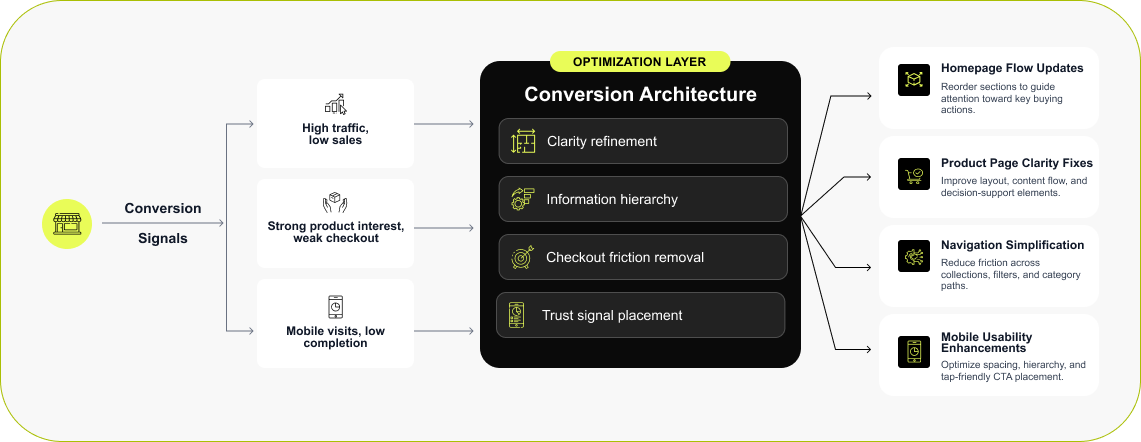

AI Conversion Optimization (CRO + PDP + Checkout)
Low conversion is rarely a design issue. Using Shopify AI insights, we optimize product pages and checkout by fixing clarity gaps, misplaced information, and friction points. AI helps us identify where shoppers hesitate, so we can improve messaging, structure, and flow—raising conversion rates without redesigning what already works.
Read More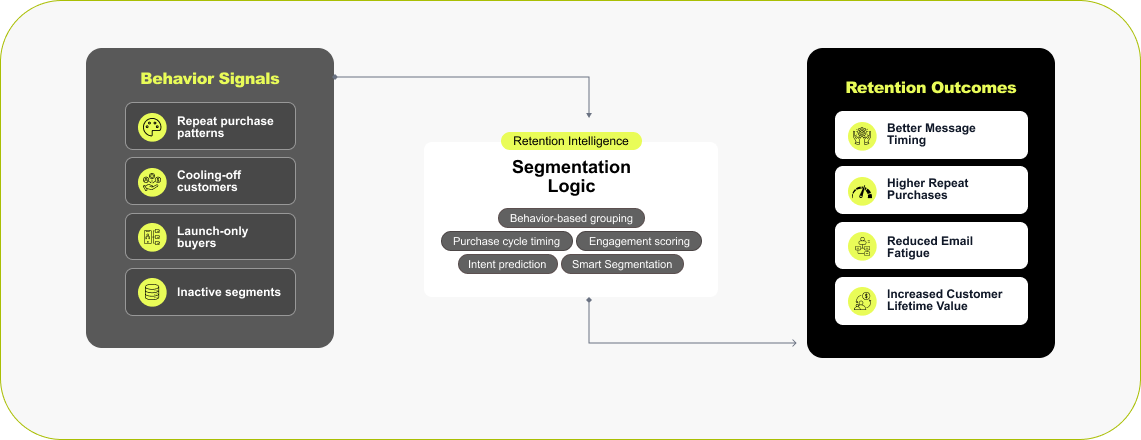

Smarter Retention, Not Louder Marketing
We often see stores sending the same emails to everyone. Same timing. Same offers. Using tools like Klaviyo AI, we segment based on behavior — who’s likely to buy again, who’s cooling off, who only buys during launches. That changes how and when we follow up. The result is fewer emails, better timing, and higher repeat purchases — without increasing ad spend.
Read More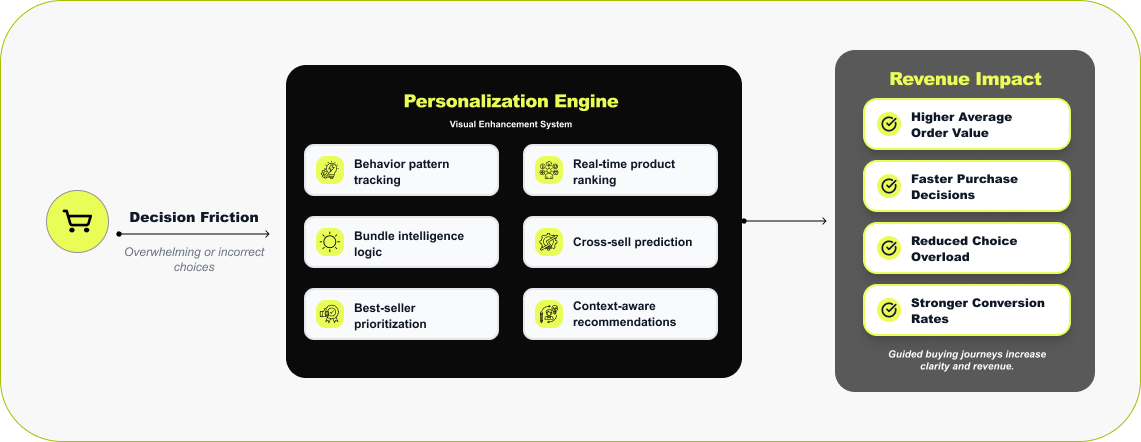

AI Personalization & Product Recommendations
Customers browse multiple similar products, then leave. That’s not a traffic issue — it’s decision fatigue. We’ve used tools like Rebuy AI and Octane AI to guide shoppers toward the right choice — bestsellers, bundles, or products that usually convert together. When customers feel guided instead of overwhelmed, both conversion and AOV move up.
Read More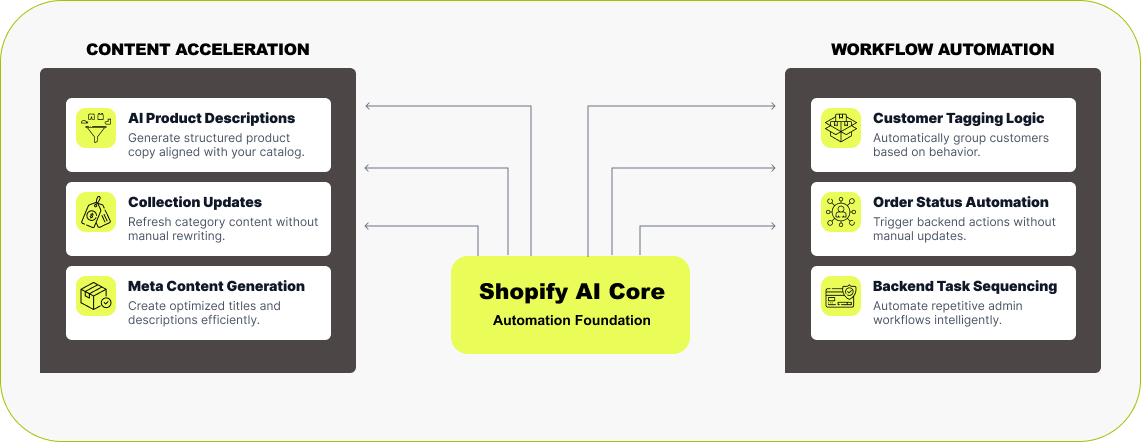

AI Content & Automation Workflows
As a Shopify store grows, content and day-to-day admin work tend to pile up. Product descriptions need updates, collections change, tags get messy, and small tasks start eating time. We use tools like Shopify Magic to speed up content work without losing control. In the backend, we also leverage AI-supported automation to handle repetitive tasks like organizing products, tagging customers, and managing simple workflows.
Read More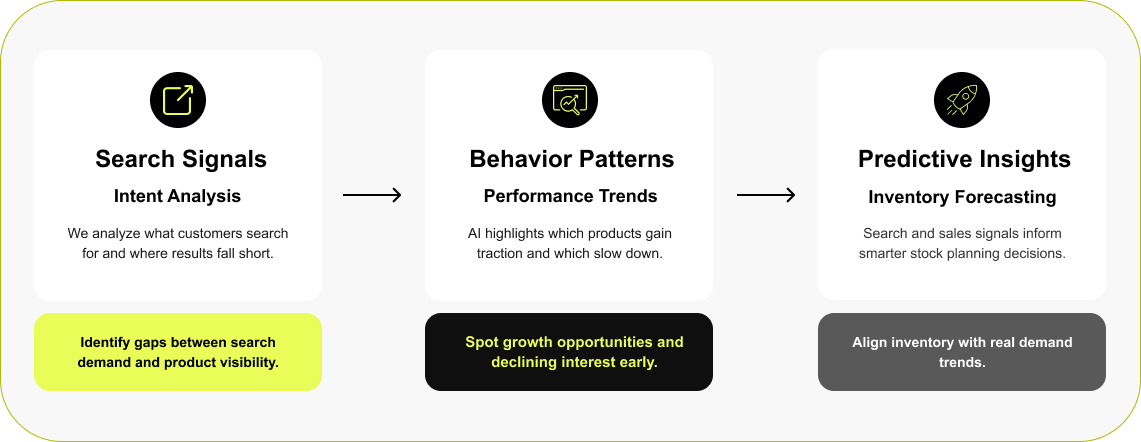

AI Search, Predictive Analytics & Forecasting
When shoppers search and don’t find what they want, they usually leave without saying a word. We use Shopify data and AI-supported insights to see what people are actually searching for, where results fall short, and which products get overlooked. These signals also help with forecasting—spotting what’s picking up, what’s slowing down, and where inventory decisions need adjustments.
Read More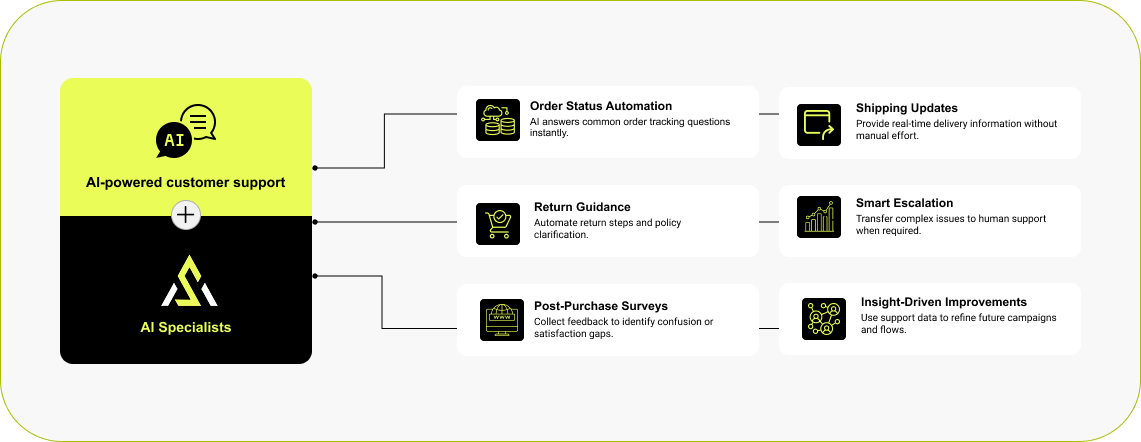

AI Post-Purchase & Customer Support Automation
After checkout, most questions are predictable. We use AI chat to handle those basics—order status, shipping updates, return info—and pass the conversation to a real person when it needs one. We also add post-purchase surveys to understand where customers felt confused or satisfied, so we can fix issues and improve future campaigns.
Read MoreAI-Powered Conversions Across Every Customer Touchpoint
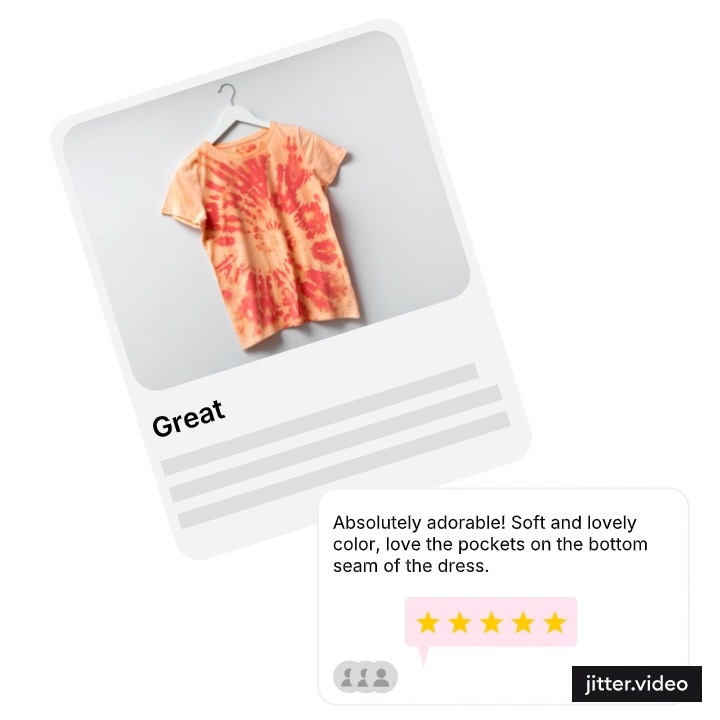
Reviews & UGC
Before buying, people want reassurance. We use AI to find the “trust gaps” on key pages—where people hesitate before “add to cart” or “checkout”. Then we place reviews and UGC (Okendo, Loox, Judge.me) where they reduce doubt, not where they just fill space.
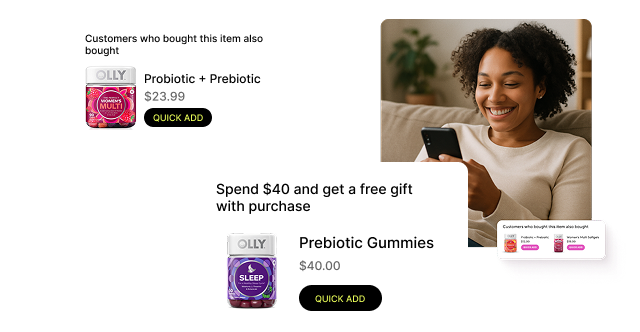
AI Product Recommendations
Most shoppers don’t need more options. They need better ones. We use Shopify AI signals plus tools like Rebuy AI or LimeSpot to recommend products based on real behavior—what people view, add, and buy together—then tune it so it doesn’t feel spammy.
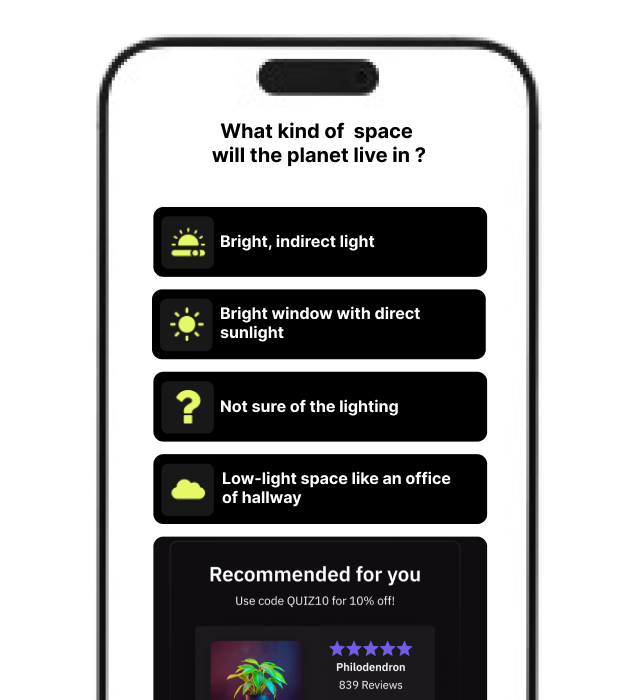
Interactive Product Quizzes
When people don’t know what to choose, they leave. Quizzes help narrow things down. A few questions, a clear recommendation, and suddenly the decision feels easier. Shopify apps like Octane AI make this feel like guidance, not a form.
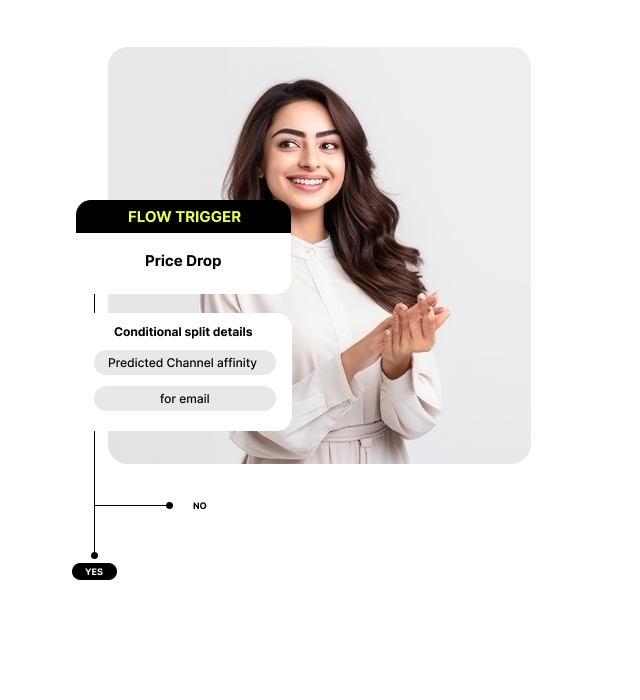
Email & SMS Marketing
Most stores blast everyone with the same flow. We use AI-driven segmentation (Klaviyo AI, Omnisend) based on real intent—browse, cart, repeat behavior—so follow-ups feel relevant. Better timing usually beats “more messages.”
Shoppable Videos
Some customers won’t buy until they see the product in action. Shoppable videos let them watch how something looks or works and add it to the cart right there. Fewer clicks. Less back and forth.

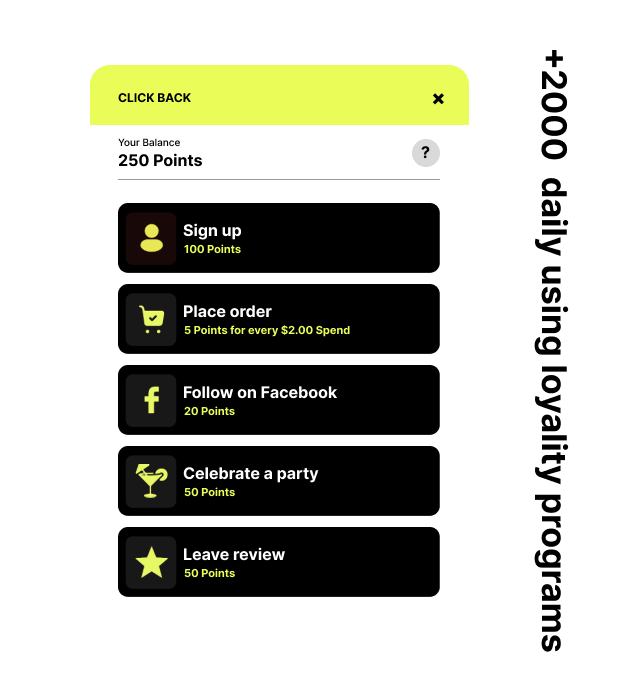
Loyalty & Referrals
AI helps here by identifying who’s most likely to return or refer. We use that signal to trigger loyalty and referral nudges (Smile.io, LoyaltyLion) at the right moment—after a good delivery experience, not randomly.
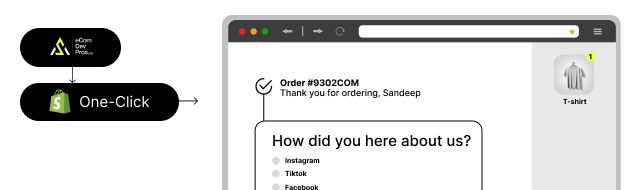
Surveys & Feedback
Ask. Listen. Improve. Short surveys tell us why someone didn’t buy or what helped them decide. Then apply AI to group patterns—pricing confusion, delivery concerns, product clarity, and optimize PDPs, offers, and messaging.
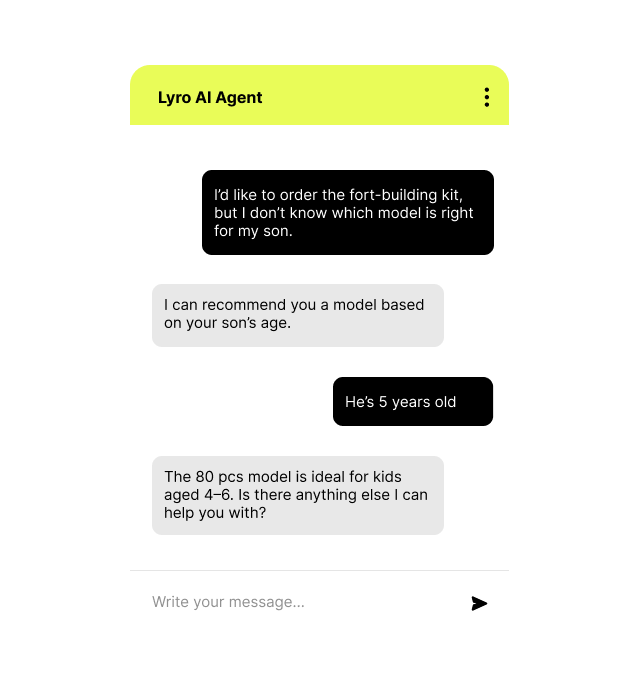
AI Chat / Shopping Help
We use AI automation to reduce post-purchase tickets and improve repeat buying. AI chat handles order status and returns, then passes edge cases to a human. We also run post-purchase surveys and feed the insights into future campaigns.
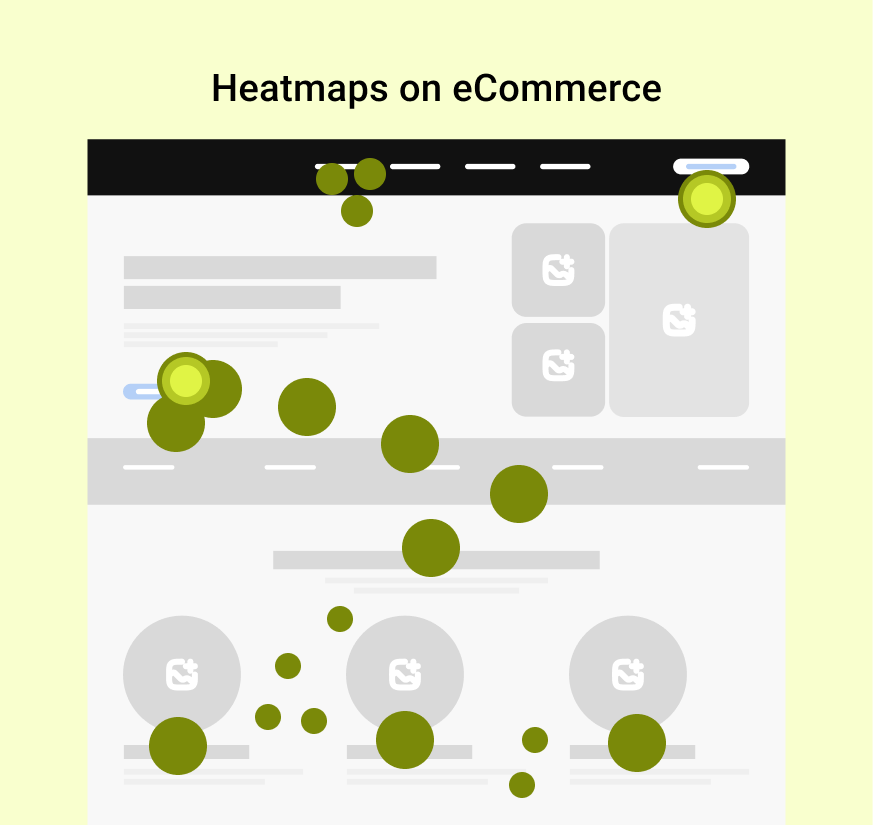
Heatmaps & Behavior Tools
Shopify reports tell you what happened. Behavior tools show why. We use AI-assisted insights from Microsoft Clarity and Hotjar to spot rage clicks, dead scroll zones, and confusing sections. Then we fix the exact friction point.
Turn AI Into Revenue, Not Just Tools
Not every Shopify store needs the same AI stack. The right setup depends on your traffic, product mix, and customer behavior. We’ll outline what to implement, what to remove, and what to optimize — clearly and practically.
Is Shopify AI Right for Your Online Store?
Not every Shopify store require same AI apps — and that’s intentional. It works best if you already have traffic and sales, but feel your store should be performing better. Things look fine on the surface, yet conversion, repeat purchases, or day-to-day efficiency aren’t where you expect them to be. When implemented correctly, AI delivers the strongest results for stores in specific growth stages.

DTC brands looking for smarter personalization
If you run a DTC brand and want your store to feel more relevant to different shoppers, Shopify AI can help. Not in a flashy way, but by improving how products are surfaced, how choices are guided, and how customers move through the site without getting stuck.

Stores that need AI-powered automation to scale
Your catalog, orders, or campaigns are growing, and manual work is becoming a bottleneck. Managing products, content, campaigns, or support by hand doesn’t scale for long. AI-powered automation helps reduce that load, so growth doesn’t turn into friction.

Shopify brands focused on conversion optimization
You’re getting traffic, but conversion rates aren’t where they should be. Shopify AI helps uncover where customers hesitate — product pages, checkout, or after the first visit — so fixes are based on real behavior, not redesign guesses.

Brands that want better forecasting, insights, and segmentation
You want clearer answers about what’s working, what’s slowing down, and what to focus on next. AI-driven insights, forecasting, and segmentation help you make decisions earlier and with more confidence.
Trusted by Modern Marketing & Growth Teams
It was an absolute pleasure working with Arete Soft Labs for our website. They answered all questions in a timely manner and gave professional feedback on our design. Will definitely be using them for all our needs going forward!
 The Bee Commander
The team maintained open and clear communication throughout the project.
 Hary Robinson
Very professional and know their job well. My favourite part working with them is they give you peace of mind which is the most important thing so that you focus n your business. Will definitely consider them for my future digital needs.
 Prachi Chauhan
What was wonderful about this was that they made very complex deliverables sound easy.
 Isolde O'Neill
The professional attitude, work ethic, and meaningfulness they put into their work were impressive.
 Maryna Gandalf
Brands Who Build, Grow, and Win With Us
Shopify AI for Growth
These questions come up often once store owners start thinking seriously about using AI on Shopify. The answers below focus on fit, effort, control, and outcomes—so you can understand how this works in practice before deciding what the next step should be.
Is Shopify AI suitable for small or growing stores, or only large brands?
+Leveraging Shopify AI isn’t about size. It’s about whether there’s enough activity in the store for Shopify AI to learn from.
You don’t need to be a big brand, but you do need real traffic and orders coming in. AI works when there’s actual customer behavior to look at — what people click, where they pause, where they leave.
For growing stores, this usually helps fix conversion issues early, before they turn into bigger problems. For more established brands, it’s about tightening things up, cutting wasted effort, and making better decisions faster.
If a store is still very new and testing its first product, AI won’t do much yet. But once there’s momentum, it becomes genuinely useful.
How long does it take to implement AI for Shopify growth?
+Implementing Shopify AI is not an overnight switch, and it’s not a long, drawn-out project either.
Most of the initial work happens in the first few weeks. That’s where we review the store, identify where AI actually makes sense, and set up the first changes. Some improvements, like fixing friction points or adjusting product discovery, can start showing impact fairly quickly.
Other areas, like personalization or retention, take more time because they rely on customer behavior over weeks, not days. The key point is that this is phased. We don’t try to do everything at once. We start with what will move the needle fastest, then build from there.
If you’re expecting instant results, AI isn’t the right tool. If you’re looking for steady, measurable improvement, the timeline makes sense.
How much control do I have over AI-driven changes on my store?
+Shopify AI doesn’t run your store on autopilot. You’re always in control.
We use Shopify’s built-in AI tools, like Sidekick and Shopify analytics, to highlight what’s happening across key touchpoints—product pages, search, checkout, and post-purchase. AI shows us patterns, like where customers hesitate or where drop-offs start. What happens next is a human decision.
When we work with AI-powered apps—such as Rebuy for recommendations, Gorgias for support automation, or Klaviyo for segmentation—nothing goes live blindly. Product recommendations, quizzes, emails, and on-site messages are reviewed, adjusted, and tested based on your brand and comfort level.
AI helps us decide where to look and what to test. You decide what stays, what changes, and what never gets used. It’s a support system, not a replacement for judgment.
Will AI change how my brand voice or messaging sounds?
+No — unless you choose to let it.
We don’t hand your brand voice over to AI. Tools like Shopify Magic are used to speed things up, not to decide how your store sounds. They help with drafts or clean-ups, but everything is reviewed and adjusted before it goes live.
That applies everywhere. Product pages still read the way your customers expect. Emails sent through tools like Klaviyo follow your tone, not a template voice. Even AI chat replies are set up with limits, so anything sensitive or unclear goes to a real person.
AI helps save time. Your brand voice stays human.
How do you decide which AI tools are worth the investment?
+We decide based on where the store is struggling today—not on what’s trending. Most decisions fall into a few common situations:
- People browse, compare, then leave Usually means they’re unsure what to buy. In those cases, guided recommendations or quizzes make sense.
- Traffic is coming in, but conversion feels off Before adding anything new, we look at behavior—where people pause, scroll back, or drop off—and fix that first.
- Support is eating up too much time When the same questions come up again and again, AI chat can handle the basics and pass the rest to a human.
- Emails are going out, but nothing’s happening That’s often a targeting or timing issue, not a volume issue. Segmentation usually matters more than new campaigns.
- The product catalog keeps growing Content updates, tagging, and organization start breaking down. That’s where automation actually helps.
- Too many apps are already installed This happens a lot. Sometimes the right move is removing tools or using what’s already there properly.
Every tool has a job. If it doesn’t solve a real problem, it’s not worth keeping.
How do you measure success from Shopify AI optimization?
+We start by deciding where AI is being applied, then measure only what’s relevant to that area. Not everything needs the same metrics.
- Product discovery & PDPs We look at add-to-cart rates, scroll depth, time spent on key sections, and exits. If AI-driven recommendations or content changes are working, shoppers move forward instead of bouncing.
- Cart & checkout We track drop-offs step by step. Fewer abandons, fewer returns to previous steps, and more completed checkouts tell us friction is being removed.
- Email, SMS, and follow-ups The focus is on recovery and repeat behavior—cart recovery rate, click-throughs tied to intent, and second purchases, not just opens.
- Post-purchase & support We measure ticket volume, response time, and repeat questions. If AI automation is effective, support load drops without hurting satisfaction.
- Day-to-day operations We watch how the work feels behind the scenes. Less manual cleanup, fewer errors, and simpler workflows all count.
If the area we touched starts performing better, we keep going. If it doesn’t, we adjust or pull it back.
What kind of improvements should I realistically expect?
+Most stores don’t see one big “before and after” moment. What usually changes is how things feel day to day.
Customers move through the store with less hesitation. Fewer people get stuck comparing products or leaving halfway through checkout. Decisions feel easier, even if nothing looks dramatically different on the surface.
Order values tend to creep up as recommendations and timing improve, not because shoppers are pushed harder. Follow-ups feel more relevant, so repeat purchases start happening without relying on constant discounts.
Behind the scenes, a lot of small frustrations fade. Fewer repetitive tasks, fewer avoidable support questions, and less time spent fixing the same issues over and over.
The win isn’t a sudden spike. It’s a store that works more smoothly and performs more consistently.
What does the AI Growth Roadmap include?
+There’s no standard version of this, because not all stores face the same problems at the same time.
If a store is newly launched, we keep the focus narrow. The priority is making sure people can understand the product, complete checkout without friction, and that the store is collecting the right data from day one. At this stage, AI is used in small ways — mainly to spot early drop-offs and reduce repetitive admin work before it becomes part of the routine.
For stores that are already selling and pushing to grow, the roadmap looks very different. We look closely at how customers move through the site, where they hesitate, what gets ignored, and what brings people back. This is where Shopify AI and a few proven AI tools help improve product discovery, follow-ups, and day-to-day efficiency as volume increases.
The result isn’t a list of tools. It’s a clear set of priorities — what to fix now, what to leave alone, and where AI will actually earn its place based on how the store is operating today.
Our Shopify AI Technology Partners