



 647-812-5125
 Share
Share
 Share
Share
 Tweet
Tweet
 Email
Email
 Summarize with AI



TL;DR — Shopify Agency or Freelancer? Here’s the Short Answer
We’ve worked with dozens of Shopify founders, and we’ve seen both paths — the quick wins and the painful rebuilds.
A Shopify freelancer is often the right starting point if you’re launching your first store, testing a single product, or running on a tight budget. A good freelancer can set up a theme, help you go live fast, and keep early costs low.
As your store grows, the demands change. You start needing consistent UX planning, proper SEO foundations, conversion tracking that actually works, and someone keeping an eye on updates and technical upkeep. That’s usually the point where a single person, no matter how skilled, can’t cover it all.
A Shopify web design agency solves that by bringing a team together — designers, developers, marketers, and optimization specialists working in sync. It keeps the gaps smaller, the results measurable, and your store ready to scale rather than just stay online.
In short:
- Work with a freelancer when you need a quick, budget-friendly launch.
- Hire a Shopify agency when your store becomes a thriving business that depends on performance, not just looks.
Both have their place — but the cost of choosing too small when you’re ready to grow is almost always higher than it seems.
The Real Question: What Are You Actually Hiring For?
Most founders start this decision thinking they’re hiring someone to build a website.
In reality, you’re hiring someone to help you reach business goals — traffic, conversions, repeat customers, growth. The design and code are just the tools that get you there.
We’ve learned this after rebuilding countless Shopify stores that looked great but didn’t perform.
The freelancer did what they were asked: install a theme, customize colors, and launch the site.
What was missing was the bigger picture — understanding the audience, mapping the buying journey, and planning for how every click turns into a sale.
That’s the real difference between a Shopify freelancer and a Shopify web design agency.
A freelancer focuses on execution — building pages, tweaking layouts, and installing apps. An agency looks at the system as a whole: design, UX, SEO, performance, analytics, and post-launch support.
Neither is wrong; they simply serve different purposes.
If you just need to get online, a skilled freelancer can deliver a clean, functional store.
But if your store is meant to drive consistent revenue or scale into multiple markets, you need a coordinated team that can think beyond launch day.
You’re not just hiring someone to build a site — you’re hiring a partner to shape how your business performs online.
Freelancer Claims vs. Agency Reality
Once you start looking for someone to build your Shopify store, you’ll notice the same patterns everywhere — hundreds of freelancers offering quick builds, low quotes, and impressive reviews. It’s easy to believe that faster and cheaper automatically means better value.
The truth is, those claims often hold up only in the short term. Let’s look at what they really mean once your store is live and you’re trying to grow.
- “Freelancers are cheaper.”
Upfront, yes. But many brands end up paying twice — once for the build, and again to fix missing SEO, analytics, or performance issues later. - “Freelancers are faster.”
They can be — until multiple clients need updates at once. With no project manager or defined process, timelines stretch, and priorities shift. - “You’ll work directly with one person.”
That can be great until that one person gets busy or moves on. Agencies spread knowledge across a team, so progress doesn’t depend on one inbox. - “Freelancers are more flexible.”
True for small updates. But scaling a store requires structure. And, it involves planning, CRO, testing, QA, and more, things freelancers rarely have time to formalize.
Freelancers are perfect for early ideas and simple stores. But when your business depends on steady sales, marketing, and data-driven growth, you need reliability — a process, not just a person.
The Freelancer Option — When It Works (and When It Doesn’t)
All of those claims aside, freelancers absolutely have their place — especially at the start of a brand’s journey. We’ve worked with plenty of store owners who began that way, and in many cases, it was the right call.
If you’re testing a new product, starting small, or just need a store live quickly, a freelancer can do a solid job. They’re usually nimble, affordable, and can move fast when the project scope is clear.
The problems begin when the business starts growing. Solo builders juggle multiple clients, so updates and support can slow down just when you need them most. That’s when cracks show — analytics left out, missing redirects, or design choices that look fine but quietly hurt conversions.
We’ve seen this pattern more times than we can count. The store launches, looks great, but the numbers don’t move. Not because of bad intent — just limited bandwidth and expertise.
Freelancers help you start — agencies help you sustain and scale.
The Shopify Agency Advantage — Where Growth Meets Structure
Agencies get a mixed reputation — too process-heavy, too slow, too expensive.
And for small brands just trying to get a store live, that can feel true. But once you’re past the startup stage, process isn’t a burden — it’s how you keep momentum without breaking things.
A Shopify agency isn’t just a group of designers and developers; it’s a system built for scale.
Every step, from discovery to testing, exists to prevent the problems that drain time and money later — broken analytics, design debt, SEO gaps, or conversion drop-offs no one can trace.
The difference shows up when your business starts growing fast.
Freelancers thrive on speed and flexibility; agencies specialize in coordination and long-term impact.
A well-run agency keeps campaigns, design, CRO, and SEO moving in sync, so your store evolves as your customers do.
Yes, there are meetings, milestones, and revisions. But those checkpoints are how great stores are built — with intention, data, and accountability. The same systems that might feel slower at first are what let brands expand across new markets, launch new collections, and keep sales strong through every update.
An agency won’t just deliver a store — it will help you build a framework for continuous growth. And when you’re running a business that depends on every sale, that structure becomes the real competitive edge.
When you start looking at it that way, cost begins to mean something different.
It’s not just what you spend to launch — it’s what you invest to keep growing.
Shopify Agency vs Freelancer: Cost Comparison — Price vs Value
Budget is usually where the decision between a freelancer and an agency gets tricky.
On paper, a freelancer will almost always look cheaper. You’ll see a lower hourly rate or a small project quote that feels easy to approve. For new brands, that’s appealing — until the hidden costs start to show up later.
We’ve rebuilt many stores that began that way. The pattern is familiar: a rushed launch, missing or broken SEO setup, no conversion tracking, and no clear plan for updates.
What looked like a $2,000 project quietly turns into an $8k -$10k rebuild once the fixes begin. It’s not that the freelancer did something wrong — they just weren’t set up to manage every part of a growing store or have all the expertise required.
When you work with a Shopify web design agency, you pay more upfront, but you’re paying for process, structure, and accountability. Every stage — research, UX, design, development, testing — is handled by specialists who know how their part affects the next. That approach saves money long term because you build it right the first time.
The real question isn’t “Who’s cheaper?” but “Who’s more likely to help the store earn back what you spend?”
A solid Shopify build should start paying for itself within months, not create more work down the road.
When you line up cost and value side by side, the next step is to look at fit — who’s right for your stage, your goals, and the way your business runs day to day.
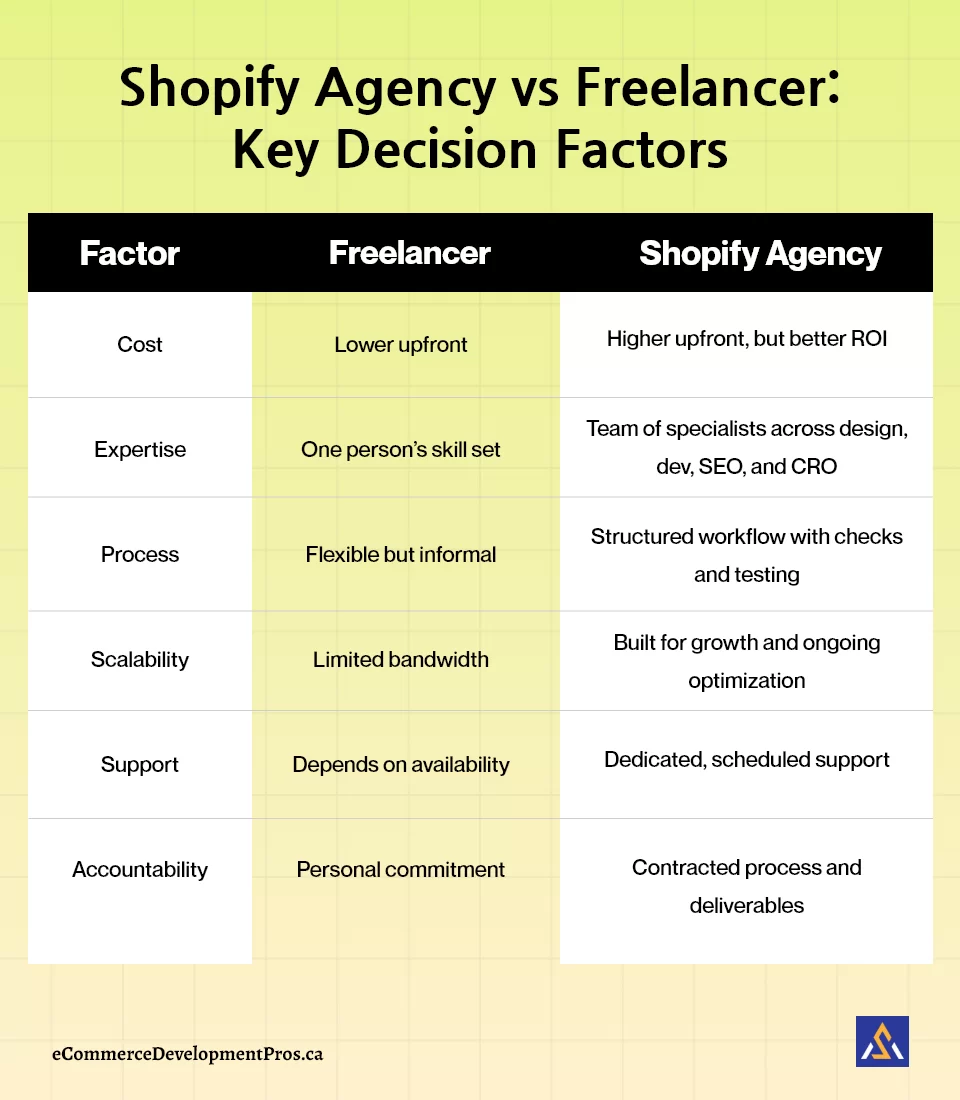
Shopify Agency vs Freelancer: Key Decision Factors to Decide
In the end, the choice is pretty simple once you see it in black and white. Here’s what usually matters most when you’re deciding who to trust with your store:
- Budget: A freelancer will cost less to start. An agency costs more, but you pay once for a store that’s built right.
- Skill depth: A freelancer brings one set of skills. An agency gives you a mix — design, development, CRO, SEO — all working together.
- Process: Freelancers work flexibly; agencies follow a plan. If you want predictable results, the plan wins every time.
- Growth: Freelancers can help you launch. Agencies help you handle what comes after — scaling traffic, improving conversions, and adding new features.
- Support: When things break or need updating, an agency has people in place to respond; a freelancer can only do so much alone.
If you just need to get a site live, a freelancer can absolutely do the job. But if your business relies on steady sales, data, and ongoing improvement, it’s worth investing in a team that builds and maintains for growth.
Shopify Agency vs Freelancer: Choosing What’s Right for Your Store
Every Shopify store starts small.
And, your store deserves more than a launch. It deserves a plan.
For many founders, that first step with a freelancer makes sense — it’s quick, affordable, and gets you moving.
But as your business grows, the work becomes less about getting a site online and more about keeping it performing. That’s where a team built around strategy, UX, and optimization makes a real difference.
An agency isn’t a replacement for freelancers; it’s the next stage. It’s what helps your store evolve from a project into a lasting sales channel.
When you have designers, developers, and marketing specialists all working together, decisions get sharper, results come faster, and growth feels steady instead of accidental.
The right choice depends on where you are now. If you just need to test an idea, start small. If you’re ready to build something that supports your business long term, bring on a team that’s built to think that way.

Let’s Build What’s Next
If your Shopify store has outgrown quick fixes, it might be time for a team that plans, builds, and supports your growth.
We’ve helped brands move from “just live” to “consistently selling.”
Let’s see what that looks like for you.