



 647-812-5125
 Back to Ecommerce Glossary
What Is One-Page Checkout?
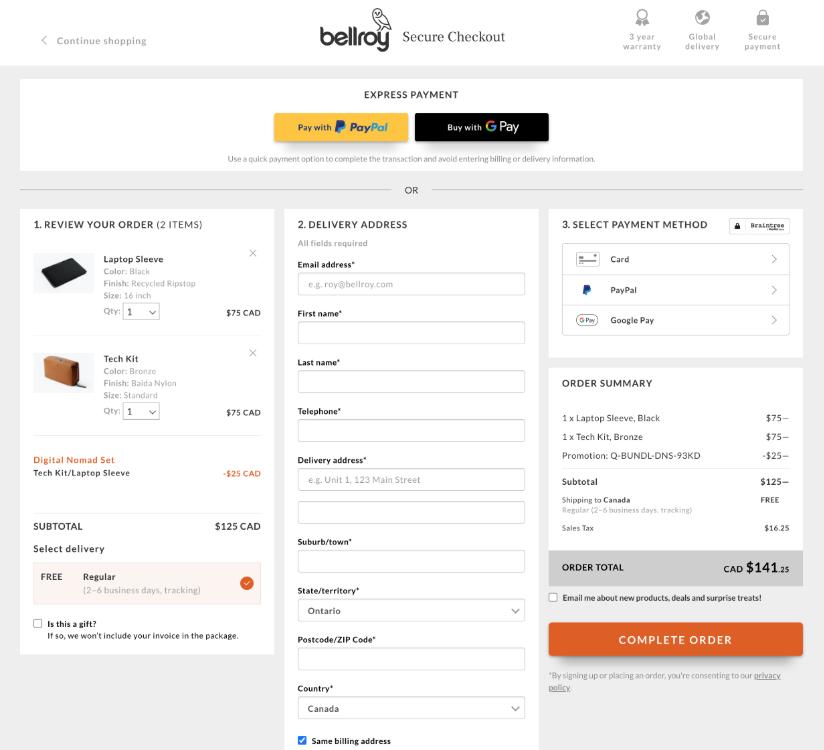
A one-page checkout completes the entire checkout process on a single page.
All key steps like shipping, payment, and order review are visible at once, so customers can place the order without moving through multiple steps or pages.
What Is the Difference Between One-Page Checkout, Multi-Step Checkout, Express Checkout, and Buy Now Button?
Each checkout option results in a finished order. What varies is how the process is set up and how quickly shoppers can complete it.
One-Page Checkout vs Multi-Step Checkout vs Express Checkout vs Buy Now Button |
||||
|---|---|---|---|---|
| Aspect | One-Page Checkout | Multi-Step Checkout | Express Checkout | Buy Now Button |
| How it works | All checkout actions appear on a single page | Checkout is divided into multiple steps or pages | Uses saved customer details to speed up checkout | Sends the shopper directly to checkout |
| Page flow | One continuous checkout screen | Separate pages for shipping, payment, and review | Runs through the standard checkout flow | Bypasses the cart entirely |
| Customer input | Entered manually on one page | Entered manually across steps | Mostly pre-filled | Minimal input required |
| Cart review | Reviewed before checkout | Reviewed before checkout | Reviewed before checkout | Cart review is skipped |
| Relative speed | Faster than multi-step | Slowest option | Faster than standard checkout | Fastest option |
| Best suited for | Stores prioritizing clarity and simplicity | Complex, high-value, or custom orders | Returning or ready-to-buy shoppers | Single-item or impulse purchases |
| Primary strength | Everything visible at once | Clear, guided progression | Reduced typing and friction | Instant purchase flow |
Why Ecommerce Stores Use One-Page Checkout?
One-page checkout simplifies decision-making at checkout, one of several Shopify CRO strategies for reducing friction at the final step.
By avoiding multiple screens, shoppers can move from details to payment with fewer obstacles.
Common reasons:
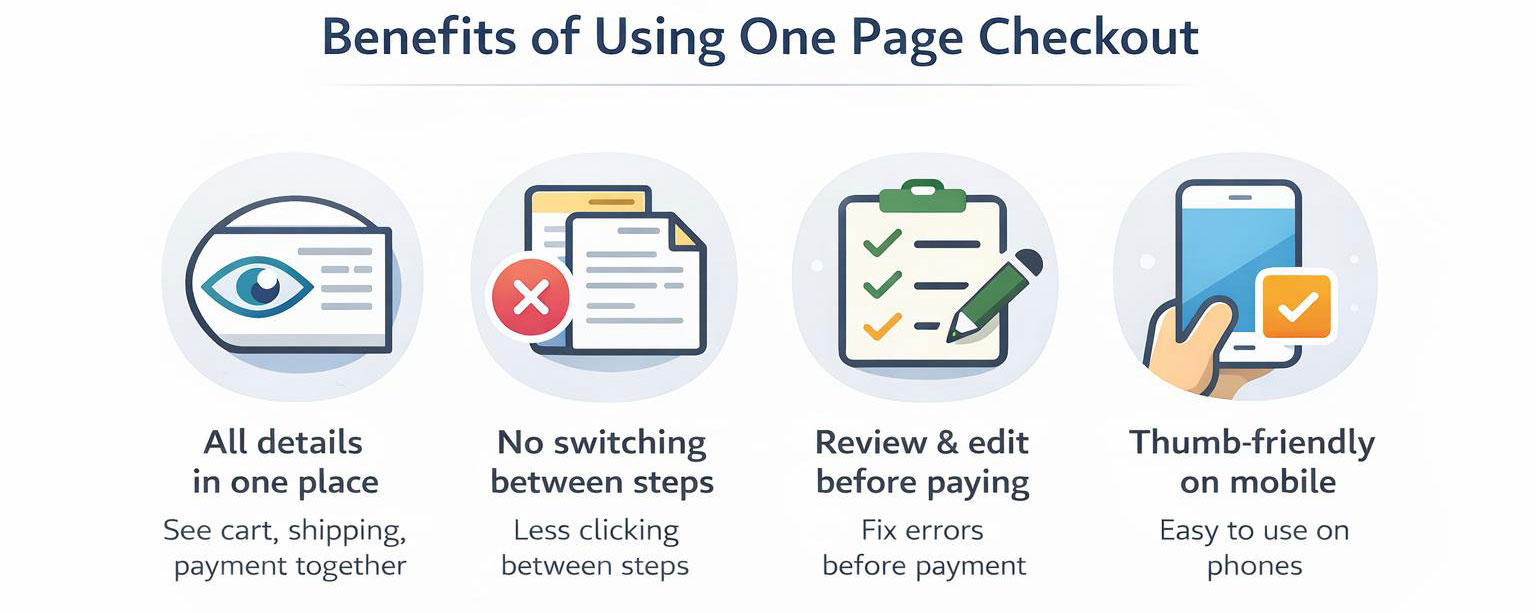
- Checkout feels easier to follow as all the details are shown in one place
- Fewer chances to abandon mid-process due to less number of steps
- Orders can be reviewed before payment
- Better usability on mobile devices
Where One-Page Checkout Fits in the Ecommerce Journey?
One-page checkout sits at the final stage of the ecommerce journey, when a shopper is ready to complete their purchase.
It appears after product selection and cart review, serving as the transition between the cart and order confirmation by keeping shipping, payment, and order details on a single page.
When One-Page Checkout Can Hurt Conversions
One-page checkout can hurt conversions when it tries to do too much at once, which is why checkout layout is a common focus in Shopify conversion optimization.
If the page becomes dense, slow, or unclear, shoppers hesitate—even when they intend to buy.
This often shows up as:
- Form fatigue from too many inputs
- Performance issues on mobile networks
- Poor visual flow
- Lack of reassurance for higher-risk purchases
- Surprise costs at the final step