



 647-812-5125



Quick Answer
A Shopify website can cost anywhere from $300 to more than $60,000 CAD to launch. A basic DIY store typically costs $300-$1,000, while a professionally designed store for a growing business generally costs $3,000-$15,000+. Complex Shopify and Shopify Plus builds with custom design, integrations, and advanced functionality commonly cost $15,000-$60,000+.
When Shopify subscriptions, apps, marketing, content, maintenance, and optimization are included, the first-year total cost of ownership typically ranges from $7,500 to $80,000+ CAD.
Based on our experience building more than 220 Shopify stores, the final cost is usually determined by five factors:
- The level of design customization required
- The number and complexity of features
- Third-party systems and integrations
- Product, customer, and order migration requirements
- The marketing and optimization work required after launch
A higher-priced Shopify store does not simply have a better-looking design. The additional investment usually covers more complex workflows, stronger conversion architecture, integrations, automation, scalability, and long-term operational efficiency.
Shopify Website Cost at a Glance |
|||
|---|---|---|---|
| Store Type | Setup Cost | Ongoing Monthly Cost | Typical Scope |
| DIY Starter | $300-$1,000 | $50-$150 | Shopify plan, free or paid theme, domain, and essential apps |
| Professional Store | $3,000-$15,000+ | $200-$2,500+ | Theme customization or custom design, essential integrations, basic SEO, content, and CRO |
| Custom or Scaling Store | $15,000-$60,000+ | $1,000-$8,000+ | Custom UX, advanced development, system integrations, automation, ongoing optimization, and marketing |
| Shopify Plus | $35,000-$60,000+ | $3,400-$10,000+ | Enterprise commerce, B2B, complex integrations, custom workflows, and growth operations |

Curious to Know What it Would Cost to Build YOUR Shopify Store?
Every store is different. Use our Shopify Cost Calculator to get a personalized estimate based on your specific requirements.
What Do Shopify Websites at Different Price Points Look Like?
Shopify pricing becomes easier to understand when it is connected to actual project scope. The following examples show how store requirements, integrations, product complexity, and design depth affect both budget and development time.
These estimates are based on Shopify projects completed and supported by our team. They are not fixed packages; they illustrate how scope affects cost.
Real Shopify Builds: What It Takes to Launch and Scale
|
||||
|---|---|---|---|---|
| Project | Type | Scope Highlights | Estimated Build Cost (CAD) | Build Time |
| Larch Life | Scaling Store (Sustainable Home Products) |
Theme customization, bundles, visual design, blog content, basic SEO setup | ~$6,000–$7,000 | 3-4 weeks |
| FHENY | Growing Brand (Fashion) | Custom styling, minimalist branded UX, optimized for mobile, app integrations | ~$10,000–$12,000 | 7-8 weeks |
| Vassi.ca | Growing Brand (Apparel) | Collection filters, branded UX, custom fonts, mobile-first navigation | ~$10,000–$15,000 | 7-8 weeks |
| Fence Armor | Growing Brand (Fence Products) |
Mid-size catalog, UX optimization, CRO, educational content, SEO, email + reviews integrations, | ~$18,000–$20,000 | 8-10 weeks |
| Canadian Down & Feather | Enterprise- Shopify Plus / Complex (Home Bedding) |
Advanced filtering, ERP integration, wholesale logic, CRO-focused UX | $35,000–$60,000+ | 14-18 weeks |
EDP Insight
The difference between a $5,000 Shopify store and a $40,000 store is rarely visual design alone. The larger investment usually reflects custom workflows, integrations, conversion strategy, automation, scalable architecture, and the operational complexity behind the storefront.
What Does the Cost of a Shopify Website Include?
The total cost of a Shopify website includes both one-time launch expenses and recurring operating costs. The largest upfront expense is usually design and development, while Shopify subscriptions, apps, marketing, maintenance, and payment processing continue after launch.
The following twelve categories account for most Shopify website expenses.
Shopify Website Design Cost Breakdown by Category |
||||
|---|---|---|---|---|
| # | Cost Category | Typical Cost (CAD) | Cost Frequency | What Impacts This Cost |
| 1 | Shopify Plan | $37–$389/month (Plus from ~$3,400/month) | Ongoing | Sales volume, required features, transaction rate |
| 2 | Theme | $0–$700 | One-time | Free vs premium theme choice |
| 3 | Custom Design & Development | $3,000–$40,000+ | One-time | Feature complexity, integrations, UX scope, scalable architecture |
| 4 | Apps & Integrations | $50–$1,000+/month | Ongoing | Automation tools, AI-powered apps, workflow complexity |
| 5 | Domain Name, Hosting, and Security | $10–$50/year | Annual | Domain extension (.ca, .com, .store) and provider. Hosting and security are included |
| 6 | Payment Processing & POS Fees | ~2.4%–2.8% + 30¢ per transaction plus POS cost | Per Sale | Revenue volume, chosen payment gateway |
| 7 | Content Creation | $0–$10K+ | One-time + Ongoing | Copy creation for product descriptions, collection, blog posts, images (stock or custom photoshoot), and video production |
| 8 | SEO Setup | $1,000–$5,000 | One-time | Technical optimization, structured data, AI discoverability |
| 9 | CRO | $500–$5,000+ | One-time or Ongoing | UX testing, behavioral analysis, AI-assisted optimization |
| 10 | Compliance & Legal | $100–$3,000+ | One-time / Periodic | GDPR, Accessibility updates (CCPA, WCAG), privacy tools |
| 11 | Maintenance & Support | $100–$2,000/month | Ongoing | Regular updates, performance monitoring, automation, and scalability improvements |
| 12 | Marketing & Growth | $1,000–$15,000+/month | Ongoing | Paid media scale, email automation, and content |
Now that you’ve seen how Shopify website costs are structured in 2026, let’s break down each cost driver in detail — starting with the one you can’t skip.
1. How Much Does a Shopify Plan Cost in 2026?
Shopify’s main ecommerce plans in Canada range from approximately $37 to $389 CAD per month when billed annually. Shopify Plus starts at approximately $3,400 CAD per month for businesses with more complex enterprise or B2B requirements.
Annual billing lowers the effective monthly cost, while monthly billing offers more flexibility. The right option depends on your stage, staffing needs, reporting requirements, international selling setup, and transaction volume
Shopify Plan Pricing (2026 Breakdown) |
||||
|---|---|---|---|---|
| Plan | Billed Annually(CAD) | Best For | Core Features | Why Upgrade? |
| Basic | $37 | New or solo-run stores | Online store, secure checkout, Shopify Payments, AI tools, hosting, SSL, unlimited products, standard reporting | Lowest-cost way to launch a professional Shopify store |
| Grow | $99 | Growing brands | Everything in Basic, lower payment processing rates, more staff accounts, enhanced reporting, better shipping discounts | Better operational efficiency as sales and team grow |
| Advanced | $389 | Scaling brands | Everything in Grow, advanced reporting, third-party shipping rates, expanded international selling capabilities | Better reporting, automation, and lower payment fees for higher-volume stores |
| Shopify Plus | From ~$3,400 | Enterprise businesses and complex commerce | Everything in Advanced, custom checkout, advanced B2B capabilities, automation, organization management, expanded APIs, dedicated support | Built for high-volume brands, multi-store operations, and enterprise workflows |
Pricing checked against Shopify Canada’s official pricing page in August 2026. Confirm current Shopify pricing.
How to Choose the Right Shopify Plan
Choose a plan that supports where your business is heading over the next several months. Growth, staff access, reporting, shipping needs, international selling, and payment-fee savings should guide the decision.
Most new stores can begin on Basic. Grow becomes useful when you need additional staff accounts, expanded reporting, or lower processing rates. Advanced is better suited to businesses that need deeper reporting, international controls, or live third-party shipping rates. For a first-year budget breakdown by tier, see our Shopify store cost guide for 2026.
2. How Much Does a Shopify Theme Cost in 2026?
Official Shopify themes generally cost $0 to approximately $700 CAD as a one-time purchase. Themes purchased outside the official Shopify Theme Store may use one-time or recurring licences, depending on the provider..
Shopify Theme Costs 2026 |
|||
|---|---|---|---|
| Theme Type | Cost Range (CAD) | Cost Frequency | What You Get |
| Free Shopify Themes | $0 | Free | 24 official free themes from Shopify, Horizon theme collections. Built for speed, ease of setup, and long-term compatibility with platform updates. |
| Paid Shopify Themes | $100 to ~ $700 | One-time | 1000 + premium options on the Shopify Theme Store. More layouts, sections, performance, and mobile UX. |
| Third-Party Marketplace Themes | $50- $450 | Annual | Wider design variety, but quality varies. Often needs developer cleanup. |
How to Select the Right Theme?
Start by thinking long-term. Official Shopify themes offer stronger compatibility and stability.
Third-party themes provide more variety but may require extra oversight.
For most new and growing stores, a well-structured free or paid theme is more than enough. Custom development usually becomes necessary when branding, UX, or feature requirements go beyond what themes can reasonably support.
Interested in learning more about choosing the right theme? Refer to our complete guide for Shopify theme selection.
3. How Much Does Shopify Development Cost in 2026?
Shopify design and development in 2026 ranges from approximately $3,000 for streamlined builds to $40,000+ for complex implementations.
A disciplined, theme-driven strategy often limits investment to under $8,000.
Custom design systems, advanced features, and robust technical architecture, however, frequently require budgets exceeding $40,000.
Shopify Development Cost Breakdown 2026 |
||
|---|---|---|
| Type of Work | Typical Cost (CAD) | What It Includes |
| Basic Setup | $3,000–$4,000 | Someone helps you launch faster—uploading products, setting up pages, menus, shipping, and taxes. |
| Feature Add-Ons | $1,000–$5,000 | Things like product bundles, customer accounts, subscription options, or “back in stock” alerts. |
| Custom Functionality | $3,000–$15,000+ | Build-your-own-product flows, advanced filters, custom cart logic, or wholesale pricing tools. |
| Full Custom Store | $8,000–$40,000+ | A store built from scratch—designed and developed around your exact products, customers, and workflows. |
Development budget grows when you add:
- Custom buying experiences or pricing logic
- Integrations with backend systems and automation tools
- Deeper UX work around navigation, filtering, and checkout
- A structured foundation built for speed and future expansion
The more operational efficiency you expect from your store, the more development expertise it demands.
4. How Much Do Shopify Apps Cost in 2026?
Most Shopify stores spend $50-$500 CAD per month on apps. A simple launch-stage store may remain below $100 per month, while stores using subscriptions, advanced search, loyalty programs, automation, analytics, or ERP integrations can spend $500-$1,000+ per month.
App costs depend less on the number of apps than on the complexity and scale of the functions they perform.
Typical Shopify App Costs (Monthly) |
||
|---|---|---|
| App Category | Typical Cost (CAD) | What It Covers |
| Basic Utilities | $10–$30 | Announcement bars, cookie banners, SEO helpers |
| Conversion Tools | $20–$100 | AI Search and filters, conversion optimization, upsells, reviews, SMS, popups |
| Subscriptions & Bundles | $50–$300+ | Subscription engines, product bundles |
| Loyalty & Personalization | $100–$500+ | Rewards programs, AI-driven recommendations |
| Advanced Analytics | $100–$500+ | Customer intelligence, attribution tracking |
The Shopify app cost for most launch-stage stores stays under $100/month, whereas Growth-stage and scaling stores often move into the $300–$500+ range. Before adding any app, check Shopify App Store listing for pricing tiers, reviews, and compatibility, or start with our vetted app recommendations.
What Drives Shopify App Costs in 2026?
Rising app costs usually stem from four areas:
- Systems Integration: ERP, CRM, inventory, and accounting connectivity
- Feature Expansion: Subscriptions, bundles, pricing logic, personalization
- UX Optimization: Filters, popups, upsells, search improvements
- Automation & Scale: Workflow automation, fulfillment routing, retention flows
As stores scale on Shopify, these layers become necessary.
However, excessive tool stacking increases recurring subscription costs, site complexity, and long-term technical lock-in.
Smart operators conduct periodic audits to eliminate redundancy and prioritize multi-functional solutions built for long-term scalability.
5. How Much Do Domain, Hosting, and Security Cost on Shopify?
Shopify includes hosting, SSL security, CDN, and server infrastructure in every plan. The only additional cost is your domain name.
Domain & Hosting Costs (2026) |
||
|---|---|---|
| Item | Typical Cost (CAD) | Notes |
| Domain (via Shopify) | $10~$20/year | Managed directly in your Shopify dashboard |
| Domain (third-party provider) | $10–$50/year | Connect your domain with a third-party provider; requires manual connection |
| Hosting | Included | Managed infrastructure, CDN, and uptime monitoring |
| SSL Certificate | Included | Automatic HTTPS encryption |
| Security | Included | Monitoring, updates, and 99.9% uptime |
EDP Insight
Hosting and security are rarely the hidden cost on Shopify — branding is.
A strong domain name is a long-term asset. The annual fee is small, but the impact on trust and recall is significant.
Secure it early. Keep ownership separate. Choose wisely.
6. How Much Does Shopify Payment Processing Cost in 2026?
Shopify Payments online card rates in Canada generally range from approximately 2.4% to 2.8% plus 30 cents per transaction, depending on the plan, card type, and account. Stores using Shopify Payments do not pay Shopify’s additional third-party transaction fee.
Shopify Online Payment Processing Fees |
||
|---|---|---|
| Shopify Plan | Online Rate | Additional Fee (If Using Third-Party Gateway) |
| Basic | 2.8% + 30¢ | +2% |
| Grow | 2.6% + 30¢ | +1% |
| Advanced | 2.4% + 30¢ | +0.6% |
| Shopify Plus | Custom rates | Custom rates |
Using Shopify Payments eliminates the additional third-party transaction fee.
As your revenue grows, upgrading plans can reduce your per-transaction cost — which can meaningfully impact margins at scale.
For physical retail, Shopify POS Pro is listed at approximately $119 CAD per month per location, plus hardware costs.
7. How Much Does Shopify Content Creation Cost in 2026?
Creating content for a Shopify store can cost anywhere from free to well over $10,000, depending on how much help you bring in and how polished you want it to be.
Typical Shopify Content Costs (2026) |
||
|---|---|---|
| Approach | Typical Cost (CAD) | What It Covers |
| DIY / AI-Assisted | $0–$300 | Basic product copy, simple visuals |
| Freelance Copywriter | $500–$3,000+ | Optimized product and collection pages |
| Professional Photography / Video | $500–$5,000+ | Product shoots, lifestyle imagery, demos |
| UGC Platforms | $20–$1,000+/month | Reviews and customer-generated content |
| Full Content Team | $2,000–$10,000+ | Site-wide copy, visuals, conversion-focused messaging |
Costs increase based on product count, SEO depth, brand positioning, and visual production requirements.
A typical eCommerce website usually needs content for high- impact areas such as:
- Homepage messaging
- Product descriptions (benefits over features)
- Collection page summaries
- Visual assets (product + lifestyle)
- Trust-building pages (About, policies)
- Microcopy throughout checkout
- Blog posts
Strong content helps reduce friction, improves conversion rates, helps get discovered by AI systems, and supports SEO simultaneously.
8. How Much Does Shopify SEO Cost in 2026?
A one-time SEO setup for a Shopify store usually lands between $750 and $5,000. The range depends on how much cleanup or restructuring is required.
Most businesses invest $1,500 to $5,000 or more per month for consistent, ongoing SEO work. The higher end applies when the niche is competitive or when steady content and link acquisition are part of the plan.
Shopify SEO Cost Breakdown (2026) |
|||
|---|---|---|---|
| Service Type | Typical Cost (CAD) | Frequency | What It Covers |
| Basic SEO Setup | $750–$5,000 | One-time | Technical SEO, structured data, sitemap setup, crawlability optimization |
| Ongoing SEO | $1,500–$5,000+ | Monthly | Content strategy, keyword targeting, authority building, AI discoverability, performance tracking |
What pushes the SEO cost up?
- Number of products as a store with 50 products is very different from one with 2,000
- Industry– Ranking in fashion isn’t the same as ranking in a niche B2B space
- Content requirements– Some stores need light edits — others need full content builds
- Targeting multiple countries– Cross-border SEO adds another layer
- Deeper technical adjustments for AI discoverability (schema, crawl control, structure fixes) take time
When to Invest in Shopify SEO?
SEO makes sense if you’re building for long-term traffic, entering a competitive category, or expanding into new markets.
If traffic is steady but revenue isn’t moving, it usually makes more sense to fix conversion gaps before putting more money into SEO.
If you’re planning long-term growth, SEO should not work in isolation. It needs to align with content, AI optimization, CRO, and paid acquisition.
Explore our detailed guide on ecommerce marketing strategies to understand how to build a complete growth system around your Shopify store.
9. How Much Does Shopify Conversion Rate Optimization (CRO) Cost in 2026?
A CRO audit usually costs somewhere between $1,000 and $3,000. That’s a one-time deep dive into how your store is actually performing — what’s working, what’s leaking revenue, and where users are dropping off.
Ongoing CRO is a different level of commitment. Monthly testing and improvements usually fall between $1,000 and $5,000+, increasing with traffic and scale.
Shopify CRO Investment Breakdown (2026) |
|||
|---|---|---|---|
| Service | Range (CAD) | Structure | Focus Areas |
| CRO Audit | $1,000–$3,000 | Single engagement | Funnel performance, user behavior review, and friction mapping |
| Ongoing Optimization | $1,000–$5,000+ monthly | Continuous | Experiment design, split testing, conversion improvements, checkout flow refinement |
Why does the CRO cost vary?
CRO cost vary because:
- A store with 5,000 visitors behaves differently from one with 200,000.
- A simple funnel is easier to optimize than a layered one with upsells and bundles.
- The more apps and integrations you run, the more variables there are.
- Frequent testing means more time spent building, measuring, and refining.
- Bigger revenue goals usually demand deeper experimentation.
When Should You Invest in CRO?
Improving your conversion rate isn’t about getting more traffic. It’s about getting more out of the traffic you already have.
- If you’re paying for ads and the numbers aren’t where they should be, CRO matters.
- If people visit but don’t buy, CRO matters.
- If checkout abandonment is high, CRO matters.
If no one is finding your store in the first place, that’s an SEO problem.
If people are finding you but not converting, that’s a CRO problem.
10. How Much Do Compliance and Legal Requirements Cost on Shopify in 2026?
For many Shopify stores, compliance cost falls somewhere between $100 and $3,000+, shaped by location and regulatory requirements.
If you operate in the EU, California, or serve global traffic, privacy tools are usually required. Accessibility work adds another layer of cost.
Typical Shopify Compliance Costs (2026) |
||
|---|---|---|
| Item | Typical Cost (CAD) | When It’s Needed |
| Cookie & Privacy Tools (GDPR, CCPA, consent banners, data requests) | $100–$500 per year | Required for EU, California, or stores with international traffic |
| Accessibility Testing & Fixes (WCAG / AODA) | $1,000–$5,000+ | Recommended before launch or redesign |
| Legal Policy Setup (privacy policy, terms, disclaimers) | Low to moderate | Policy generators or review by a lawyer |
What Does Shopify Cover for Compliance & Security?
Shopify takes care of platform-level security. That includes encryption, PCI compliance, fraud protection, and ongoing system updates.
What it does not handle is your legal compliance.
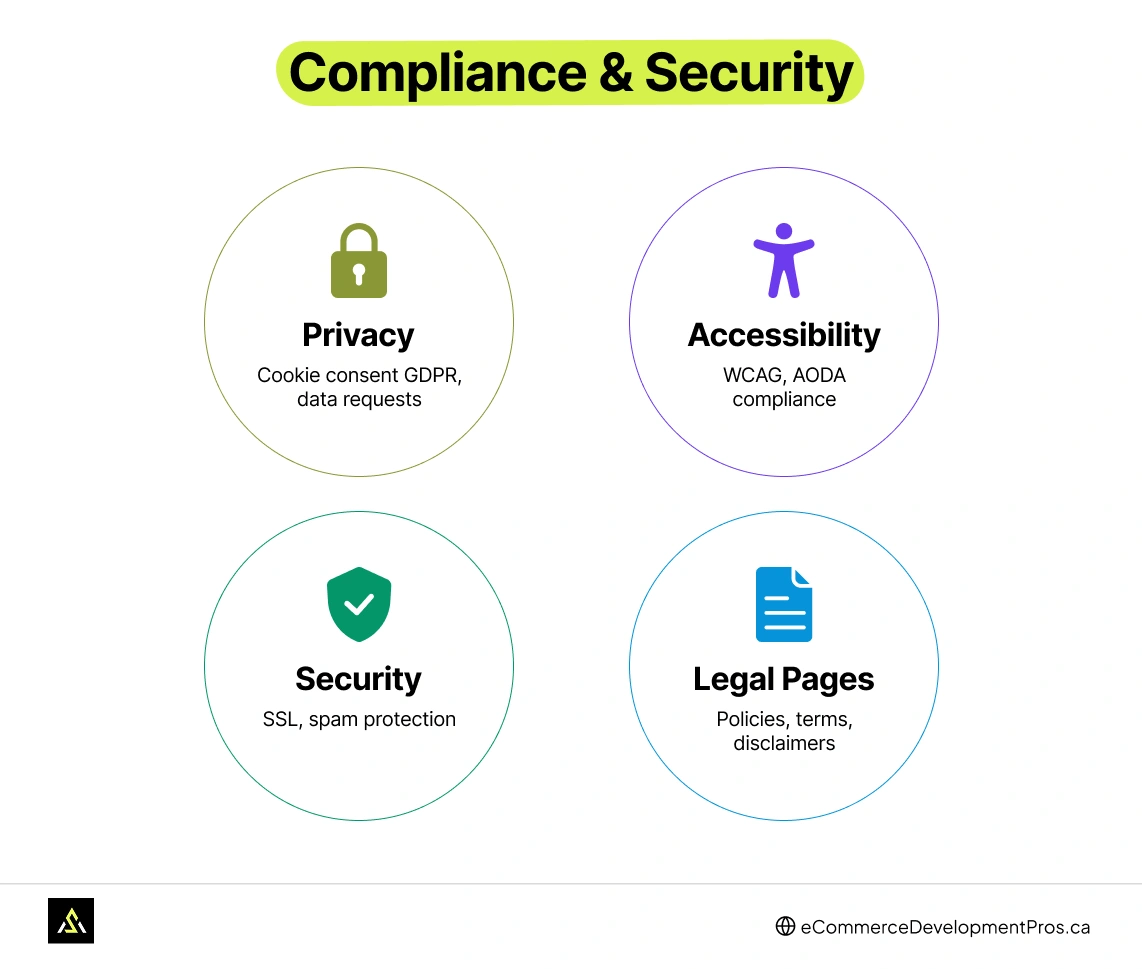
Privacy policies, cookie consent tools, accessibility standards (WCAG, AODA, ADA), and responsible handling of customer data are up to the store owner — especially if you sell in multiple regions.
Every country has its own regulations. Selling internationally adds new compliance requirements.
11. How Much Does Shopify Maintenance & Support Cost in 2026?
Shopify maintenance might cost you $0 if you manage everything yourself. It can also run $2,000+ per month if you bring in outside support.
Shopify handles hosting and security, but the store still needs active management as apps need updates. Integrations break. Pages need testing. Performance drops if no one is watching it. As the store grows, someone has to stay on top of it.
Typical Shopify Maintenance Costs (2026) |
||
|---|---|---|
| Support Type | Typical Cost (CAD) | What It Includes |
| DIY | $0 | Self-managed updates and troubleshooting |
| Freelance / On-Demand | $25–$250/hour | Bug fixes, small updates, and emergency issues |
| Monthly Retainer | $300–$2,000/month | Performance monitoring, compatibility updates, automation checks, scalability improvements |
| In-House Team | Varies | Dedicated development, optimization, and scaling support |
12. How Much Does Shopify Marketing & Promotion Cost in 2026?
Marketing budgets for Shopify stores usually fall between $1,000 and $10,000+ per month, depending on paid media strategy and expansion goals.
Once development is complete, marketing often turns into the largest ongoing investment — and the clearest driver of growth.
Shopify Marketing Cost Breakdown (2026) |
||
|---|---|---|
| Channel | Typical Monthly Cost (CAD) | What It Covers |
| Paid Advertising | $600–$10,000+ | Meta, Google, TikTok ads, retargeting, product testing |
| Email & SMS Marketing | $0–$500+ (tools) | Automation flows, abandoned cart recovery, promotions |
| SEO & Content Marketing | $500–$5,000+ | Organic traffic growth, blog content, and on-page optimization |
| Social Media & UGC | $100–$5,000+ | Creator content, influencer campaigns, customer-generated content |
| Analytics & Attribution | $0–$500+ | Tracking, reporting, and revenue attribution tools |
Marketing costs rise with higher revenue goals, tougher competition, stronger creative demands, and external agency involvement.
There’s no need to activate every channel from day one. Your budget should match your current stage — and your next realistic milestone.
How AI Is Changing Shopify Website Costs in 2026?
In 2026, AI can reduce costs in areas like content drafting, product recommendations, email and customer support automation, customer behaviour analysis and analytics, and basic merchandising. Tasks that once required hours of manual work can now be done faster.
But AI doesn’t replace strategy.
Stores still need:
- Clean site architecture
- Strong product positioning
- Structured data for search and AI visibility
- Ongoing performance oversight
In many cases, AI reduces execution time — but it raises the bar for quality and structure.
- If AI is used well, it lowers operational effort.
- And if AI is used poorly, it creates clutter, automation conflicts, and inconsistent messaging.
The real cost impact depends on how intentionally AI is implemented.
Is Shopify Worth the Investment?
Shopify isn’t always the cheapest way to launch an online store. But in most cases, it’s the smartest one if you build and scale it the right way.
What Makes Shopify Worth It
Shopify gives you more than a storefront. It includes:
- A platform that’s stable and doesn’t need constant fixes
- Hosting, SSL, and updates—already built into your plan
- Tools and apps that help you scale without hiring a full dev team
- A checkout flow that’s been tested (and proven) across millions of transactions
- Built-in AI tools to make setup, merchandising, and support faster than ever
When you compare that to custom builds or platforms that need heavy dev just to stay running, Shopify often comes out ahead in time, money, and flexibility.
What Is the Total Cost of Ownership (TCO) of a Shopify Website?
In 2026, the first-year Total Cost of Ownership (TCO) for most Shopify stores typically falls between $7,500 and $80,000+ CAD
TCO includes both one-time build costs and ongoing operational expenses.
What Shopify TCO Includes
Total Cost of Ownership = Build Investment + (Monthly Operating Costs × 12)
Here’s what usually contributes:
Shopify Total Cost of Ownership (TCO) |
||
|---|---|---|
| Cost Area | Typical Range (CAD) | Frequency |
| Shopify Plan | $49–$517/month (Plus from ~$3,400/month) | Ongoing |
| Apps & Add-ons | $50–$500+/month | Ongoing |
| Theme | $0–$700 | One-time |
| Development | $0 –$30,000+ | Project-based or ongoing |
| Content Creation | $0–$3,000/month | Variable |
| SEO & CRO | $500–$5,000/month | Ongoing or project basis |
| Marketing & Ads | $300–$10,000+/month | Ongoing |
| Maintenance & Support | $100–$2,000/month | Ongoing |
| Domain & Email | $20–$50/year (domain), Email Extra | Annual |
| Compliance & Accessibility | $100–$3,000+/year | As needed |
Why TCO Matters?
Many businesses focus only on setup costs.
But profitability depends on:
- Managing recurring app expenses
- Structuring marketing spend efficiently
- Reducing payment fee leakage
- Planning scalable architecture early
- Avoiding costly rebuilds
A lower launch cost does not always mean lower long-term cost.
It adds up fast on other platforms in comparison to Shopify. With Shopify, most of it’s built in—or easy to plug in.
Shopify vs Other Platforms: First-Year TCO Comparison |
||||
|---|---|---|---|---|
| Platform | Build Cost | Monthly Cost | Year 1 TCO (CAD) | Operational Responsibility |
| Shopify | $5K–$50K+ | $200–$3,000+ | $7.5K–$84K+ | Low, as hosting, security, and updates are managed by the platform |
| WooCommerce | $3K–$40K+ | $30–$3,000+ | $8K–$100K+ | High, as hosting, security, and updates are managed by the store owner |
| Magento (Adobe Commerce) | $10K–$100K+ | $500–$5,000+ | $20K–$200K+ | Very high technical overhead and infrastructure management |
| BigCommerce | $500–$5,000+ | $99–$2,000+ | $8K–$75K+ | Medium offers a SaaS model with managed infrastructure |
Actual costs vary based on complexity, integrations, and growth goals. The difference is often in maintenance responsibility and technical overhead — not just subscription fees.
Final Take: What Does a Shopify Store Really Cost in 2026?
A Shopify store doesn’t stop costing money after launch. The real expense shows up in how you operate and grow it.
In 2026, the first-year total cost of ownership typically ranges from $7,500 to $80,000+ CAD, depending on technical scope, growth ambition, and operational complexity.
That figure includes more than design work. It covers infrastructure, apps, automation, content production, marketing, compliance, and ongoing support.
Shopify’s strength isn’t low entry pricing. It’s the stability of the system and the ability to scale on top of it.
Long-term results depend on how deliberately the store is structured and maintained.
You know what it costs. Now see how we build it.
Take a look at our Shopify web design and development service — our process, portfolio, and what’s included.
Shopify Website Design Cost 2026 FAQ
How much does it cost to build a Shopify website?
A Shopify website costs anywhere from $300 to $60,000+ CAD, depending on how it’s built. A DIY store using a free or paid theme runs $300–$1,000 to set up. A professionally designed store for a growing brand typically falls between $3,000–$15,000+. Full custom builds with advanced integrations run $15,000–$60,000+. Monthly costs on top of that range from $50–$8,000+ depending on your plan, apps, and marketing tools.
👉 See our full Shopify Website Cost Breakdown
Can I build a Shopify website for free?
You can start a free trial and use free themes — but you’ll still need to pay for a Shopify plan ($49+/month CAD) and a domain ($10–$50/year) at minimum. A completely free Shopify store isn’t really possible once you go live.
Why is Shopify so expensive?
Shopify plans in Canada run $49–$517/month CAD, with Plus starting around $3,400/month. Total monthly costs, including apps and tools, typically run $200–$800+ for a growing store. The platform bundles hosting, security, checkout, and updates — costs climb when premium apps, paid themes, and custom development are added.
Shopify is not expensive—if you use it right. Shopify handles hosting, security, checkout, updates, and more, which saves you a lot of money.
👉 See our Total Cost of Ownership guide for more.
How much does Shopify charge per sale?
Shopify doesn’t take a cut of your sales directly, but transaction fees apply based on your plan.
For Shopify Payments in Canada: 2.4%–2.8% + 30¢ CAD online, 2.4%–2.6% + 0¢ in person. Third-party payment processors (PayPal, Stripe, BNPL payment options) add 0.6%–2%, depending on your plan.
Do I need to hire a Shopify developer?
Not always. A clean theme with a few solid apps is enough to launch a basic store without custom code. If you need bundles, subscriptions, advanced filters, or B2B logic, a developer or agency saves time and avoids costly mistakes. Custom development typically runs $3,000–$40,000+ CAD, depending on scope and complexity.
👉 Check our guide to Shopify Development Costs
How much should I budget for Shopify apps?
Most stores spend $50–$500/month on apps, depending on their stage. Start with essentials only — email, reviews, SEO, and one or two key features. App costs scale with automation tools, AI-powered integrations, and workflow complexity as the store grows.
👉 See our Shopify App Cost Breakdown
What’s the best Shopify plan for new stores?
For most new stores, Basic is the right starting point — and honestly, it’s more capable than people expect. You get a fully functional store, unlimited products, discount codes, and abandoned cart recovery. The gap between Basic and the higher tiers mostly comes down to reporting depth and transaction fees, neither of which matters much until you’re doing real volume.
We typically recommend upgrading to Grow when you’re consistently hitting $5K–$10K/month and want better analytics to inform decisions. Advanced makes sense when your transaction fee savings start to outweigh the plan cost — that math usually works out around $50K+/month in revenue.
Shopify Plus is a different category entirely — it’s built for high-volume merchants with complex operations, not a store that’s still finding its footing.
The short answer: launch on Basic, keep your budget for marketing and inventory, and let your revenue tell you when it’s time to move up.
👉 See a full plan breakdown with cost comparisons
What’s the difference between using a paid theme and going custom?
A paid theme is the right call when you’re still testing the market. You’re not trying to win on design at that stage — you’re trying to learn whether people want what you’re selling. A well-configured theme on Shopify does that job fine, and it gets you live in days rather than weeks.
Custom design becomes worth the investment once you know your market and you’re leaving money on the table because of it — awkward navigation, a checkout flow that doesn’t match how your customers think, or a brand that looks identical to your competitors. That’s when the economics shift.
The honest test: if a customer landing on your store can’t immediately tell what you sell, who it’s for, and why they should trust you — a theme won’t fix that. Custom work will.
👉 Not sure where you fall? Our Shopify Cost Calculator can help you figure out what makes sense for your budget and stage.
What is the Total Cost of Ownership (TCO) for a Shopify store?
The TCO for a mid-size Shopify store generally falls between $7,500 and $80,000+ over the first year. That covers design, development, the Shopify plan, apps, content, and ongoing marketing. DIY stores sit at the lower end — custom-built stores with full growth operations land at the higher end.
👉 Learn more about Shopify TCO here
How long does it take to build a Shopify website?
A theme-based store can launch in 3–4 weeks with content ready to go. A growing brand store typically takes 7–10 weeks. Custom enterprise builds with advanced integrations run 14–18 weeks.
Build time depends on scope, number of pages, and how quickly feedback rounds move.
Is Shopify worth it for small businesses?
Shopify’s Basic plan is $49 CAD/month and covers hosting, checkout, payment processing, and a mobile-ready store out of the box. Most small businesses don’t need anything else to get started. And when the business grows, the platform grows with it — no rebuilding on something new down the road.
How much does Shopify maintenance cost per month?
At eCommerce Development Pros, the Essential Care plan starts at $349/month and handles day-to-day upkeep. Growth Optimization ($649/month) brings in CRO, speed work, and UX improvements. Performance Plus ($949/month) is built for DTC and Shopify Plus stores that need someone watching things closely. See our Shopify maintenance plans for more details.

Ready to Build Smart on Shopify?
Whether you’re launching or scaling, we’ll help you map the right build- based on your goals, not guesswork.
Let’s talk about what your store needs- and what it should cost.