



 647-812-5125
 Back to Ecommerce Glossary
What Is an Online Marketplace?
An online marketplace works much like a shopping mall online where separate sellers run their own shops, but everything is listed and sold on the same website.
- The marketplace owner runs the website itself, including how checkout works.
- Each seller takes care of their own product listings and stock.
- Shoppers can look through products from different sellers and pay for everything in a single order.
What Are the Common Examples of Online Marketplaces?
A few widely recognized marketplace platforms are:
- Amazon – Hosts millions of third-party sellers in addition to selling its own products.
- Etsy – Provides a platform for independent sellers specializing in handcrafted and unique goods.
- eBay – Operates as a marketplace where both casual sellers and companies sell new or used goods.
- Walmart Marketplace – Allows outside sellers to offer products through Walmart’s established online store.
All these platforms:
- Do not own most of the inventory
- Independent sellers provide the products or services
- Customers transact through the platform
This structure — multiple sellers operating under one digital roof — is what defines an online marketplace.
How an Online Marketplace Works?
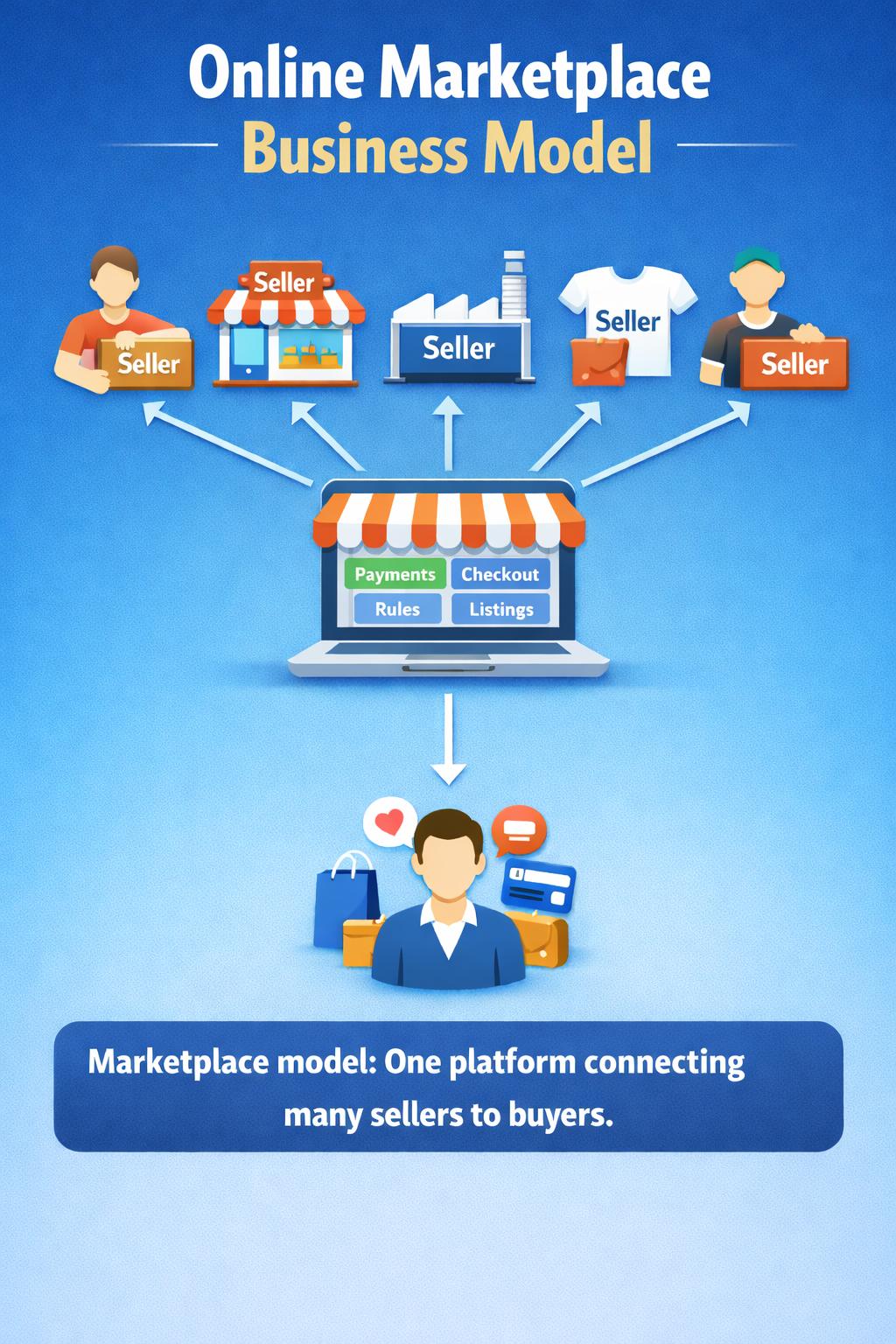
An online marketplace works by letting multiple sellers list products on a shared platform that manages checkout while sellers handle inventory and fulfillment.
The online marketplace model works in the following way:
- Sellers list products on the marketplace
- Customers browse, compare, and place orders
- The platform manages the storefront and transaction flow
- Sellers fulfill orders and handle inventory
The marketplace acts as an intermediary between buyers and sellers.
What Makes a Business an Online Marketplace?
A business becomes an online marketplace when different sellers are listing products on the same site — and the company behind it is handling the system, checkout, and rules.
Core Criteria
A website qualifies as an online marketplace if:
- It has multiple independent sellers
Different businesses list and sell products on the same platform. - It brings sellers under one buying journey
Shoppers browse across multiple sellers, but everything happens inside one website and one checkout system. - The platform manages the transaction
Payments, checkout flow, and order processing run through the marketplace — not through individual sellers.
What Is the Difference Between Online Marketplace, Ecommerce Store, and Dropshipping?
Many businesses mix up marketplace, ecommerce store, and dropshipping — three distinct ecommerce business models that overlap but aren’t the same.
Here is a simple comparison to separate them:
Online Marketplace vs Ecommerce Store vs Dropshipping |
|||
|---|---|---|---|
| Aspect | Online Marketplace | Ecommerce Store | Dropshipping |
| What it describes | A platform that allows multiple sellers to sell | A single business selling its own products | A fulfillment method where products ship from a supplier |
| Who is selling | Many independent sellers | One brand or business | One brand or business |
| Who owns the products | Individual sellers | The store owner | The supplier |
| Who manages inventory | Each seller manages their own stock | The store manages its inventory | The supplier manages stock |
| Who controls checkout | The platform controls the checkout experience | The brand controls its own checkout | The brand controls checkout |
| Customer relationship | Primarily owned by the platform | Owned by the brand | Owned by the brand |
| Revenue model | Commission or listing fees | Product sales margin | Product margin without holding inventory |
What Are the Benefits of an Online Marketplace for Buyers and Sellers?
A marketplace isn’t just a website. It’s a system that benefits both sides at once.
Online Marketplace Value for Buyers and Sellers |
|
|---|---|
| From the Buyer’s Perspective | From the Seller’s Perspective |
| Finds multiple sellers in one place | Taps into customers who are already searching |
| Avoids jumping between different stores | Skips building a full ecommerce setup |
| Uses platform reviews to make decisions | Uses the platform’s checkout and payment flow |
| Pays securely through one system | Enters the market with lower upfront cost |
| Buys from different sellers in one order | Grows sales without running backend systems |
As more sellers participate, product variety expands.
As variety expands, buyer traffic grows.
That growth attracts even more sellers.
Over time, this compounding effect strengthens the platform.
What Are the Trade-Offs of an Online Marketplace?
An online marketplace offers reach and infrastructure, but it also comes with limitations. Businesses give up some control in exchange for access to demand.
Some of the most common limitations are:
- High competition: Sellers frequently compete against near-identical listings in the same search results.
- Platform fees: Marketplaces typically charge commissions, listing fees, or subscription costs.
- Limited brand control: Sellers must work within the platform’s design and operating rules.
- Restricted customer data access: The platform often owns the primary customer relationship.
- Dependence on platform policies: Changes in fees, search visibility, or rules can directly affect sales.
When an Online Marketplace Model Makes Sense?
A marketplace model makes sense when the business isn’t trying to own inventory — it’s trying to organize supply.
It works well when:
- Products come from many different suppliers. No single brand controls the catalog.
- Customers want options. Comparison matters — price, seller ratings, availability.
- The platform’s role is coordination. It sets the rules, handles checkout, and builds trust.
Growth comes from adding sellers. The more vendors join, the more useful the platform becomes.