



 647-812-5125



🎯This Is for eCommerce Founders Who Don’t Want to Guess.
If you’re building a Shopify store around a new product idea, this post might just save you from a painful, expensive flop.
Here’s the truth: most eCommerce launches fail because people skip Shopify product validation. They fall in love with the product, assume demand, and go straight to build mode. Then reality hits—and it’s quiet.
This guide is for you if:
- You’re in the pre-launch phase and want more than a “let’s see what happens” strategy backed by real product concept validation.
- You’re growing a DTC brand and want to validate product ideas before investing in inventory, design, or ads.
- You’re part of an agency or growth team, helping brands de-risk their next launch with proper eCommerce product research.
- Or maybe you’ve been here before—launched something you thought people wanted, only to hear… nothing.
If any of that hits home, you’re in the right room. What follows isn’t theory. It’s a practical pre-launch product validation playbook to help you test smarter, launch cleaner, and sell faster—with proof in hand.
Why Most Shopify Launches Fail (And How Yours Won’t)
Every product idea is a hypothesis.
That might feel weird to hear, especially if you’re already in love with your idea. But here’s the hard truth: until people pay you (or at least signal serious intent), your idea is just that — an idea.
And in the Shopify world, launching a product is easier than ever. The real challenge? Make sure you’re building something people actually want before sinking time, money, and energy into a full-blown store.
That’s where Shopify product validation comes in. This isn’t about vague “gut feelings” or friendly feedback. It’s about creating real-world signals that your product has legs.
In this post, I’ll show you exactly how to validate your product idea using a framework we call the Signal Stack, along with free and paid tactics, examples from DTC brands, and a no-fluff scorecard for knowing when you’re ready to launch.
Let’s dive in.
Understanding Product Validation
Before we go tactical, let’s get clear on the strategy.
Product concept validation is about answering one core question:
- Will people actually buy this product?
That’s different from:
- Customer validation – Am I targeting the right people?
- Market validation – Is the broader market worth entering?
While all three matter, shopify product validation is your first gate. You’re looking for data-backed eCommerce product research that proves your specific offer resonates before you spend a dollar on inventory or build out a Shopify store.
Spoiler: Validation isn’t your friends telling you it’s “cool.” It’s email signups, landing page opt-ins, pre-orders, and people voting with their wallets.
Product Idea Validation – The Signal Stack Framework
In early-stage eCommerce product idea validation is the most overlooked. It isn’t binary. It’s not a yes-or-no decision, and it’s definitely not a gut call based on a few DMs or some “likes” on a teaser post.
That’s why we use what we call the Signal Stack — a layered validation framework designed to capture meaningful, directional proof that your idea has traction.
Why a Stack?
Because :
- No single signal is reliable on its own.
- Likes may look good, but they often mean very little.
- A high CTR doesn’t always reflect real buying intent.
- A signup doesn’t guarantee the person is ready to purchase.
The goal is to read the bigger picture, not single metrics in isolation. The Signal Stack lets you do exactly that — layering engagement data, conversion behavior, real feedback, and follow-up actions to see whether your product idea genuinely connects with people.
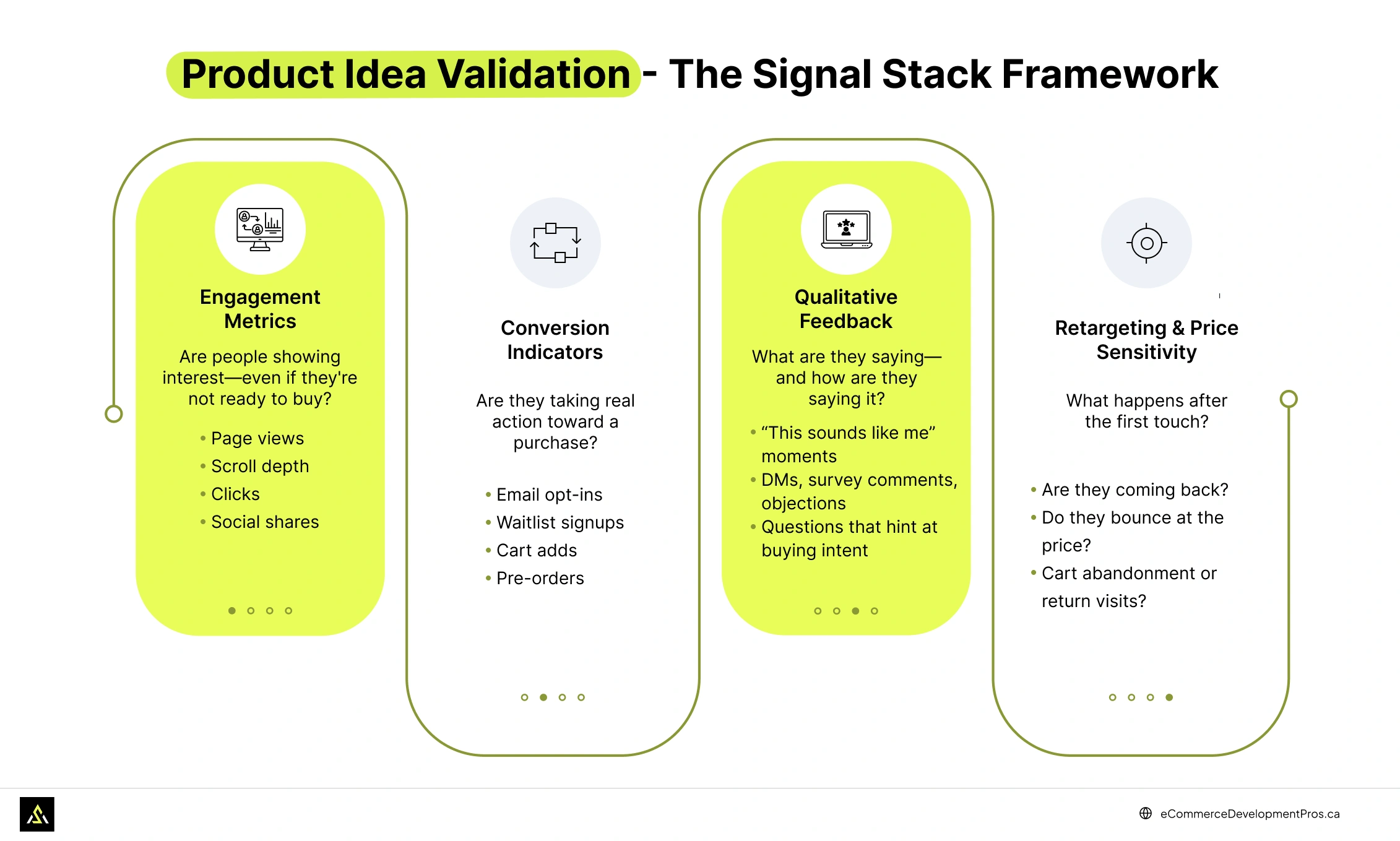
Observe how it works:
🔹 Engagement Metrics
Are people interacting with your early concepts even if they’re not buying yet?
This is your first sign of interest. When people land on your MVP landing page, what do they do?
Monitor the following metrics:
- Time on page: Are they spending time reading your offer?
- Scroll depth: Are they reaching the CTA or bouncing early?
- Bounce rate: Do they leave immediately?
- Social shares or saves: Do they think it’s worth sharing?
These indicators suggest that someone finds your idea at least intriguing—but they’re not enough on their own. Treat them as soft signals.
Think of engagement as “curiosity.” It’s the top of the MVP for the Shopify store validation funnel.
🔹 Conversion Indicators
Are they taking tangible action that suggests intent?
This is where validation gets real. A user who hands over their email, joins a waitlist, or hits “add to cart” is showing clearer buying behavior.
Conversion signals include:
- Email opt-ins for early access
- Waitlist signups (with or without incentives)
- Pre-orders (even if you’re not shipping yet)
- Product quiz completions with an opt-in
- Cart additions or checkout starts (even without a final purchase)
The more friction involved—and the more they’re still willing to act—the stronger the signal.
A conversion is someone “voting” for your product with time, data, or money. These are essential to test product demand online strategies.
🔹 Qualitative Feedback
Pay attention to what people say—and how they say it.
The numbers help, but tone tells you more.
This part of the validation moves past dashboards.
It’s about real words from real people.
Here’s how to read those qualitative signals:
- Open-form surveys (“What would make this a must-buy?”)
- Instagram DMs and email replies with emotional language
- Community reactions on Reddit, Discord, or Facebook groups
- Objections and questions (“Does this come in a larger size?”) = purchase intent cues
- “This sounds like me” moments – when someone self-identifies with your product’s positioning
Pay attention to patterns.
- Are people confused about the offer?
- Are they excited?
- Are they asking the same questions repeatedly?
That’s all signal.
Feedback helps you uncover why people are (or aren’t) converting—and how to tweak messaging, product, or price.
🔹 Bonus Layer: Retargeting & Price Tests
- Are people returning?
- Are they price-sensitive?
- Are they ghosting after checkout?
This layer is all about post-touch behavior—what happens after the first visit.
How to track it:
- Retargeting audiences: High return visitor % = deeper interest
- Cart abandon data: Did they hesitate at shipping? Price? Options?
- Price sensitivity tests: Run A/B landing pages with different pricing or offers
- Time between touches: Do they revisit 2–3 days later? That’s a strong signal.
These are advanced signals, but they tell you if someone is truly deliberating a purchase—not just passing by.
🚨 One Signal Is a Maybe. A Stack Is a Green Light.
This is where most product ideas go wrong. Founders see one encouraging signal and sprint toward launch. But:
- High engagement + no opt-ins = not validated
- High opt-ins + terrible pre-order rate = needs refining
- Glowing feedback but no conversions = vanity traction
You’re looking for alignment. Multiple signals from different layers—interest, intent, feedback, behavior—all pointing in the same direction.
That’s when you know it’s go time.
Product Validation Tactics and Tools
At this point, you know what signals to look for – engagement, conversion, feedback, and behavioral proof.
Now, let’s talk about how to generate those signals to validate your product idea.
The tactics below are split into low-cost (lean and scrappy) and advanced (fast and scalable).
Both are effective; the difference is how quickly and deeply they generate insight.
💸 Low-Cost Validation Tactics
For early-stage MVP for Shopify store testing, simplicity wins.
You don’t need a dev team or a big ad budget to validate a product idea. Some of the best signals come from using simple, no-code tools and real communities.
You don’t need a big stack. You need to test fast and learn what sticks.
Try these steps and see if your idea has traction:
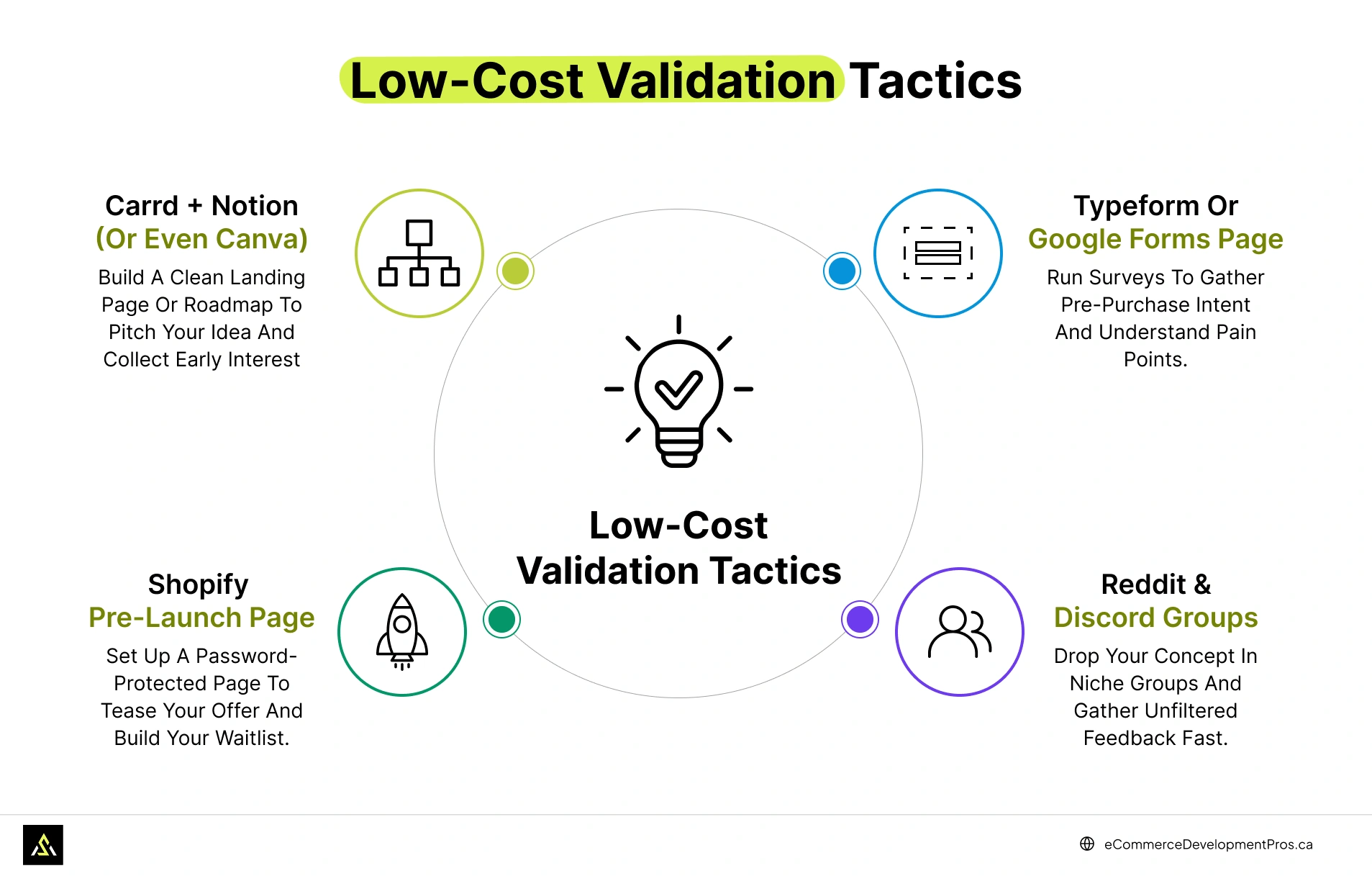
🛠️ Carrd + Notion (or Canva)
First, put together a clean, simple page.
Then add one short headline and a single clear action you want people to take.
After that, drop in a few mockups or product images so the idea feels real.
Link a form so people can leave an email.
Why it works: it feels real enough that people decide on instinct, interested or not.
📝 Typeform or Google Forms
Run a short survey.
Ask what problem people still have in your space.
Add one line at the end: “Want me to tell you when it launches?”
Why it helps: you learn what hurts and who cares enough to answer.
Pro tip: Add a question like, “Would you like to be notified if we build this?” → Build your early list on the spot.
🛍️ Shopify Pre-Launch Page
Create a password-protected page.
Keep it simple—headline, short copy, one signup box.
Use it as a teaser to collect interest.
Tip: “Coming soon” often does the work for you; it builds a small sense of urgency.
This approach gives the impression that something is coming—urgency and exclusivity help generate opt-ins.
💬 Reddit and Discord Groups
Find the corners of the internet where your buyers hang out.
Share your idea plainly.
Ask, “Does this solve anything for you?”
Watch the replies.
Questions show doubt.
Excitement shows fit.
Bonus: run a poll. Let them choose between two versions.
Bonus Tactic: Run a poll: “Which product would you buy?”
This simple prompt helps test positioning, price points, and emotional pull.
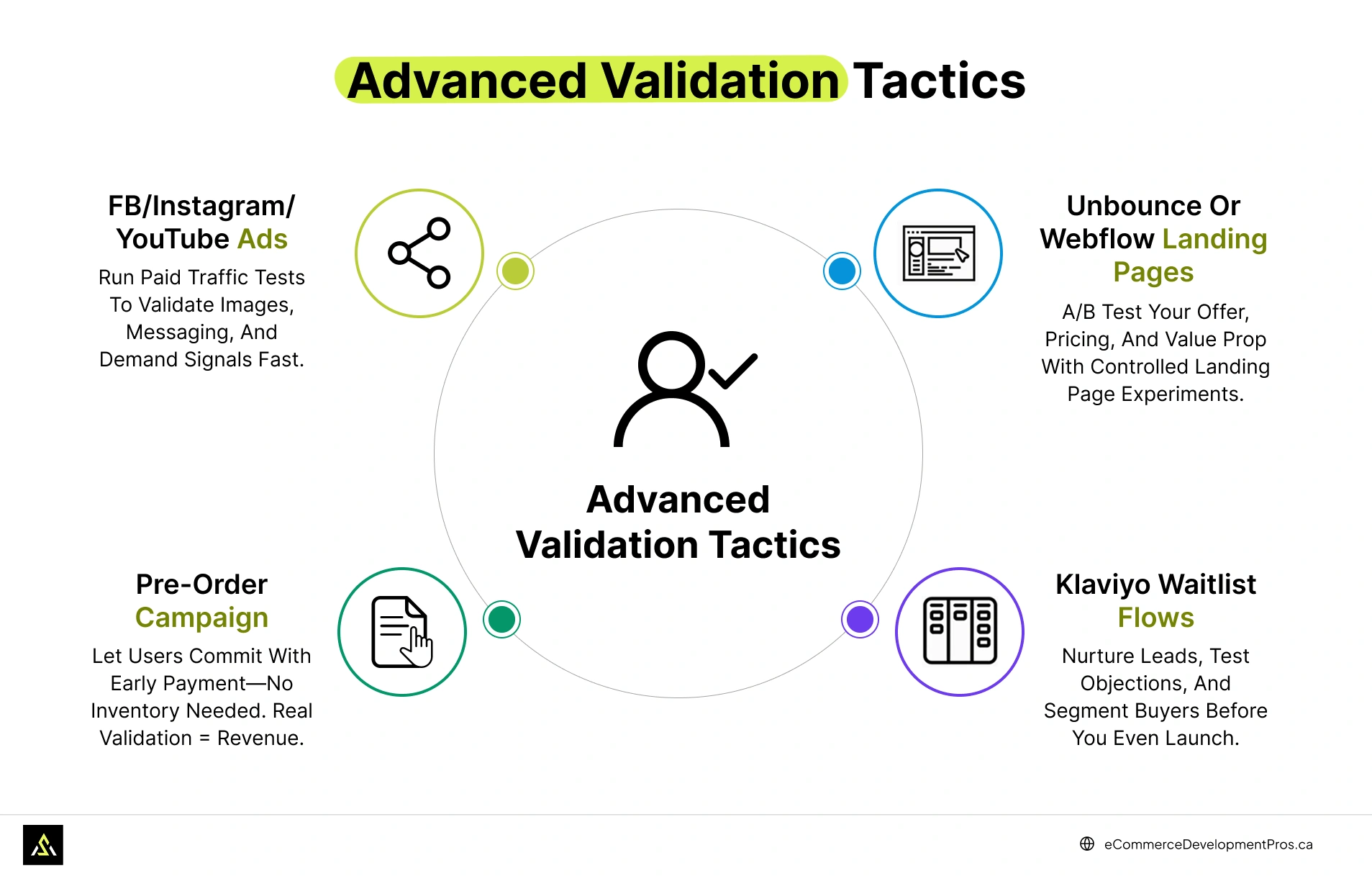
💰 When you’re ready to spend a bit
📱 Facebook, Instagram, or YouTube Ads
Run a few small ads with different images and headlines.
Send people to your page.
See which ad wins. That’s your real-world message test.
Pro tip: The image/headline combo with the highest CTR tells you what messaging resonates most.
🧪 Unbounce or Webflow Pages
Build two short pages.
Change one thing—price, headline, or button.
See which one converts better.
🛒 Pre-Order Campaigns
Ask people to reserve early.
Offer a small discount.
Be clear about delivery time.
Even a handful of real pre-orders means something clicked.
🔄 Klaviyo Waitlist Emails
After someone joins, send two or three short emails.
Ask what they liked, what stopped them, what they’d change.
Their words tell you who’s ready to buy.
🧠 Don’t Forget Behavioral Analytics
Regardless of which tactic you choose, install behavioral tracking.
Use tools like:
These tools let you:
- Watch scroll and click heatmaps
- Identify rage clicks or exit points
- Analyze how far users get before bouncing
Use these tools to test product demand online with measurable, repeatable outcomes.
Product Idea Validation Case Studies: Real-World Examples
It’s one thing to talk about validation frameworks. It’s another to see them in motion. Below are a few validation case studies that illustrate how smart DTC brands—big and small—put their ideas to the test before fully launching.
None of them relied on luck. All of them focused on real signals—and it made all the difference.
🧃 OLIPOP’s Flavor Expansion: Listening Before Launching
OLIPOP, the fast-growing functional soda brand, didn’t just drop new SKUs and hope for the best. Before expanding their product line, they turned to their most valuable resource: their own customers.
How they validated:
- Sent out email polls to their existing subscriber list
- Asked customers to vote on upcoming flavor options
- Encouraged open-ended write-ins and feedback
What they got:
- Thousands of responses
- Clear quantitative data on which flavors were most desirable
- Qualitative insights that helped with naming, messaging, and even packaging
Why it worked:
They weren’t asking strangers on the internet. They used customer validation strategies and tapped into a loyal community already engaged with the brand. The feedback loop was immediate, authentic, and actionable.
🔁 Takeaway: If you’ve already got an audience—even a small one—they’re your testing ground. Don’t guess. Ask.
👟 Sneaker Startup (Anonymous): Battle of the Styles
A small sneaker label had two new designs.
Both looked good on paper.
They didn’t know which one people would actually wear.
Therefore, instead of guessing, they ran a quick test.
How they tested:
- Spent $500 on Instagram Story ads for sneaker fans.
- Asked one simple question: Style A or Style B?
- Tracked votes, swipe-ups, and email sign-ups for each.
What happened:
One design won fast.
More clicks. More sign-ups.
After launch, it sold three times better than the other pair.
The comments helped shape the story and product pitch.
Why it worked:
They used ads to learn, not to sell.
Every click was a signal.
The audience told them where to go next.
🧠 Takeaway: Ads don’t have to sell. Sometimes they’re just a quick way to listen.
🕯️ Candle Brand: Demand Before Stock
A small candle maker didn’t wait for shelves to fill.
They wanted proof first.
How they tested:
- Built one simple page on Carrd with clean mockups.
- Offered 20 percent off for early pre-orders.
- Set a small public goal: “500 sign-ups before launch.”
What they saw:
637 people signed up in six days.
They built a list and a small community before making a single candle.
That traction helped them get better supplier pricing.
Why it worked:
They made the offer feel real even before it existed.
Early access created a bit of pressure, but in a good way.
No leftover stock. No big risk.
Takeaway: You don’t need inventory to prove demand. You just need a clear promise—and people willing to raise a hand.
✅ The Common Thread
Each of these brands used simple tactics—polls, landing pages, low-budget ads—but paired them with the right mindset:
- They measured.
- They iterated.
- They didn’t wait until launch to listen.
This is the validation mindset. And it’s how you build a product that actually sells on Shopify or anywhere else. A strong product validation framework.
Assessing Product Idea Validation Results: Are You Ready to Launch?
So, you’ve launched your landing page, pushed out some ads, collected emails, and maybe even pre-orders. But here’s the real question:
How do you know when you’ve validated your product enough to go from “idea” to “build”?
Too many DTC founders either:
- Pull the trigger too early (based on hype, not proof), or
- Stay stuck in validation limbo, always testing, never building.
Let’s fix that with a clear, flexible framework to help you decide when you’re truly ready to move forward – with everything from eCommerce product research to launch.
📊 Your Validation Benchmark Cheat Sheet
Every product and niche is a little different, but here are some battle-tested benchmarks that signal strong early traction:
| Metric | What It Measures | Threshold |
| Email Opt-in Rate | Interest in offer | > 25% = strong signal |
| Click-Through Rate (CTR) | Resonance of messaging (ads) | > 1% = meaningful traction |
| Pre-order Conversion Rate | Purchase intent under friction | > 5% = solid green light |
| Landing Page Bounce Rate | Message clarity & fit | < 55% =compelling story |
These are not arbitrary numbers—they reflect patterns observed in successful MVP for Shopify store launches and real-world product market fit journeys.
If you’re consistently hitting (or exceeding) these numbers—especially across multiple signals in your Signal Stack—you’re probably ready to build, launch, and scale.
Validation is about pattern recognition, context, and avoiding false positives.
🚨 Beware of Pre-Launch Validation Traps
Early numbers can fool you.
Good surface stats. Bad sales. Happens a lot.
❌ High engagement, no conversions
Shares go up. Time on page looks great.
But… no sign-ups. No pre-orders. No checkouts.
That’s a problem.
Why this happens
- Fun idea, not a needed one.
- Message feels nice, but doesn’t solve anything.
- Offer isn’t clear or strong enough.
Fix it
- Tighten the offer. Make the value obvious.
- Add one clear CTA.
- Test price, guarantee, and shipping copy.
❌ Vanity metrics
Likes. Follows. “This looks cool.”
Nice to have. Not proof.
Do this instead —
- Track actions: sign-ups, waitlists, pre-orders, surveys with real answers.
- Score by intent: email + quiz + checkout start > a “like.”
- Cut audiences that don’t click or opt in.
❌ Out-of-Context Validation
Testing with the wrong audience skews results. If your ads are attracting unqualified traffic (wrong country, wrong age, wrong intent), a 1% CTR isn’t validation—it’s noise.
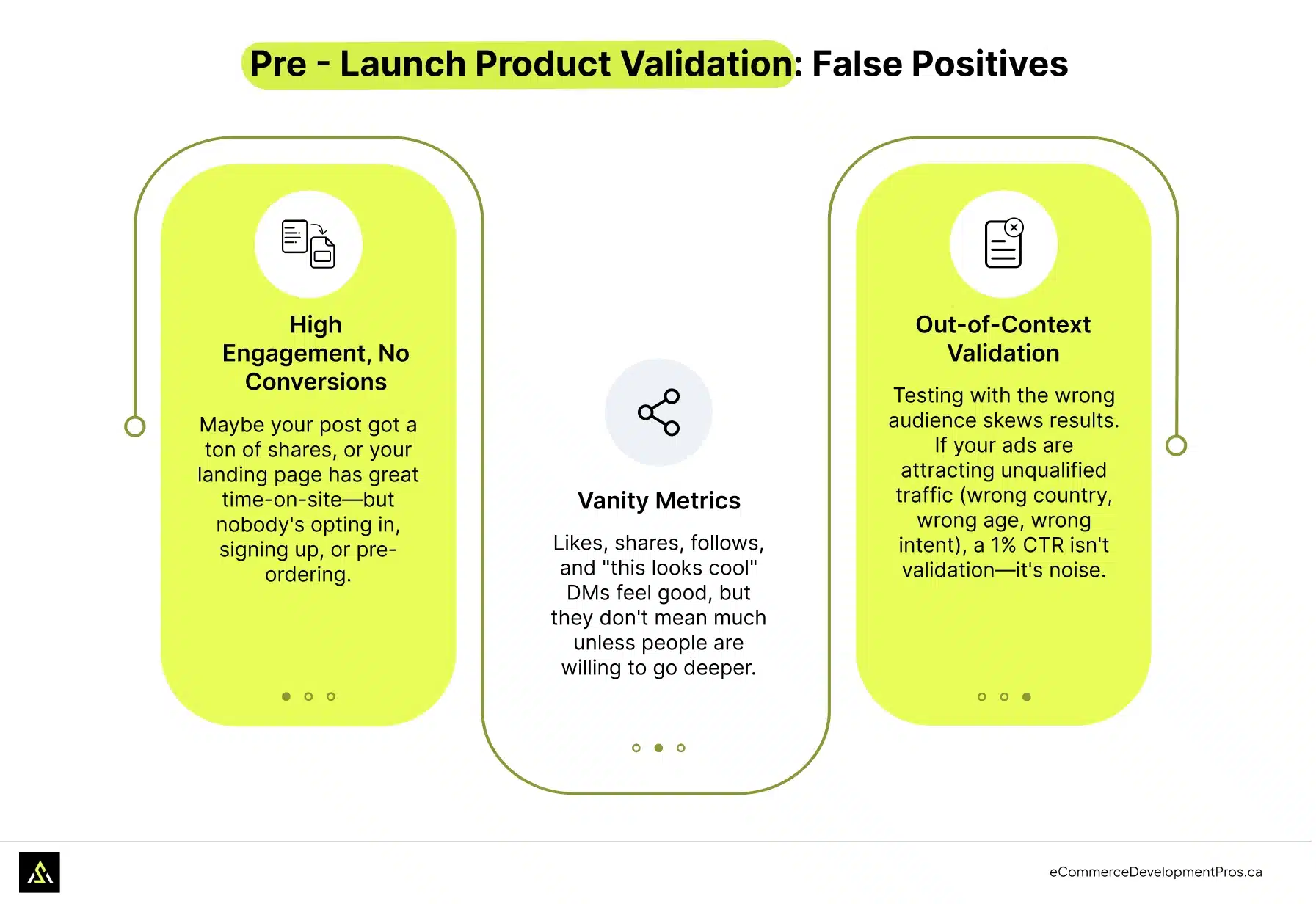
These are classic traps in test product demand online experiments—look past the noise and trust multi-layered signals.
Pro tip: Always double-check who your signals are coming from—not just what they are.
🚀 Traction Triggers: When to Move Forward
We use the term “Traction Triggers” to describe the early, measurable signs that your product has the momentum it needs.
Here’s what solid shopify product validation looks like in action:
- 300+ waitlist signups in 7 days
- 10% of survey respondents opting into a preorder
- Positive feedback that echoes across channels – “This is exactly what I’ve been looking for.”
- Returning visitors checking your offer more than once
- Steady pre-orders without pushing discounts
The key is not just volume but consistency across your validation stack.
One spike?
- Interesting.
Sustained traction across signals?
- That’s your green light. 🟢
✅ Final Check
Ask yourself:
- Are the signals you’re collecting lining up the same way?
- Is there enough data to reduce launch risk significantly?
- Can I confidently explain why my product will sell based on what real people did, not just what I think?
If the answer is yes:
- It’s time to build
If the answer is “sort of:
- Don’t panic—adjust your messaging, refine your offer, or test a new channel. Iterate; don’t guess.
This is how the smartest brands validate. They don’t guess. They validate product ideas, learn quickly, and pivot before the stakes get high.
Don’t Skip the Proof
If you’re in eCommerce, here’s a reality check worth taping to your computer:
- The fastest way to burn cash is to build first and validate later.
It’s tempting to jump straight into production, packaging, and Shopify themes. After all, building feels like progress. It’s exciting. It’s tangible.
But if you’re building based on assumptions, you’re not growing a brand—you’re gambling.
The DTC brands that scale smart? They don’t guess.
They invest in product validation before they build.
They:
- Stack real-world signals
- Measure traction in the wild
- Learn from their market before investing in inventory
By the time they flip the switch and launch, they’re not hoping for demand—they’re riding a wave they already saw forming.
🛑 So if you’re about to launch, pause and ask:
- What proof do I have that people will buy this?
Not what you believe. Not what your best friend said.
What actual proof lives in your data, your feedback, and your traction stack?
- If that proof is clear, layered, and consistent, go build it.
- If not? Don’t panic.
Go back to your Signal Stack. Refine your message. Test your offer. Talk to real people.
Because product ideas are cheap.
Validated products?
Those are the ones that scale.
Next Steps: Your Shopify Product Validation Action List
Before you bounce, let’s make this useful.
Put the idea into motion.
Here’s a simple and step-by-step way:
- Choose one idea to test — Choose one product idea or variation to validate. Trying to test everything at once usually just blurs the results, so begin with the option that feels most promising.
- Set up your basics:
- A simple landing page (Carrd or Shopify)
- An opt-in form (Klaviyo, Typeform, etc.)
- Behavioral tracking (Hotjar or Lucky Orange)
- Add your traffic sources — Once that’s in place, pick a small mix of traffic sources. Usually, 1–2 low-cost tactics paired with one paid channel is enough to get meaningful data without overcommitting.
- Set a few numbers to watch — After that, define your validation benchmarks. Think opt-in rate, CTR, bounce rate—whatever metrics help you determine whether the idea is gaining traction.
- Run the test — Now run the experiment for at least 5–7 days. Give it time. Keep the clear CTA. And don’t change the setup mid-test; it will keep the data reliable.
- Look at what happens — As the results come in, analyze your traction triggers. Look for signals that stack across engagement, conversions, and any early feedback. Patterns matter more than isolated spikes.
- Make a choice — From there, decide what’s next. Do you build it as is, adjust the offer, or shift to a different idea altogether?
- Keep it going — And finally, repeat or scale based on what you discover. Strong signals deserve more investment; weaker ones may need another round of testing—or a fresh direction.
And really, don’t just skim this. Ship the test.