








Montreal, QCGrannie Annie
Bilingual B2B Shopify store with wholesale registration, approval, gated pricing and passwordless login, plus shipping calculated by province and case quantity.
Every project has one senior lead who owns it from discovery to launch. You are never passed between account managers, and every brief, design file, approval and decision sits in Flux, our project management portal, which you can check at any time.
Your senior lead runs discovery and stays your single point of contact until launch. If you already sell online, we audit the current store first: GA4 and Search Console data, session recordings in Microsoft Clarity, and a full Screaming Frog crawl. You get a written scope with milestones, so the budget is settled before design starts.
Catalogue structure gets decided before anyone opens a design file. We plan collections, filters and navigation around how your customers search, then wireframe the key templates in Figma. On Soccer City, this stage meant reorganizing 3,000+ SKUs across 100+ collections.
Designers build full desktop and mobile layouts in Figma from the approved wireframes, along with a component library your team can reuse later. You review real page designs, not mood boards, and nothing moves to development until you sign off.
Developers build a theme your team can edit through Shopify sections, without calling us for every change. We connect and test each app, import products with Matrixify, and configure CAD payments, provincial tax, Canadian carriers and French content where needed.
We test on physical devices and through BrowserStack, check speed with Lighthouse and Core Web Vitals, and place test orders from different provinces. For replatforming, every old URL is mapped to its new address. Your current store stays live until a single, planned cutover.
After launch we watch speed, errors and checkout behaviour for the first 4 weeks and fix what real traffic exposes. From there, most clients move onto a maintenance or CRO plan with the same team.
Three recent projects from three provinces, each solving a different problem.
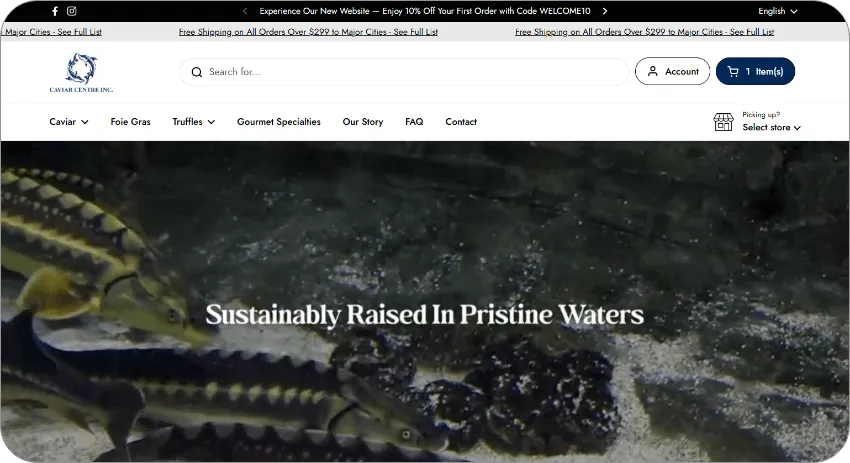
Montreal, QCBilingual B2B Shopify store with wholesale registration, approval, gated pricing and passwordless login, plus shipping calculated by province and case quantity.
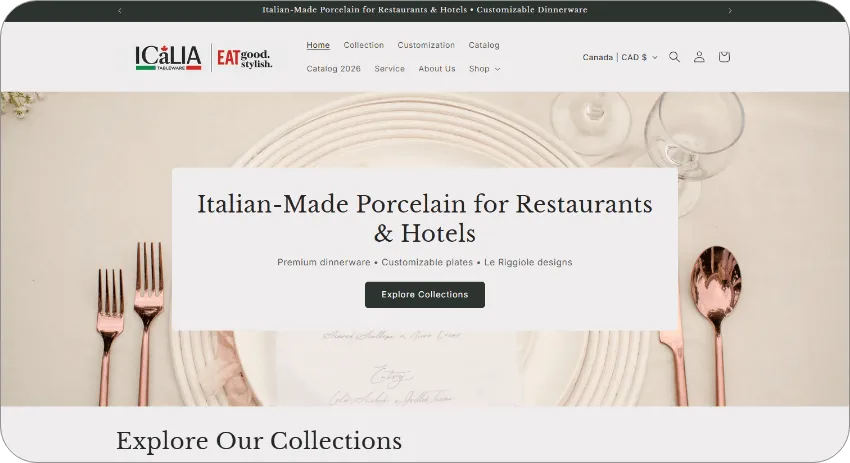
Vancouver, BCX-Cart to Shopify migration for a soccer retailer selling to shoppers and sports teams, including shared inventory across dozens of team stores. Rankings held after launch.
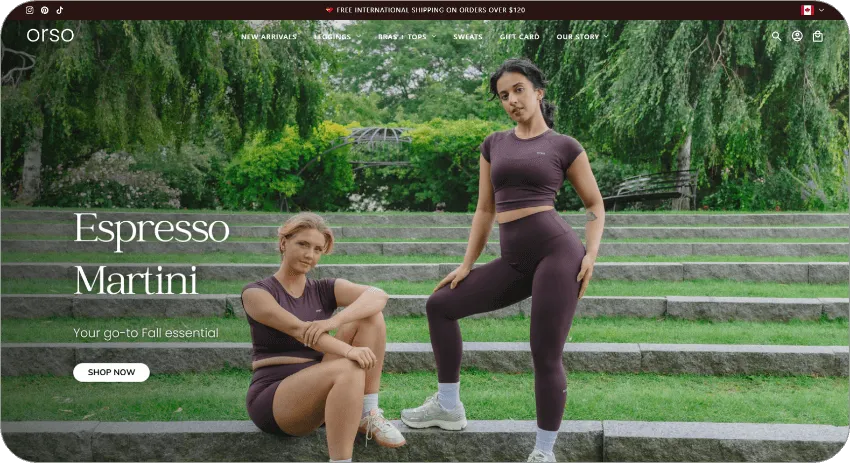
Ottawa, ONLuxury fashion store redesigned with an editorial feel to support a growing roster of designers.
Wherever you are based, you work with the same senior lead and the same Toronto and Ottawa team. Choose your city for local projects and details.
Ontario brands rarely sell only in Ontario. We set up HST alongside other provinces’ tax, US selling through Shopify Markets, and shipping rates that stay profitable beyond the GTA.
Quebec shoppers expect a full French store, not a translated layer. We build bilingual Shopify stores with separate URLs for each language and configure GST and QST from the start.
BC orders carry GST plus PST, and deliveries to the islands and the interior cost more than most merchants expect. We configure tax correctly and build shipping rates that protect margin on remote orders.
Alberta has no provincial sales tax, but customers in other provinces do. We set Shopify up so Alberta orders charge GST only while out-of-province orders charge the correct HST or PST, with shipping rates for city and rural deliveries.
Manitoba and Saskatchewan each add their own provincial sales tax to GST, and most orders travel long distances. We configure both taxes and build shipping rates around real carrier costs for the region.
Nova Scotia, New Brunswick and Newfoundland and Labrador charge HST, and parcels here travel further than most. We set up HST, carrier rates for the region and, for New Brunswick brands, full English and French stores.
Budget moves with complexity, not page count. A redesign on an existing catalogue with a premium theme sits toward the lower end. Bilingual builds, gated wholesale pricing, large catalogues and replatforms with full redirect mapping move it up.
For new stores, the build happens on our Shopify Partner account, so you pay no Shopify plan fees until launch. What you will not see from us is a low entry price followed by change requests for work that should have been scoped at the start.
Shopify website projects with eCommerce Development Pros start at $10,000 CAD. Most clients invest between $20,000 and $100,000, depending on custom design, B2B and integration requirements, and whether data is migrated from another platform. Every quote is written and fixed to an agreed scope after discovery.
Every Shopify project starts with a few of the same questions: what will it cost, how long will it take, and what happens to my store when changes are made? These are fair concerns, and we hear them from nearly every client we work with.
For a store that matters to your revenue, hire a team that has built for the Canadian market before. Offshore rates look cheaper, but the savings tend to disappear in rework on provincial tax, French content, and carrier setup, and in feedback loops across time zones. With us, one senior lead runs your project from discovery to launch, in your business hours, and every brief, file and approval is logged in Flux, our project management portal.
Shopify website projects with us start at $10,000 CAD. Most of our clients invest between $20,000 and $100,000, depending on how much custom design, B2B functionality, integration work, and data migration the store needs. A redesign on an existing catalogue sits at the lower end. A bilingual B2B build or a large-catalogue replatform sits higher. You get a written quote after discovery, and our Shopify Cost Calculator gives a starting estimate before we talk.
A new Shopify store with a focused catalogue and standard functionality takes 4–5 weeks. Larger catalogues, complex logic such as B2B pricing or custom shipping rules, and third-party integrations take 8–16 weeks, depending on complexity. Timelines hold when workstreams run in parallel and product content arrives on schedule, so content deadlines are written into the scope from day one.
Yes. We work with brands across Canada, including Grannie Annie in Montreal and Soccer City in Vancouver. Your senior lead runs scheduled video calls, and every brief, design file, and approval sits in Flux, our project management portal, so your location makes no difference to how the project runs.
You do. For new stores, we build in a development store under our Shopify Partner account, so you pay no Shopify plan fees during the build. At launch, we transfer ownership to you, including the store, theme, apps, and data. For redesigns of an existing Shopify store, we work as collaborators on your account, so ownership never changes hands.
For most DTC and B2B brands doing serious online revenue, yes. Shopify started in Ottawa, and CAD pricing, Interac, Shopify Payments, provincial tax, and Canada Post rates work without custom development. Native B2B tools now cover gated wholesale pricing and approvals, which used to need a separate platform. One limit to know up front: on standard plans, checkout customization is restricted to branding and the thank-you and order status pages. If your business depends on custom checkout logic, you need Shopify Plus, and that only makes economic sense once your volume supports it. We will tell you during discovery if Shopify is not the right fit.
Yes, once tax is configured properly for each province you sell into. Most errors we see come from rushed setups, such as products missing tax overrides or shipping rates taxed incorrectly. We set tax up during the build and test real orders from several provinces before launch.
The best setup comes from your order profile, and we advise on it before anything is built. Canada Post and Purolator both connect to Shopify, and apps such as ShipStation cover other carriers. For many stores, Shopify’s built-in tools are enough to set rates by zone and weight. Others need custom rates based on order volume and customer location: Grannie Annie’s wholesale rates are calculated by province and case quantity. We model rates against your margins so free-shipping thresholds do not quietly cost you money.
Yes. Shopify Markets runs US pricing in USD, US shipping rates, and duties from the same store and admin. We set it up during the build, so American orders show landed costs at checkout instead of surprise charges at delivery, which is one of the most common reasons cross-border orders get refused.
Yes. Grannie Annie’s B2B store in Montreal runs fully in English and French, including wholesale registration and customer accounts. Each language gets its own URLs and metadata, so both versions can be indexed and ranked, and your team manages translations inside Shopify.
As a planning guide, start evaluating Shopify Plus at around CAD $2 million in annual online sales. Without a specific Plus feature you need, we would usually want to see CAD $3–5 million before recommending the move.
Shopify currently lists Plus at $3,400 CAD/month on a three-year term ($3,650 on a one-year term), against $389 CAD/month for Advanced billed yearly. That is about $36,132 more per year, before migration or implementation costs: roughly 1.8% of revenue at $2 million and 0.9% at $4 million.
Consider Plus sooner if you need multiple expansion stores (nine are included), more advanced B2B setups, or checkout customization.
Below $2 million, we usually recommend staying on Advanced. Between $2 and $5 million, run the numbers. Above $5 million, assess Plus seriously, based on the value it adds rather than sales volume alone.
The same team that built the store stays on. Shopify maintenance plans cover app and theme updates, fixes, and small improvements, and many clients add CRO or marketing once real sales data comes in. You keep one point of contact rather than starting over with a support desk.